



Question: Q9. Product differentiation, advertising, and entry deterrence (45 points) There are two firms, an incumbent (1) and an entrant (E). They compete on price with
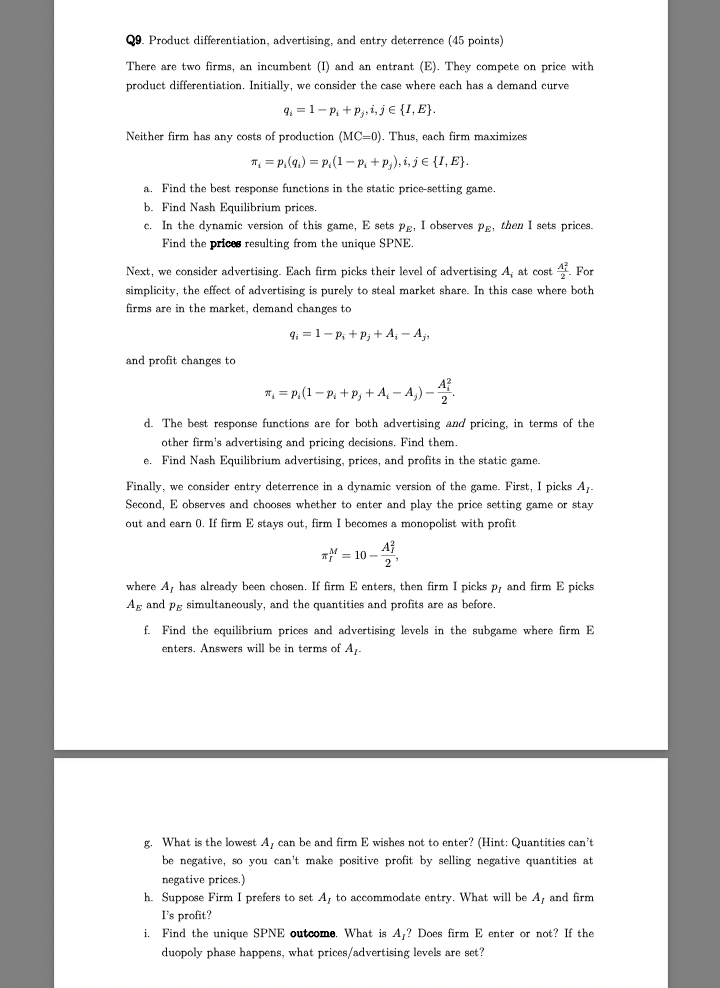
Q9. Product differentiation, advertising, and entry deterrence (45 points) There are two firms, an incumbent (1) and an entrant (E). They compete on price with product differentiation. Initially, we consider the case where each has a demand curve 4. =1-pi+ ppi,je {I, Ey. Neither firm has any costs of production (MC=0). Thus, each firm maximizes T. = P.(q ) = P.(1 - p,+p;),i,je {I, E). a. Find the best response functions in the static price-setting game. b. Find Nash Equilibrium prices. c. In the dynamic version of this game, E sets pg, I observes pg, then I sets prices. Find the prices resulting from the unique SPNE. Next, we consider advertising. Each firm picks their level of advertising A, at cost . For simplicity, the effect of advertising is purely to steal market share. In this case where both firms are in the market, demand changes to 4: = 1 - p,+ p; + A; - Aj, and profit changes to 1, = P.(1 -P. + p, + A, - A,) _ A d. The best response functions are for both advertising and pricing, in terms of the other firm's advertising and pricing decisions. Find them. e. Find Nash Equilibrium advertising, prices, and profits in the static game. Finally, we consider entry deterrence in a dynamic version of the game. First, I picks A,- Second, E observes and chooses whether to enter and play the price setting game or stay out and earn 0. If firm E stays out, firm I becomes a monopolist with profit TH = 10 - Ai where A, has already been chosen. If firm E enters, then firm I picks p, and firm E picks As and pg simultaneously, and the quantities and profits are as before. f. Find the equilibrium prices and advertising levels in the subgame where firm E enters. Answers will be in terms of A,- g. What is the lowest Ay can be and firm E wishes not to enter? (Hint: Quantities can't be negative, so you can't make positive profit by selling negative quantities at negative prices.) h. Suppose Firm I prefers to set A, to accommodate entry. What will be A, and firm I's profit? Find the unique SPNE outcome. What is A,? Does firm E enter or not? If the duopoly phase happens, what prices/advertising levels are set
Step by Step Solution
There are 3 Steps involved in it

Get step-by-step solutions from verified subject matter experts