







Question: Q9 Queue implemented using two stacks: Version 3 3 Points Suppose both S1 and 52 are used to store the queue data so that the
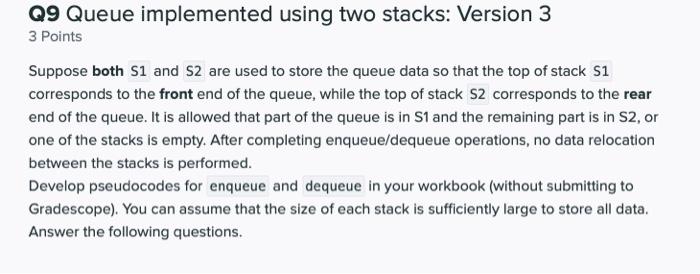
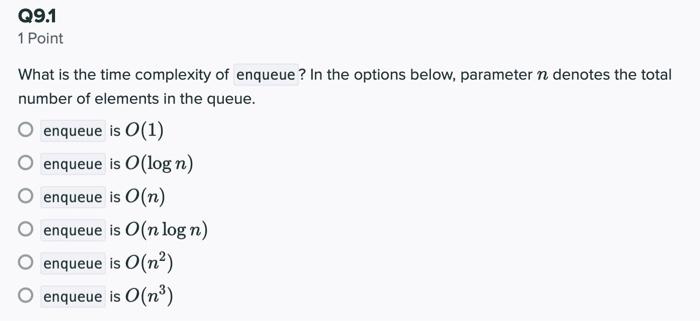
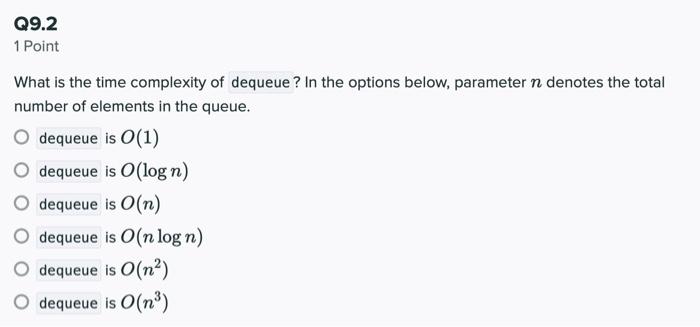
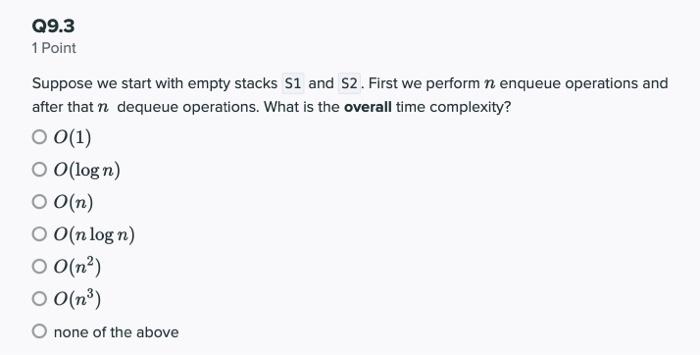
Q9 Queue implemented using two stacks: Version 3 3 Points Suppose both S1 and 52 are used to store the queue data so that the top of stack S1 corresponds to the front end of the queue, while the top of stack s2 corresponds to the rear end of the queue. It is allowed that part of the queue is in S1 and the remaining part is in 52, or one of the stacks is empty. After completing enqueue/dequeue operations, no data relocation between the stacks is performed. Develop pseudocodes for enqueue and dequeue in your workbook (without submitting to Gradescope). You can assume that the size of each stack is sufficiently large to store all data. Answer the following questions. Q9.1 1 Point What is the time complexity of enqueue ? In the options below, parameter n denotes the total number of elements in the queue. enqueue is 0(1) enqueue is O(log n) enqueue is O(n) O enqueue is O(n log n) enqueue is O(n) Oenqueue is O(n) Q9.2 1 Point What is the time complexity of dequeue ? In the options below, parameter n denotes the total number of elements in the queue. dequeue is O(1) O dequeue is O(log n) O dequeue is O(n) O dequeue is O(n log n) O dequeue is O(n) O dequeue is O(n) Q9.3 1 Point Suppose we start with empty stacks S1 and 52. First we perform n enqueue operations and after that n dequeue operations. What is the overall time complexity? O 0(1) O O(logn) O O(n) O O(n log n) O O(n) O Q(n) O none of the above
Step by Step Solution
There are 3 Steps involved in it

Get step-by-step solutions from verified subject matter experts
 Study Help