





Question: Q(A1) The cost for a documentary collection is less expensive than a letter of credit because the bank: a) Does not transfer the funds. b)
Q(A1) The cost for a documentary collection is

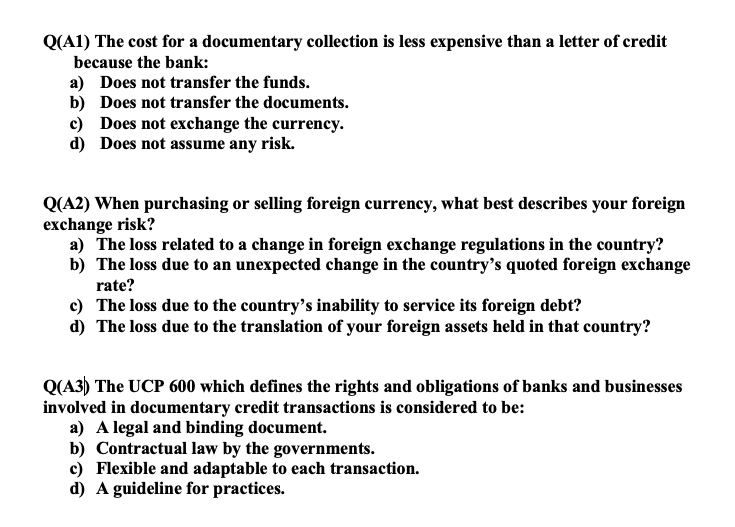
Q(A1) The cost for a documentary collection is less expensive than a letter of credit because the bank: a) Does not transfer the funds. b) Does not transfer the documents. c) Does not exchange the currency. d) Does not assume any risk. Q(A2) When purchasing or selling foreign currency, what best describes your foreign exchange risk? a) The loss related to a change in foreign exchange regulations in the country? b) The loss due to an unexpected change in the country's quoted foreign exchange rate? c) The loss due to the country's inability to service its foreign debt? d) The loss due to the translation of your foreign assets held in that country? Q(A3) The UCP 600 which defines the rights and obligations of banks and businesses involved in documentary credit transactions is considered to be: a) A legal and binding document. b) Contractual law by the governments. c) Flexible and adaptable to each transaction. d) A guideline for practices

Step by Step Solution

There are 3 Steps involved in it

1 Expert Approved Answer
Step: 1 Unlock blur-text-image

Question Has Been Solved by an Expert!

Get step-by-step solutions from verified subject matter experts

Step: 2 Unlock
Step: 3 Unlock

Students Have Also Explored These Related General Management Questions!