







Question: QI Points = 6 (Problem 5.4) In a random sample 965 adults in the United States, 422 say they could not cover a $600 unexpected
![2 0.5] What population is under consideration in the data set? (b)](https://s3.amazonaws.com/si.experts.images/answers/2024/06/667fa7bfc3523_047667fa7bfa01d9.jpg)
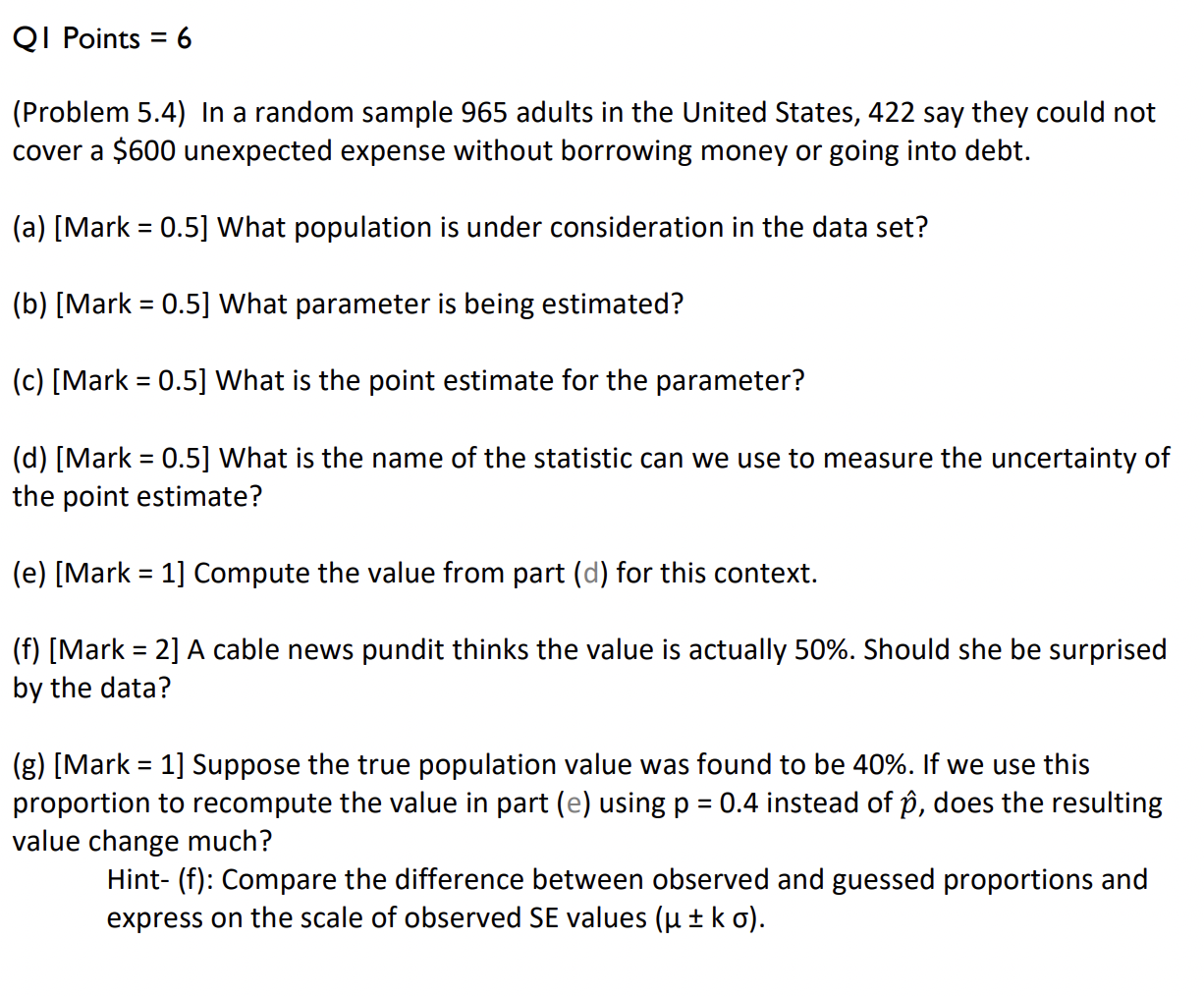
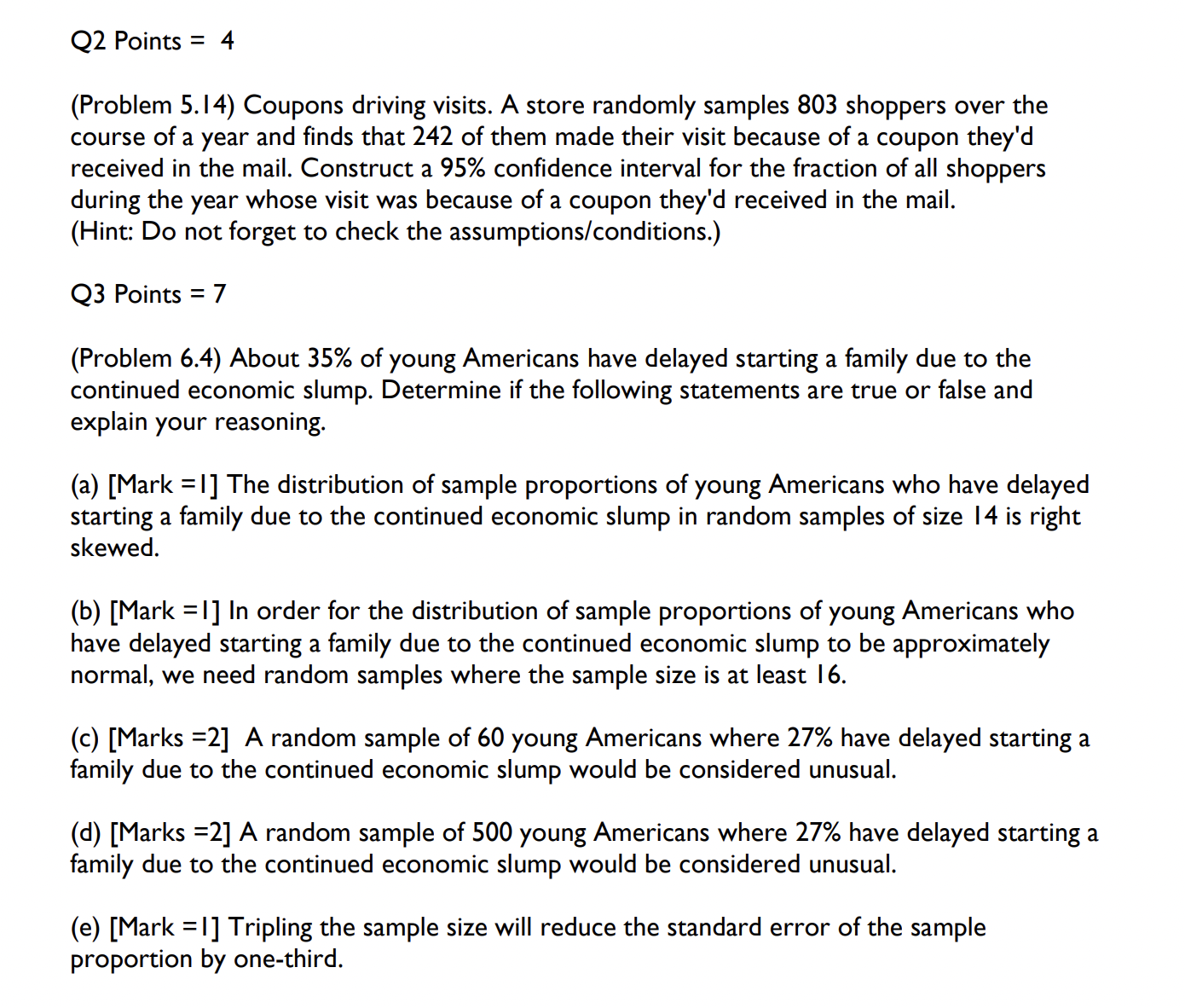
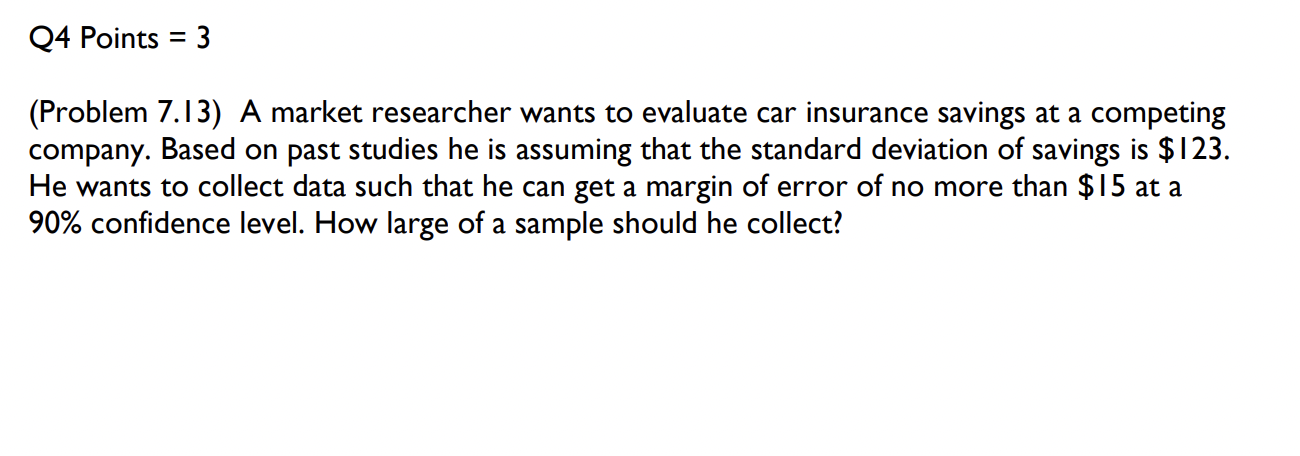
QI Points = 6 (Problem 5.4) In a random sample 965 adults in the United States, 422 say they could not cover a $600 unexpected expense without borrowing money or going into debt. (a) [Mark 2 0.5] What population is under consideration in the data set? (b) [Mark 2 0.5] What parameter is being estimated? ((2) [Mark = 0.5] What is the point estimate for the parameter? (d) [Mark = 0.5] What is the name ofthe statistic can we use to measure the uncertainty of the point estimate? (e) [Mark = 1] Compute the value from part (d) for this context. (f) [Mark = 2] A cable news pundit thinks the value is actually 50%. Should she be surprised by the data? (g) [Mark 2 1] Suppose the true population value was found to be 40%. If we use this proportion to recompute the value in part (9) using p = 0.4 instead of :3. does the resulting value change much? Hint (f): Compare the difference between observed and guessed proportions and express on the scale of observed SE values (p i k 0). Q2 Points = 4 (Problem 5.|4) Coupons driving visits. A store randomly samples 803 shoppers over the course of a year and finds that 242 of them made their visit because of a coupon they'd received in the mail. Construct a 95% condence interval for the fraction of all shoppers during the year whose visit was because of a coupon they'd received in the mail. (Hint: Do not forget to check the assumptions/conditions.) Q3 Points = 7 (Problem 6.4) About 35% of young Americans have delayed starting a family due to the continued economic slump. Determine if the following statements are true or false and explain your reasoning. (a) [Mark =l] The distribution of sample proportions of young Americans who have delayed starting a family due to the continued economic slump in random samples of size I4 is right skewed. (b) [Mark = I] In order for the distribution of sample proportions of young Americans who have delayed starting a family due to the continued economic slump to be approximately normal, we need random samples where the sample size is at least l6. (c) [Marks =2] A random sample of 60 young Americans where 27% have delayed starting a family due to the continued economic slump would be considered unusual. (d) [Marks =2] A random sample of 500 young Americans where 27% have delayed starting a family due to the continued economic slump would be considered unusual. (e) [Mark = I] Tripling the sample size will reduce the standard error of the sample proportion by one-third. Q4 Points = 3 (Problem 7. | 3) A market researcher wants to evaluate car insurance savings at a competing company. Based on past studies he is assuming that the standard deviation of savings is $ I23. He wants to collect data such that he can get a margin of error of no more than $ | 5 at a 90% confidence level. How large of a sample should he collect? Q5 Points = 7 (Chapter 18, Exercise 24) Hoping to lure more shoppers downtown, a city builds a new public parking garage in the central business district. The city plans to pay for the structure through parking fees. During a two-month period (44 weekdays), daily fees collected averaged $142, with a standard deviation of $17. a) [Mark =1] What assumptions must you make in order to use these statistics for inference? b) [Marks =3] Write a 90% confidence interval for the mean daily income this parking garage will generate. c) [Mark =1] Explain in context what this confidence interval means. d) [Mark = 1] Explain what "90% confidence" means in this context. e) [Mark = 1] The consultant who advised the city on this project predicted that parking revenues would average $150 per day. Based on your confidence interval, do you think the consultant was correct? Why? Q6, Points = 0.5 x 6= 3 (Ch 18 Ex 3 - 4, 9-10) Using the t-table, Excel software, or R, obtain the critical value of the t-model (t-distribution) for a) a 90% confidence interval with degrees of freedom = 16 b) a 95% confidence interval with degrees of freedom = 2022 [not a typo] c) a 98% confidence interval based on a sample of size = 22 d) a 99% confidence interval based on a sample of size = 6 Using the t-table, Excel software, or R, obtain e) P( ts 2 1.96) f) P( It31 / 2 2.5)
Step by Step Solution
There are 3 Steps involved in it

Get step-by-step solutions from verified subject matter experts
 Study Help