







Question: Qn2. Case Study (40 points) When Wayne Johansen turned 16, his dad bought him a new Garmin handheld GPS system. His family had always enjoyed
Qn2. Case Study (40 points)
When Wayne Johansen turned 16, his dad bought him a new Garmin handheld GPS system. His family had always enjoyed camping and hiking, and Wayne was usually the one who monitored their hikes with his dads GPS system. He always liked to carry the GPS to monitor the routes, distances, and altitudes of their hikes. More recently, though, he had found a new hobby using his GPS system: geocaching. Geocaching is a high-tech version of the treasure hunts that most of us did when we were kids. Participants search for geocaches or caches that are small, hidden, waterproof containers that typically contain a logbook and perhaps a small item. When found, the participant sometimes gets instructions for the next moveto either enter information into a logbook or to look for the next cache. As Wayne became more involved with his hobby, he discovered that there are many different kinds of activities for geocaching enthusiasts. The simplest ones are those that involve caches found by using GPS coordinates, although even some of these tasks can be difficult if the caches are well hidden. Some of the activities involve multi-point drops where there is a set of clues in multiple locations that must be followed to arrive at the final cache point. Some activities involve puzzles that must be solved to determine the coordinates of the final cache. Before long, Wayne wanted to make his own caches and post them for people to find. He discovered that there were several Web sites with access to geocaching information, caches, and memberships. He joined one of the geocaching Web sites and used it to log his findings. But he decided he would like to create his own system for tracking all the information he had about his caches. Conveniently, Waynes older brother Nick, a college student majoring in information systems, was looking for a semester project for one of his programming classes. The two of them decided to develop a system to help Wayne keep track of all his geocaching activities. In this end-of-chapter case, you will go through the various core processes of an SDLC and perform some of the activities of a development project. The project is divided into days, as was our Tradeshow System project. The daily assignments for this case should be considered as preliminary efforts and rough drafts. The objective of these assignments is to help you remember the overall approach to software development. Several assignments have been listed for each day to allow your instructor to select those that best meet the objectives of the course.
Brainstorm all the functions this geocaching system might do and write a rough draft of the System Vision Document based on your brainstorming Ideas (as our Tradeshow System project has been studied)
Hint: Think of what Wayne wants the system to do and why this helps him. Keep it at a very high level. These activities closely relate to Core Process 1: Identify the problem and obtain approval.
The document needs to include three sections: problem description, system capabilities, and business benefits.
One example can be below figure:
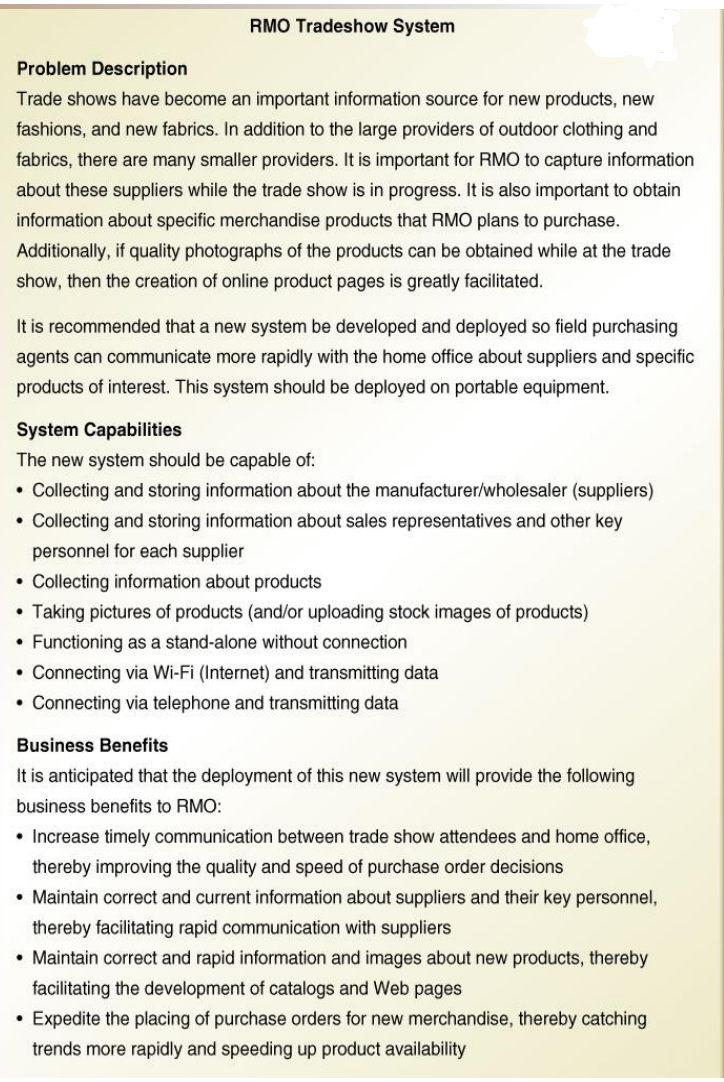
Problem Description Trade shows have become an important information source for new products, new fashions, and new fabrics. In addition to the large providers of outdoor clothing and fabrics, there are many smaller providers. It is important for RMO to capture information about these suppliers while the trade show is in progress. It is also important to obtain information about specific merchandise products that RMO plans to purchase. Additionally, if quality photographs of the products can be obtained while at the trade show, then the creation of online product pages is greatly facilitated. It is recommended that a new system be developed and deployed so field purchasing agents can communicate more rapidly with the home office about suppliers and specific products of interest. This system should be deployed on portable equipment. System Capabilities The new system should be capable of: - Collecting and storing information about the manufacturer/wholesaler (suppliers) - Collecting and storing information about sales representatives and other key personnel for each supplier - Collecting information about products - Taking pictures of products (and/or uploading stock images of products) - Functioning as a stand-alone without connection - Connecting via Wi-Fi (Internet) and transmitting data - Connecting via telephone and transmitting data Business Benefits It is anticipated that the deployment of this new system will provide the following business benefits to RMO: - Increase timely communication between trade show attendees and home office, thereby improving the quality and speed of purchase order decisions - Maintain correct and current information about suppliers and their key personnel, thereby facilitating rapid communication with suppliers - Maintain correct and rapid information and images about new products, thereby facilitating the development of catalogs and Web pages - Expedite the placing of purchase orders for new merchandise, thereby catching trends more rapidly and speeding up product availability
Step by Step Solution
There are 3 Steps involved in it

Get step-by-step solutions from verified subject matter experts
 Study Help