







Question: Qu. 2 (10 marks) In this question we shall use hexadecimal digits (0-9, AF) to represent blocks of 4 binary digits. So 0 is 0000,3
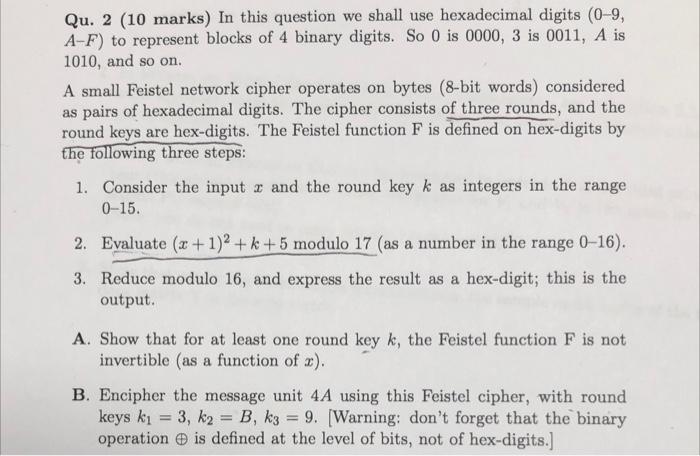
Qu. 2 (10 marks) In this question we shall use hexadecimal digits (0-9, AF) to represent blocks of 4 binary digits. So 0 is 0000,3 is 0011,A is 1010 , and so on. A small Feistel network cipher operates on bytes (8-bit words) considered as pairs of hexadecimal digits. The cipher consists of three rounds, and the round keys are hex-digits. The Feistel function F is defined on hex-digits by the following three steps: 1. Consider the input x and the round key k as integers in the range 015. 2. Evaluate (x+1)2+k+5 modulo 17 (as a number in the range 0-16). 3. Reduce modulo 16 , and express the result as a hex-digit; this is the output. A. Show that for at least one round key k, the Feistel function F is not invertible (as a function of x ). B. Encipher the message unit 4A using this Feistel cipher, with round keys k1=3,k2=B,k3=9. [Warning: don't forget that the binary operation is defined at the level of bits, not of hex-digits.]
Step by Step Solution
There are 3 Steps involved in it

Get step-by-step solutions from verified subject matter experts
 Study Help