



Question: Qualititative study: https://www.ncbi.nlm.nih.gov/pmc/articles/PMC5813303/pdf/14.pdf Comparative effectiveness of patient education methods for type 2 diabetes: a randomized controlled trial Quantitative study: https://pubmed.ncbi.nlm.nih.gov/21986350/ Understanding the Meaning of Food
Qualititative study: https://www.ncbi.nlm.nih.gov/pmc/articles/PMC5813303/pdf/14.pdf Comparative effectiveness of patient education methods for type 2 diabetes: a randomized controlled trial
Quantitative study: https://pubmed.ncbi.nlm.nih.gov/21986350/ Understanding the Meaning of Food in People With Type 2 Diabetes Living in Northern Appalachia
Review both the methods and the limitations stated by the authors to identify where there may be plausible threats to external validity (for quantitative research). The test of plausibility is more than just being possible. There needs to be some real expectation of likelihood. For quantitative research, the possible threatsto External Validity in a study include:
- the Hawthorne effect,
- replication,
- generalizability,
- multiple treatments, and
- researcher bias.
For qualitative research, the possible threats to External Reliability is a study include:
- researcher status position
- informant choices
- social situations & conditions.
- analytic constructs and premises
- techniques for data collections and analysis
See example below:
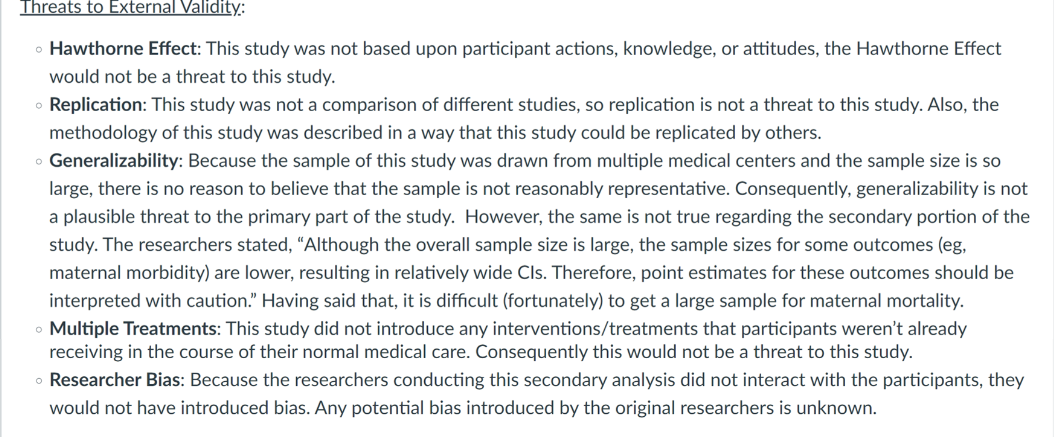
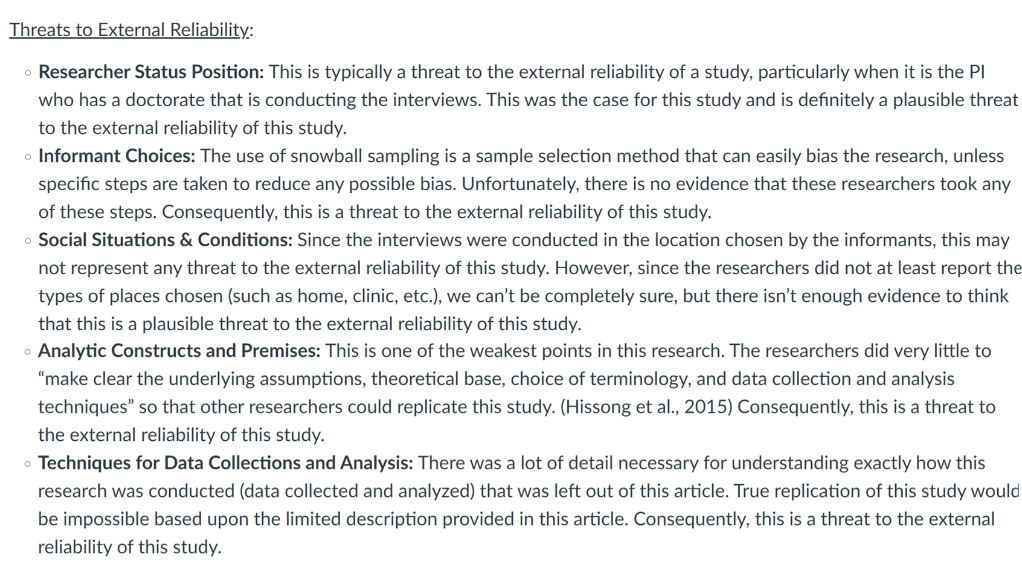
Threats to External Validity: Hawthorne Effect: This study was not based upon participant actions, knowledge, or attitudes, the Hawthorne Effect would not be a threat to this study. - Replication: This study was not a comparison of different studies, so replication is not a threat to this study. Also, the methodology of this study was described in a way that this study could be replicated by others. -- lGeneralizability: Because the sample of this study was drawn from multiple medical centers and the sample size is so large, there is no reason to believe that the sample is not reasonably representative. Consequently, generalizability is not a plausible threat to the primary part of the study. However, the same is not true regarding the secondary portion of the study. The researchers stated, "Although the overall sampie size is large, the sample sizes for some outcomes leg, maternal morbidity) are lower, resulting in relatively wide Cls. Therefore, point estimates for these outcomes should be interpreted with caution." Having said that, it is difcult (fortunately) to get a large sample for maternai mortality. - Multiple Treatments: This study did not introduce any interventions/treatments that participants weren't already receiving in the course of their normal medical care. Consequently this would not be a threat to this study. Researcher Bias: Because the researchers conducting this secondary analysis did not interact with the participants, they would not have introduced bias. Any potential bias introduced by the original researchers is unknown. Threats to External Reliability: o Researcher Status Position: This is typically a threat to the external reliability of a study, particularly when it is the PI who has a doctorate that is conducting the interviews. This was the case for this study and is definitely a plausible threat to the external reliability of this study. . Informant Choices: The use of snowball sampling is a sample selection method that can easily bias the research, unless specific steps are taken to reduce any possible bias. Unfortunately, there is no evidence that these researchers took any of these steps. Consequently, this is a threat to the external reliability of this study. . Social Situations & Conditions: Since the interviews were conducted in the location chosen by the informants, this may not represent any threat to the external reliability of this study. However, since the researchers did not at least report the types of places chosen (such as home, clinic, etc.), we can't be completely sure, but there isn't enough evidence to think that this is a plausible threat to the external reliability of this study. . Analytic Constructs and Premises: This is one of the weakest points in this research. The researchers did very little to "make clear the underlying assumptions, theoretical base, choice of terminology, and data collection and analysis techniques" so that other researchers could replicate this study. (Hissong et al., 2015) Consequently, this is a threat to the external reliability of this study. . Techniques for Data Collections and Analysis: There was a lot of detail necessary for understanding exactly how this research was conducted (data collected and analyzed) that was left out of this article. True replication of this study would be impossible based upon the limited description provided in this article. Consequently, this is a threat to the external reliability of this study
Step by Step Solution
There are 3 Steps involved in it

Get step-by-step solutions from verified subject matter experts