







Question: quantitative problem only show work please Select rate of return, so to overcome some of the IRR's limitations the modified Business executives often prefer to


quantitative problem only show work please
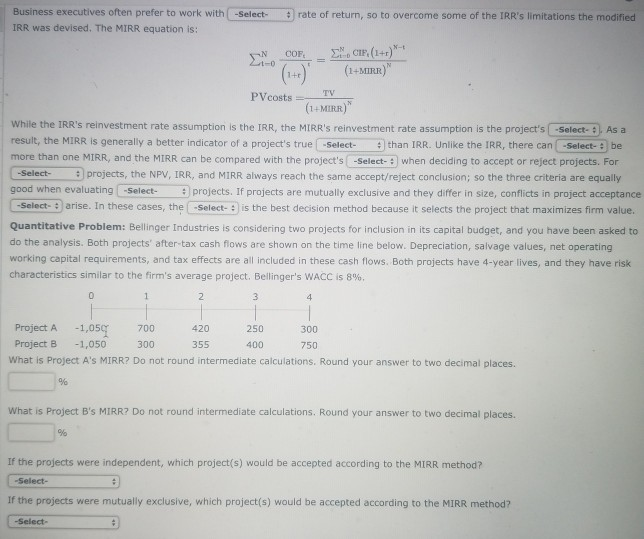
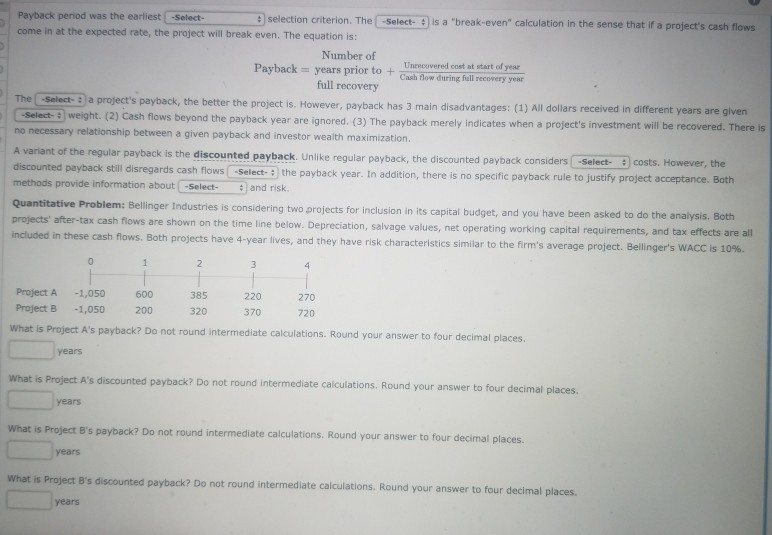
Select rate of return, so to overcome some of the IRR's limitations the modified Business executives often prefer to work with IRR was devised. The MIRR equation is: N COF (1) CHP, (1+1)** (1+MIRR" PVcosts TV (1+MIRR)" While the IRR's reinvestment rate assumption is the IRR, the MIRR's reinvestment rate assumption is the project's -Select-3). As a result, the MIRR is generally a better indicator of a project's true -Select- than IRR. Unlike the IRR, there can -Select- be more than one MIRR, and the MIRR can be compared with the project's Select when deciding to accept or reject projects. For -Select- projects, the NPV, IRR, and MIRR always reach the same accept/reject conclusion; so the three criteria are equally good when evaluating -Select- projects. If projects are mutually exclusive and they differ in size, conflicts in project acceptance -Select- arise. In these cases, the -Select- is the best decision method because it selects the project that maximizes firm value. Quantitative Problem: Bellinger Industries is considering two projects for inclusion in its capital budget, and you have been asked to do the analysis. Both projects' after-tax cash flows are shown on the time line below. Depreciation, salvage values, net operating working capital requirements, and tax effects are all included in these cash flows. Both projects have 4-year lives, and they have risk characteristics similar to the firm's average project. Bellinger's WACC is 8% Project A -1,050 700 420 250 300 Project B -1,050 300 400 750 What is Project A's MIRR? Do not round intermediate calculations. Round your answer to two decimal places. 355 What is Project B's MIRR? Do not round intermediate calculations. Round your answer to two decimal places. If the projects were independent, which project(s) would be accepted according to the MIRR method? If the projects were mutually exclusive, which project(s) would be accepted according to the MIRR method? -Select- Payback period was the earliest -Select- selection criterion. The -Select- is a "break-even" calculation in the sense that if a project's cash flows come in at the expected rate, the project will break even. The equation is: Number of Unrecovered cost at start of your Payback = years prior to t he towering full recovery year full recovery The -Select- a project's payback, the better the project is. However, payback has 3 main disadvantages: (1) All dollars received in different years are given -Select-weight. (2) Cash flows beyond the payback year are ignored. (3) The payback merely indicates when a project's investment will be recovered. There is no necessary relationship between a given payback and investor wealth maximization A variant of the regular payback is the discounted payback. Unlike regular payback, the discounted payback considers -Select- costs. However, the discounted payback still disregards cash flows Select the payback year. In addition, there is no specific payback rule to justify project acceptance. Both methods provide information about -Select- and risk Quantitative Problem: Bellinger Industries is considering two projects for inclusion in its capital budget, and you have been asked to do the analysis. Both projects' after-tax cash flows are shown on the time line below. Depreciation, salvage values, net operating working capital requirements, and tax effects are all included in these cash flows. Both projects have 4-year lives, and they have risk characteristics similar to the firm's average project. Bellinger's WACC is 10%. 1 2 3 4 Project A -1,050 600 385 220 270 Project B -1,050 200 320 370720 What is Project A's payback? Do not round intermediate calculations. Round your answer to four decimal places years What is Project A's discounted payback? Do not round intermediate calculations. Round your answer to four decimal places. years What is Project B's payback? Do not round intermediate calculations. Round your answer to four decimal places. years What is Project B's discounted payback? Do not round intermediate calculations. Round your answer to four decimal places years Project L requires an initial outlay at t = 0 of $40,000, its expected cash inflows are $14,000 per year for 9 years, and its WACC is 13%. What is the project's NPV? Do not round intermediate calculations. Round your answer to the nearest cent. NI on meie esines antes delay at t 0 21951,169, la crested cast iront en toco er verdere Project L requires an initial outlay at t = 0 of $51,143, its expected cash inflows are $9,000 per year for 10 years, and its WACC is 11%. What is the project's IRR? Round your answer to two decimal places. 00
Step by Step Solution
There are 3 Steps involved in it

Get step-by-step solutions from verified subject matter experts
 Study Help