



Question: Quantitative Problem: Rosnan Industries' 2017 and 2016 balance sheets and income statements are shown below Balance Sheets: 2017 2016 $100 275 375 $750 2,300 $3,050
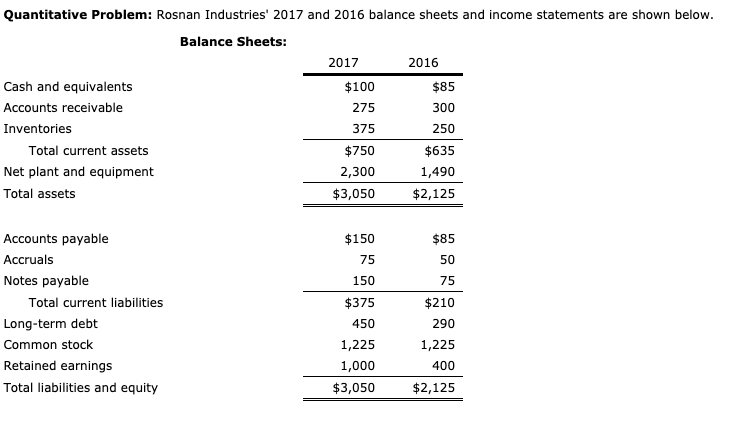
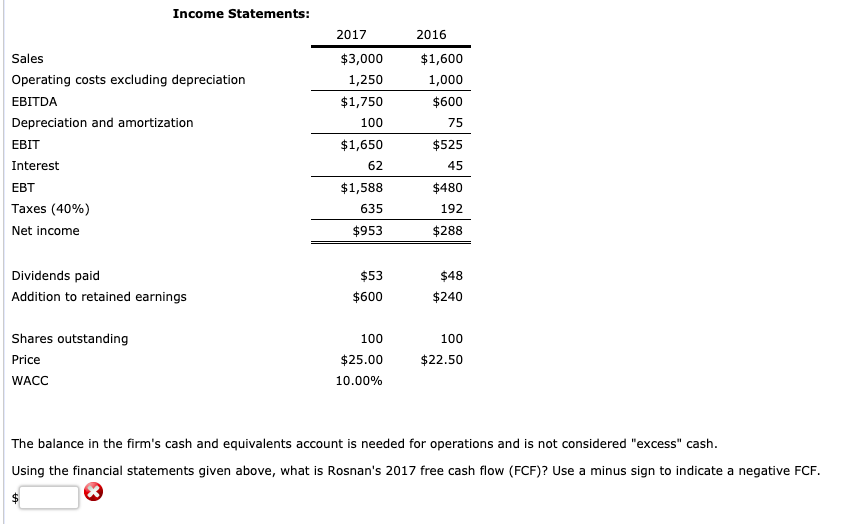
Quantitative Problem: Rosnan Industries' 2017 and 2016 balance sheets and income statements are shown below Balance Sheets: 2017 2016 $100 275 375 $750 2,300 $3,050 $85 300 250 $635 1,490 $2,125 Cash and equivalents Accounts receivable Inventories Total current assets Net plant and equipment Total assets $85 50 75 $210 290 1,225 400 $2,125 Accounts payable Accruals Notes payable $150 75 150 $375 450 1,225 1,000 $3,050 Total current liabilities Long-term debt Common stock Retained earnings Total liabilities and equity Income Statements: 2017 2016 Sales Operating costs excluding depreciation EBITDA Depreciation and amortization EBIT Interest EBT Taxes (40%) Net income $3,000 1,250 $1,750 100 $1,650 62 $1,588 635 $953 $1,600 1,000 $600 75 $525 45 $480 192 $288 Dividends paid Addition to retained earnings $53 $600 $48 $240 Shares outstanding Price WACC 100 $25.00 10.00% 100 $22.50 The balance in the firm's cash and equivalents account is needed for operations and is not considered "excess" cash Using the financial statements given above, what is Rosnan's 2017 free cash flow (FCF)? Use a minus sign to indicate a negative FCF
Step by Step Solution
There are 3 Steps involved in it

Get step-by-step solutions from verified subject matter experts