







Question: quantitative statistics problem.pls help in asap. IMPORTANT: show all your work and justify each step for full credits. Problem 1 Suppose you are interested in
quantitative statistics problem.pls help in asap.
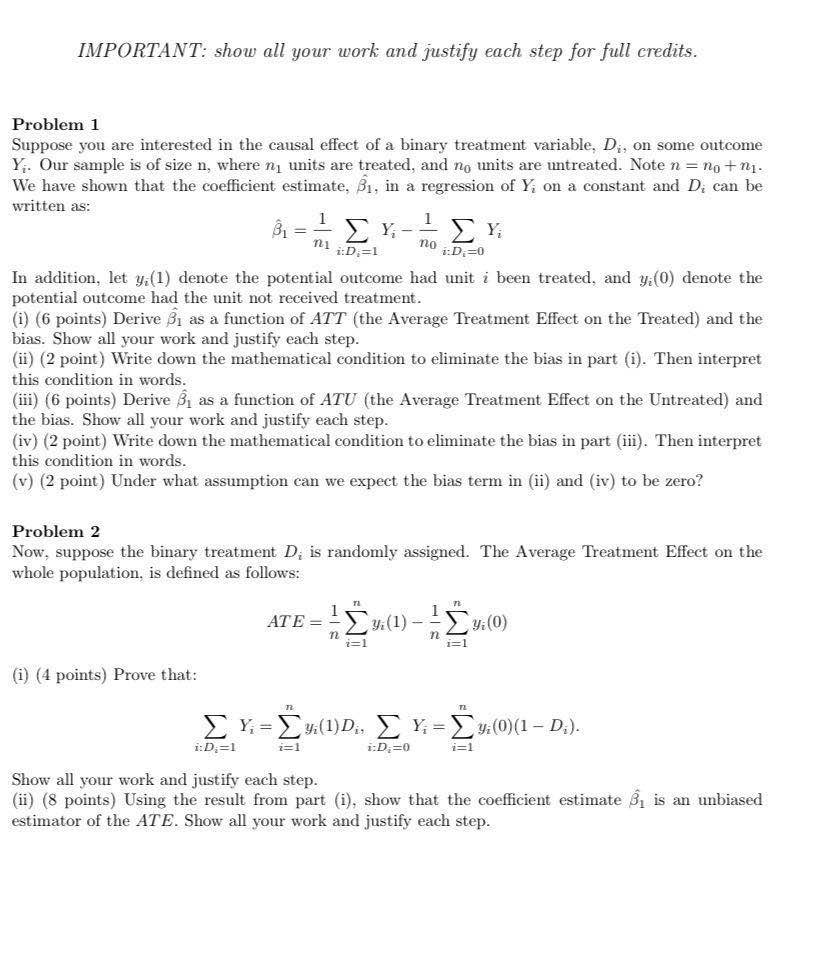
IMPORTANT: show all your work and justify each step for full credits. Problem 1 Suppose you are interested in the causal effect of a binary treatment variable, D., on some outcome Yr. Our sample is of size n, where nj units are treated, and no units are untreated. Note n = no + nj. We have shown that the coefficient estimate, 31, in a regression of Y, on a constant and D, can be written as: ni i:D,=1 no In addition, let y,(1) denote the potential outcome had unit i been treated, and y;(0) denote the potential outcome had the unit not received treatment. (i) (6 points) Derive 31 as a function of ATT (the Average Treatment Effect on the Treated) and the bias. Show all your work and justify each step. (ii) (2 point) Write down the mathematical condition to eliminate the bias in part (i). Then interpret this condition in words. (iii) (6 points) Derive S, as a function of ATU (the Average Treatment Effect on the Untreated) and the bias. Show all your work and justify each step. (iv) (2 point) Write down the mathematical condition to eliminate the bias in part (iii). Then interpret this condition in words. (v) (2 point) Under what assumption can we expect the bias term in (ii) and (iv) to be zero? Problem 2 Now, suppose the binary treatment D, is randomly assigned. The Average Treatment Effect on the whole population, is defined as follows: ATE = - ~ y.(1) -- y:(0) i=1 1= 1 (i) (4 points) Prove that: 1:D:=0 1= 1 Show all your work and justify each step. (ii) (8 points) Using the result from part (i), show that the coefficient estimate S, is an unbiased estimator of the ATE. Show all your work and justify each step
Step by Step Solution
There are 3 Steps involved in it

Get step-by-step solutions from verified subject matter experts
 Study Help