







Question: Query Optimization - Estimating I / O costs Using two relations R and S , with the join condition ( mathrm { Ri
Query Optimization Estimating IO costs
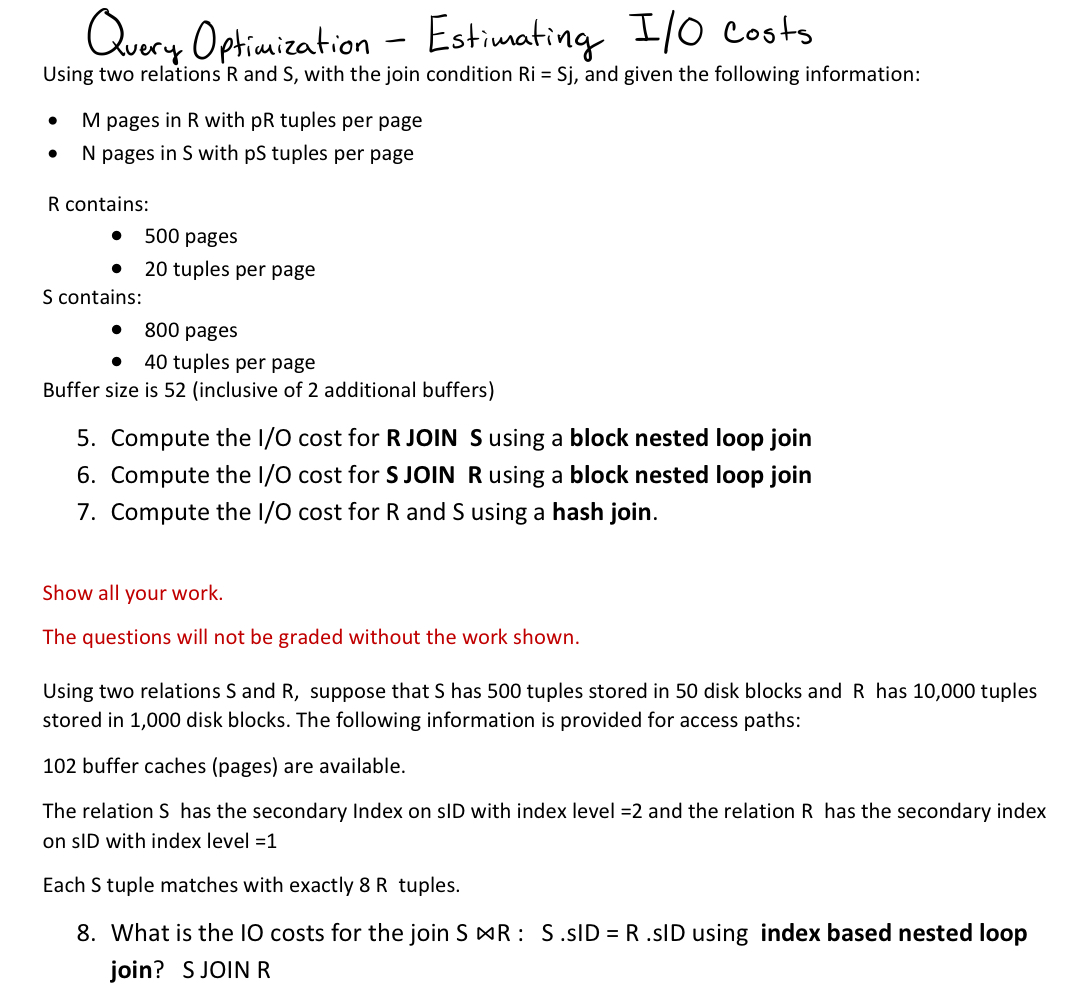
Using two relations R and S with the join condition mathrmRimathrmSj and given the following information:
M pages in R with p R tuples per page
N pages in S with p S tuples per page
R contains:
pages
tuples per page
S contains:
pages
tuples per page
Buffer size is inclusive of additional buffers
Compute the IO cost for R JOIN S using a block nested loop join
Compute the IO cost for S JOIN R using a block nested loop join
Compute the IO cost for R and S using a hash join.
Show all your work.
The questions will not be graded without the work shown.
Using two relations S and R suppose that S has tuples stored in disk blocks and R has tuples stored in disk blocks. The following information is provided for access paths:
buffer caches pages are available.
The relation S has the secondary Index on sID with index level and the relation R has the secondary index on sID with index level
Each S tuple matches with exactly R tuples.
What is the IO costs for the join S bowtie R : S sID R sID using index based nested loop join? SJOIN R
Step by Step Solution
There are 3 Steps involved in it
1 Expert Approved Answer
Step: 1 Unlock

Question Has Been Solved by an Expert!
Get step-by-step solutions from verified subject matter experts
Step: 2 Unlock
Step: 3 Unlock
 Study Help