







Question: ques 1 Write a paragraph that summarizes your main source from article ques 2 If you're using a Narrative : What makes the narrative seem
ques 1 Write a paragraph that summarizes your main source from article
ques 2
If you're using a Narrative:
What makes the narrative seem truthful, important, and relevant? Why should the narrative matter to other people today?
What voice or perspective does the narrative allow us to hear that is perhaps often hidden? Moreover, what do you think are some other possible perspectives on the same issue/problem raised in the narrative? In other words, how would the same experience/issue/problem look from a different perspective?
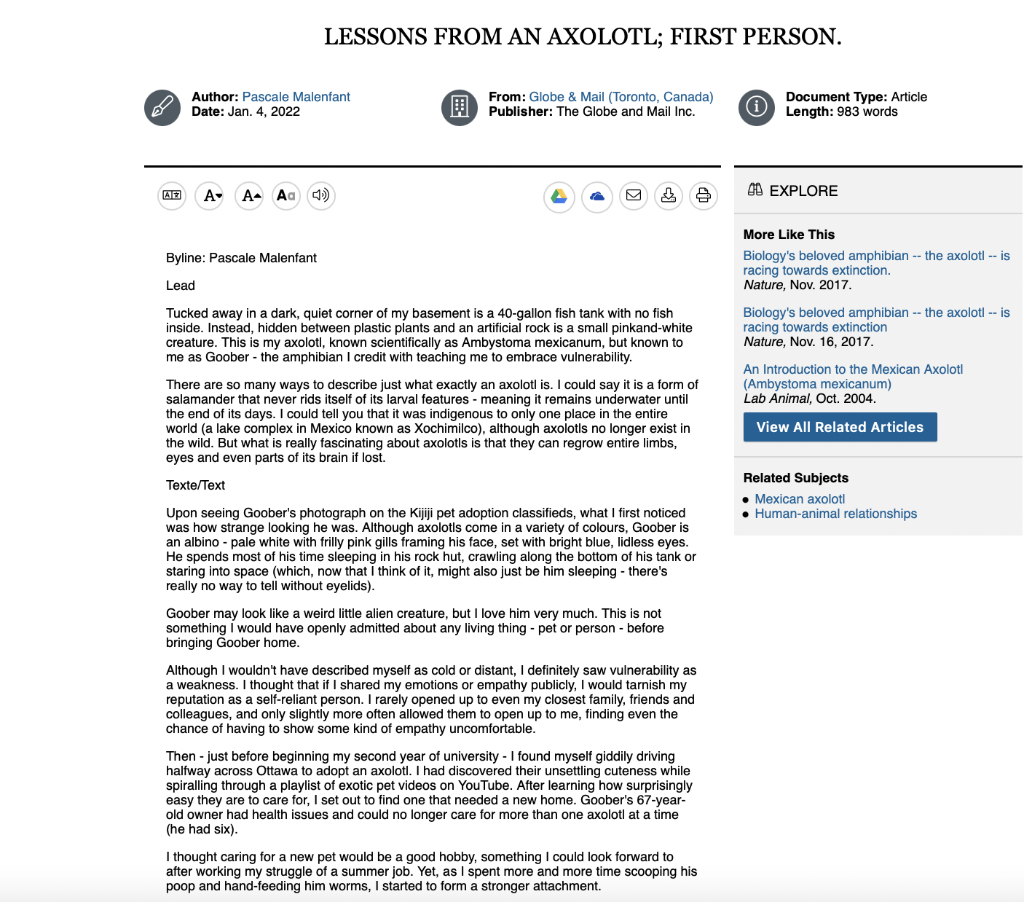
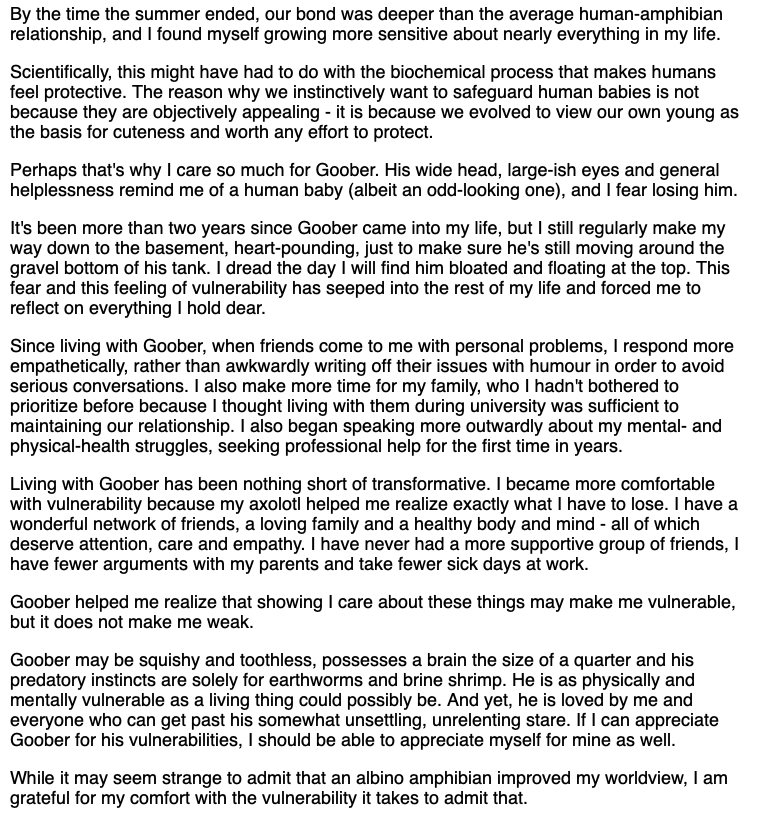
LESSONS FROM AN AXOLOTL; FIRST PERSON. Author: Pascale Malenfant Date: Jan. 4, 2022 From: Globe & Mail (Toronto, Canada) Publisher: The Globe and Mail Inc. Document Type: Article Length: 983 words AET A A Aa :) B 40 EXPLORE Byline: Pascale Malenfant More Like This Biology's beloved amphibian -- the axolotl -- is racing towards extinction. Nature, Nov. 2017. Lead Biology's beloved amphibian -- the axolotl -- is racing towards extinction Nature, Nov. 16, 2017. Tucked away in a dark, quiet corner of my basement is a 40-gallon fish tank with no fish inside. Instead, hidden between plastic plants and an artificial rock is a small pinkand-white creature. This is my axolotl, known scientifically as Ambystoma mexicanum, but known to me as Goober - the amphibian I credit with teaching me to embrace vulnerability. There are so many ways to describe just what exactly an axolotl is. I could say it is a form of salamander that never rids itself of its larval features - meaning it remains underwater until the end of its days. I could tell you that it was indigenous to only one place in the entire world (a lake complex in Mexico known as Xochimilco), although axolotis no longer exist in the wild. But what is really fascinating about axolotls is that they can regrow entire limbs, eyes and even parts of its brain if lost. An Introduction to the Mexican Axolotl (Ambystoma mexicanum) Lab Animal, Oct. 2004. View All Related Articles Texte/Text Related Subjects Mexican axolotl Human-animal relationships Upon seeing Goober's photograph on the Kijiji pet adoption classifieds, what I first noticed was how strange looking he was. Although axolotis come in a variety of colours, Goober is an albino - pale white with frilly pink gills framing his face, set with bright blue, lidless eyes. He spends most of his time sleeping in his rock hut, crawling along the bottom of his tank or staring into space (which, now that I think of it, might also just be him sleeping - there's really no way to tell without eyelids). Goober may look like a weird little alien creature, but I love him very much. This is not something I would have openly admitted about any living thing - pet or person - before bringing Goober home. Although I wouldn't have described myself as cold or distant, I definitely saw vulnerability as a weakness. I thought that if I shared my emotions or empathy publicly, I would tarnish my reputation as a self-reliant person. I rarely opened up to even my closest family, friends and colleagues, and only slightly more often allowed them to open up to me, finding even the chance of having to show some kind of empathy uncomfortable. Then - just before beginning my second year of university - I found myself giddily driving halfway across Ottawa to adopt an axoloti. I had discovered their unsettling cuteness while spiralling through a playlist of exotic pet videos on YouTube. After learning how surprisingly easy they are to care for, I set out to find one that needed a new home. Goober's 67-year- old owner had health issues and could no longer care for more than one axolotl at a time (he had six). I thought caring for a new pet would be a good hobby, something I could look forward to after working my struggle of a summer job. Yet, as I spent more and more time scooping his poop and hand-feeding him worms, I started to form a stronger attachment. By the time the summer ended, our bond was deeper than the average human-amphibian relationship, and I found myself growing more sensitive about nearly everything in my life. Scientifically, this might have had to do with the biochemical process that makes humans feel protective. The reason why we instinctively want to safeguard human babies is not because they are objectively appealing - it is because we evolved to view our own young as the basis for cuteness and worth any effort to protect. Perhaps that's why I care so much for Goober. His wide head, large-ish eyes and general helplessness remind me of a human baby (albeit an odd-looking one), and I fear losing him. It's been more than two years since Goober came into my life, but I still regularly make my way down to the basement, heart-pounding, just to make sure he's still moving around the gravel bottom of his tank. I dread the day I will find him bloated and floating at the top. This fear and this feeling of vulnerability has seeped into the rest of my life and forced me to reflect on everything I hold dear. Since living with Goober, when friends come to me with personal problems, I respond more empathetically, rather than awkwardly writing off their issues with humour in order to avoid serious conversations. I also make more time for my family, who I hadn't bothered to prioritize before because I thought living with them during university was sufficient to maintaining our relationship. I also began speaking more outwardly about my mental- and physical-health struggles, seeking professional help for the first time in years. Living with Goober has been nothing short of transformative. I became more comfortable with vulnerability because my axolotl helped me realize exactly what I have to lose. I have a wonderful network of friends, a loving family and a healthy body and mind - all of which deserve attention, care and empathy. I have never had a more supportive group of friends, I have fewer arguments with my parents and take fewer sick days at work. Goober helped me realize that showing I care about these things may make me vulnerable, but it does not make me weak. Goober may be squishy and toothless, possesses a brain the size of a quarter and his predatory instincts are solely for earthworms and brine shrimp. He is as physically and mentally vulnerable as a living thing could possibly be. And yet, he is loved by me and everyone who can get past his somewhat unsettling, unrelenting stare. If I can appreciate Goober for his vulnerabilities, I should be able to appreciate myself for mine as well. While it may seem strange to admit that an albino amphibian improved my worldview, I am grateful for my comfort with the vulnerability it takes to admit thatStep by Step Solution
There are 3 Steps involved in it
1 Expert Approved Answer
Step: 1 Unlock

Question Has Been Solved by an Expert!
Get step-by-step solutions from verified subject matter experts
Step: 2 Unlock
Step: 3 Unlock
 Study Help