







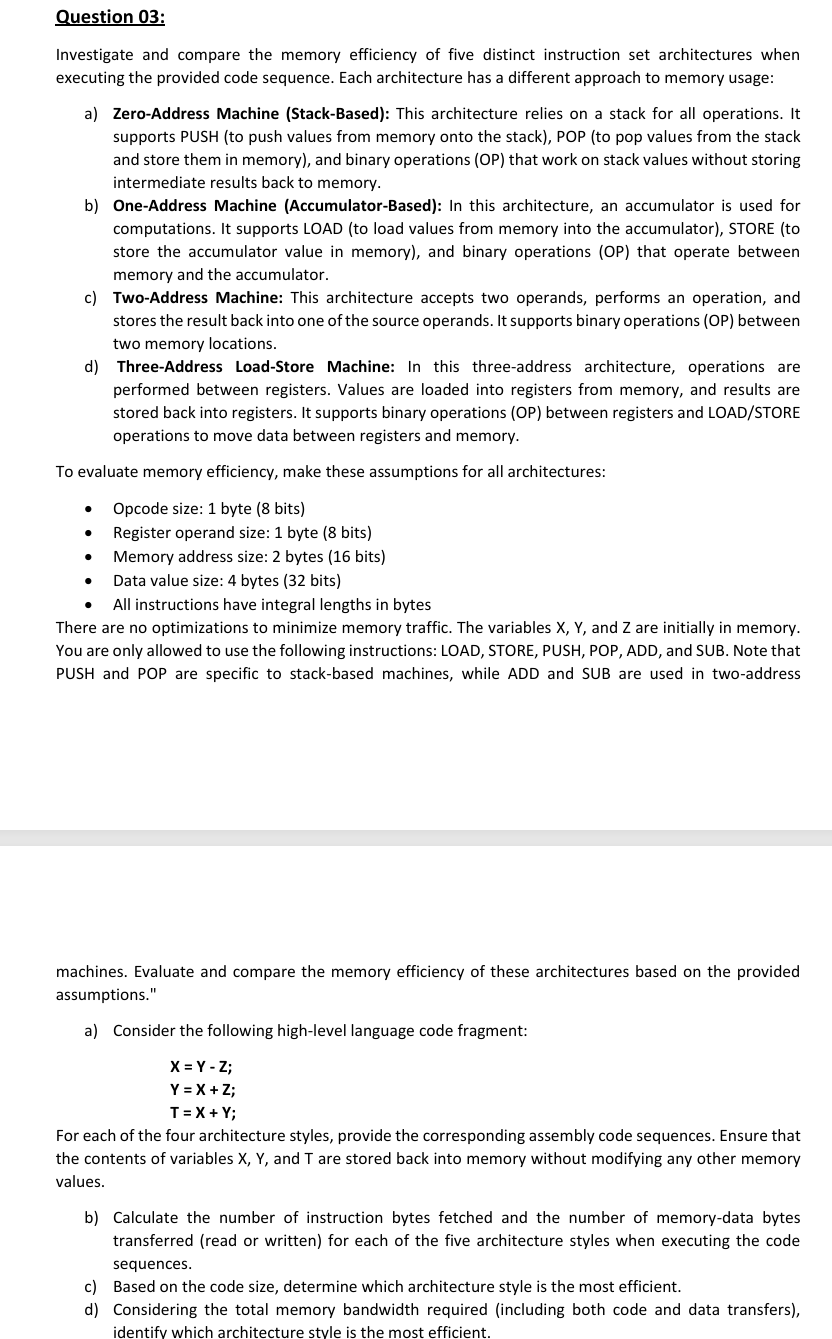
Question: Question 0 3 : Investigate and compare the memory efficiency of five distinct instruction set architectures when executing the provided code sequence. Each architecture has
Question :
Investigate and compare the memory efficiency of five distinct instruction set architectures when
executing the provided code sequence. Each architecture has a different approach to memory usage:
a ZeroAddress Machine StackBased: This architecture relies on a stack for all operations. It
supports PUSH to push values from memory onto the stack POP to pop values from the stack
and store them in memory and binary operations OP that work on stack values without storing
intermediate results back to memory.
b OneAddress Machine AccumulatorBased: In this architecture, an accumulator is used for
computations. It supports LOAD to load values from memory into the accumulator STORE to
store the accumulator value in memory and binary operations OP that operate between
memory and the accumulator.
c TwoAddress Machine: This architecture accepts two operands, performs an operation, and
stores the result back into one of the source operands. It supports binary operations OP between
two memory locations.
d ThreeAddress LoadStore Machine: In this threeaddress architecture, operations are
performed between registers. Values are loaded into registers from memory, and results are
stored back into registers. It supports binary operations OP between registers and LOADSTORE
operations to move data between registers and memory.
To evaluate memory efficiency, make these assumptions for all architectures:
Opcode size: byte bits
Register operand size: byte bits
Memory address size: bytes bits
Data value size: bytes bits
All instructions have integral lengths in bytes
There are no optimizations to minimize memory traffic. The variables and Z are initially in memory.
You are only allowed to use the following instructions: LOAD, STORE, PUSH, POP, ADD, and SUB. Note that
PUSH and POP are specific to stackbased machines, while ADD and SUB are used in twoaddress
machines. Evaluate and compare the memory efficiency of these architectures based on the provided
assumptions."
a Consider the following highlevel language code fragment:
For each of the four architecture styles, provide the corresponding assembly code sequences. Ensure that
the contents of variables and T are stored back into memory without modifying any other memory
values.
b Calculate the number of instruction bytes fetched and the number of memorydata bytes
transferred read or written for each of the five architecture styles when executing the code
sequences.
c Based on the code size, determine which architecture style is the most efficient.
d Considering the total memory bandwidth required including both code and data transfers
identify which architecture style is the most efficient.
Step by Step Solution
There are 3 Steps involved in it
1 Expert Approved Answer
Step: 1 Unlock

Question Has Been Solved by an Expert!
Get step-by-step solutions from verified subject matter experts
Step: 2 Unlock
Step: 3 Unlock
 Study Help