







Question: Question 0 Please NOTE that Section a and Section b in the following questions are separated problems. Question 1 The following problems deal with translating
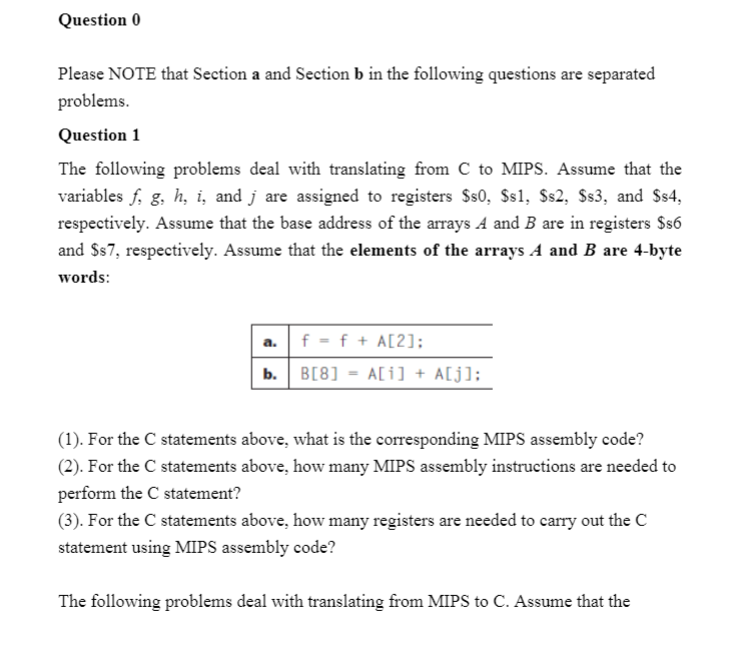
Question 0 Please NOTE that Section a and Section b in the following questions are separated problems. Question 1 The following problems deal with translating from C to MIPS. Assume that the variables f, g, h, i, and j are assigned to registers $80, $s1, $s2, $s3, and $s4, respectively. Assume that the base address of the arrays A and B are in registers $s6 and $87, respectively. Assume that the elements of the arrays A and B are 4-byte words: a. f - f + A[2]; b. B[8] = A[i] + A[j]; (1). For the statements above, what is the corresponding MIPS assembly code? (2). For the C statements above, how many MIPS assembly instructions are needed to perform the statement? (3). For the statements above, how many registers are needed to carry out the C statement using MIPS assembly code? The following problems deal with translating from MIPS to C. Assume that the Question 0 Please NOTE that Section a and Section b in the following questions are separated problems. Question 1 The following problems deal with translating from C to MIPS. Assume that the variables f, g, h, i, and j are assigned to registers $80, $s1, $s2, $s3, and $s4, respectively. Assume that the base address of the arrays A and B are in registers $s6 and $87, respectively. Assume that the elements of the arrays A and B are 4-byte words: a. f - f + A[2]; b. B[8] = A[i] + A[j]; (1). For the statements above, what is the corresponding MIPS assembly code? (2). For the C statements above, how many MIPS assembly instructions are needed to perform the statement? (3). For the statements above, how many registers are needed to carry out the C statement using MIPS assembly code? The following problems deal with translating from MIPS to C. Assume that the
Step by Step Solution
There are 3 Steps involved in it

Get step-by-step solutions from verified subject matter experts
 Study Help