







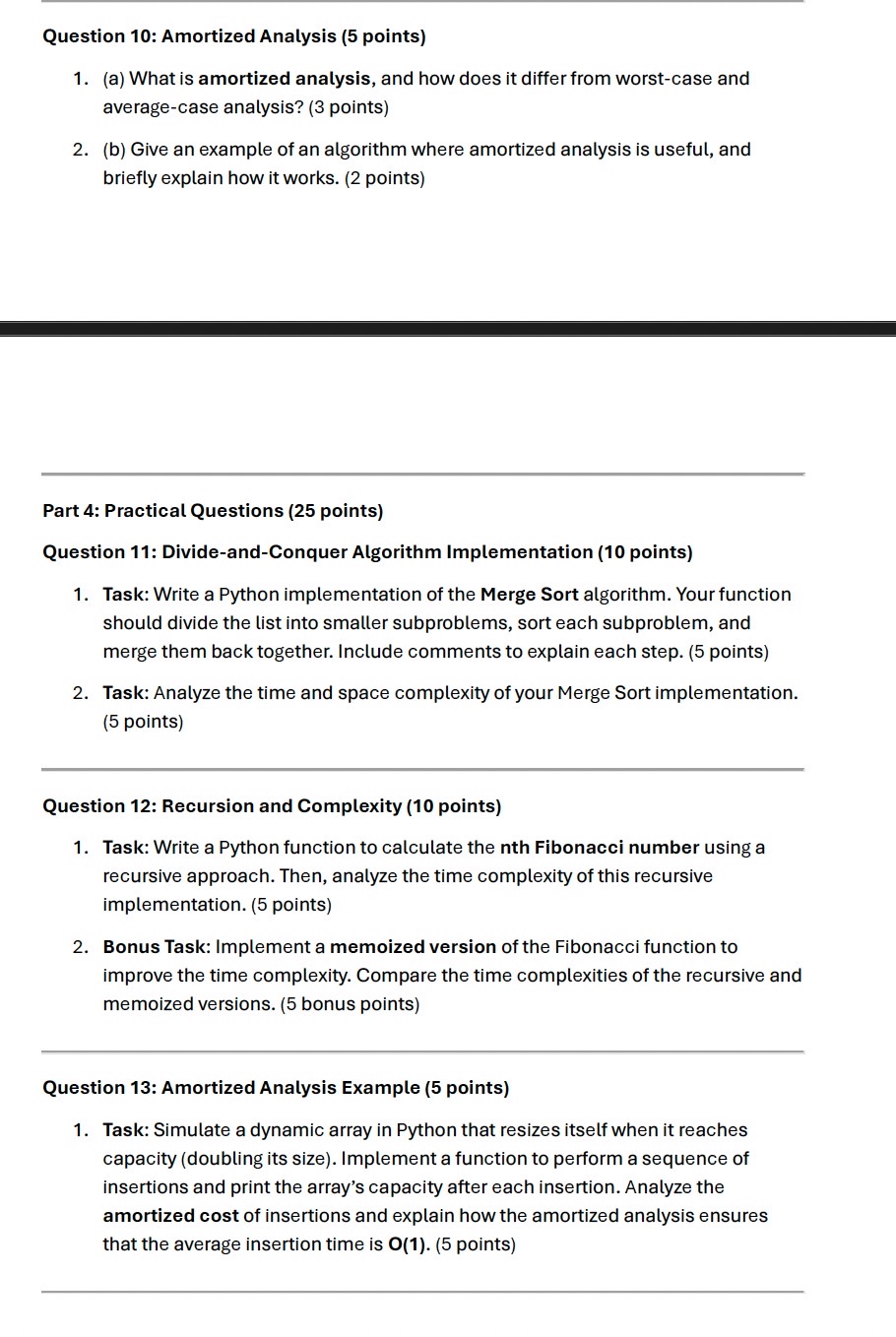
Question: Question 1 0 : Amortized Analysis ( 5 points ) ( a ) What is amortized analysis, and how does it differ from worst -
Question : Amortized Analysis points
a What is amortized analysis, and how does it differ from worstcase and averagecase analysis? points
b Give an example of an algorithm where amortized analysis is useful, and briefly explain how it works. points
Part : Practical Questions points
Question : DivideandConquer Algorithm Implementation points
Task: Write a Python implementation of the Merge Sort algorithm. Your function should divide the list into smaller subproblems, sort each subproblem, and merge them back together. Include comments to explain each step. points
Task: Analyze the time and space complexity of your Merge Sort implementation. points
Question : Recursion and Complexity points
Task: Write a Python function to calculate the nth Fibonacci number using a recursive approach. Then, analyze the time complexity of this recursive implementation. points
Bonus Task: Implement a memoized version of the Fibonacci function to improve the time complexity. Compare the time complexities of the recursive and memoized versions. bonus points
Question : Amortized Analysis Example points
Task: Simulate a dynamic array in Python that resizes itself when it reaches capacity doubling its size Implement a function to perform a sequence of insertions and print the array's capacity after each insertion. Analyze the amortized cost of insertions and explain how the amortized analysis ensures that the average insertion time is points
Step by Step Solution
There are 3 Steps involved in it
1 Expert Approved Answer
Step: 1 Unlock

Question Has Been Solved by an Expert!
Get step-by-step solutions from verified subject matter experts
Step: 2 Unlock
Step: 3 Unlock
 Study Help