







Question: QUESTION 1. 1 2 3 4 5 6 7 8 10 11 12 13 14 15 16 17 18 19 20 21 22 23 24
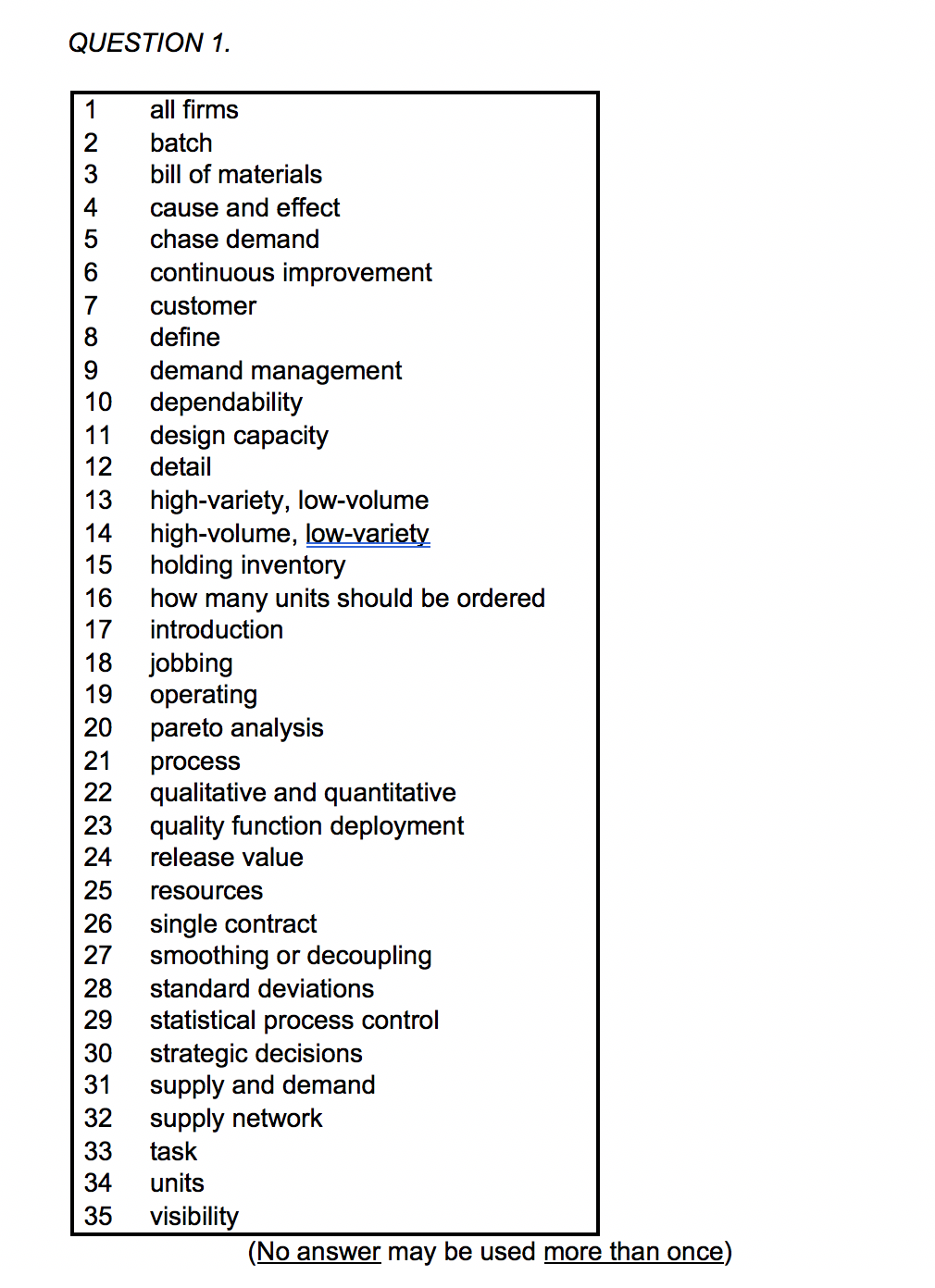
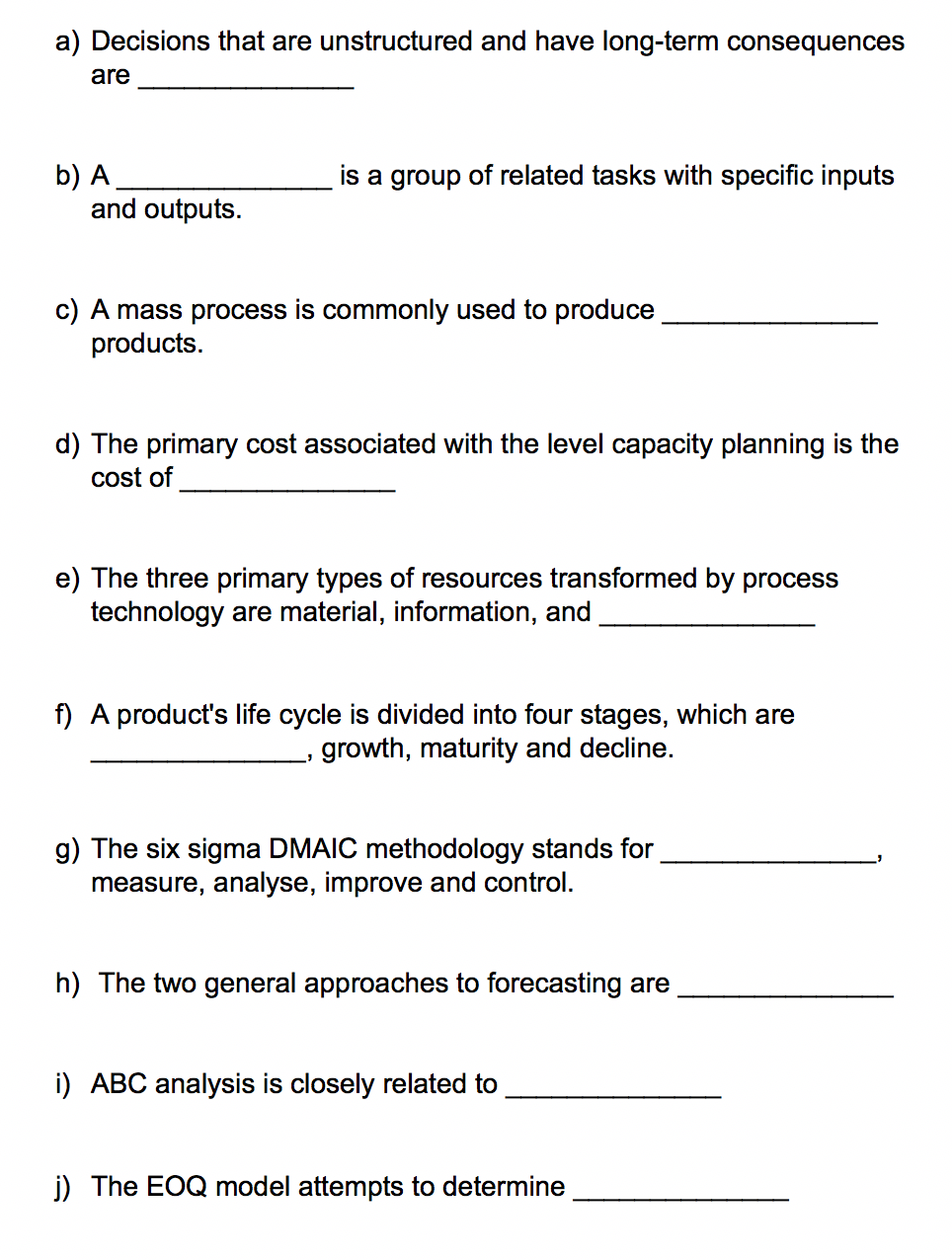
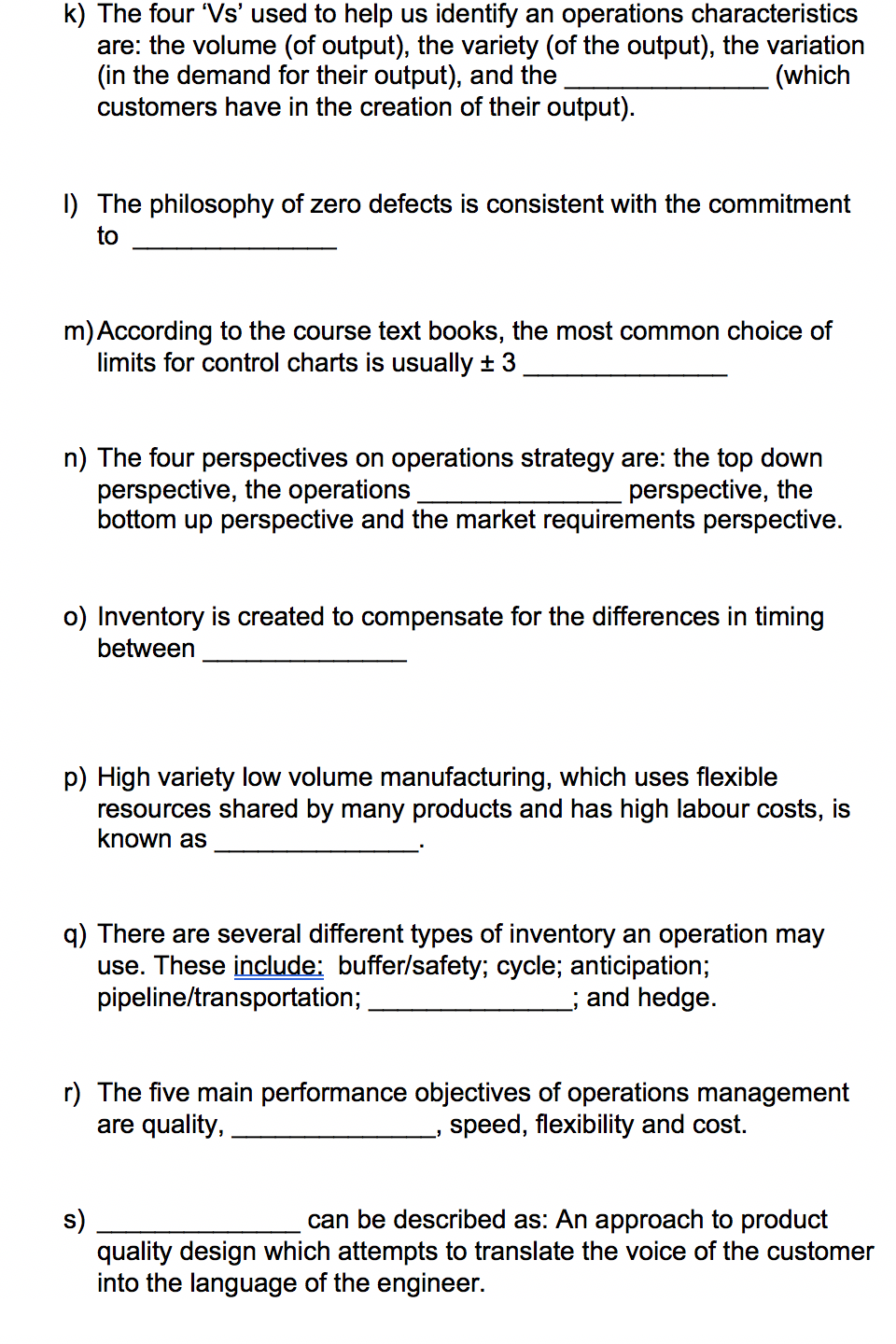
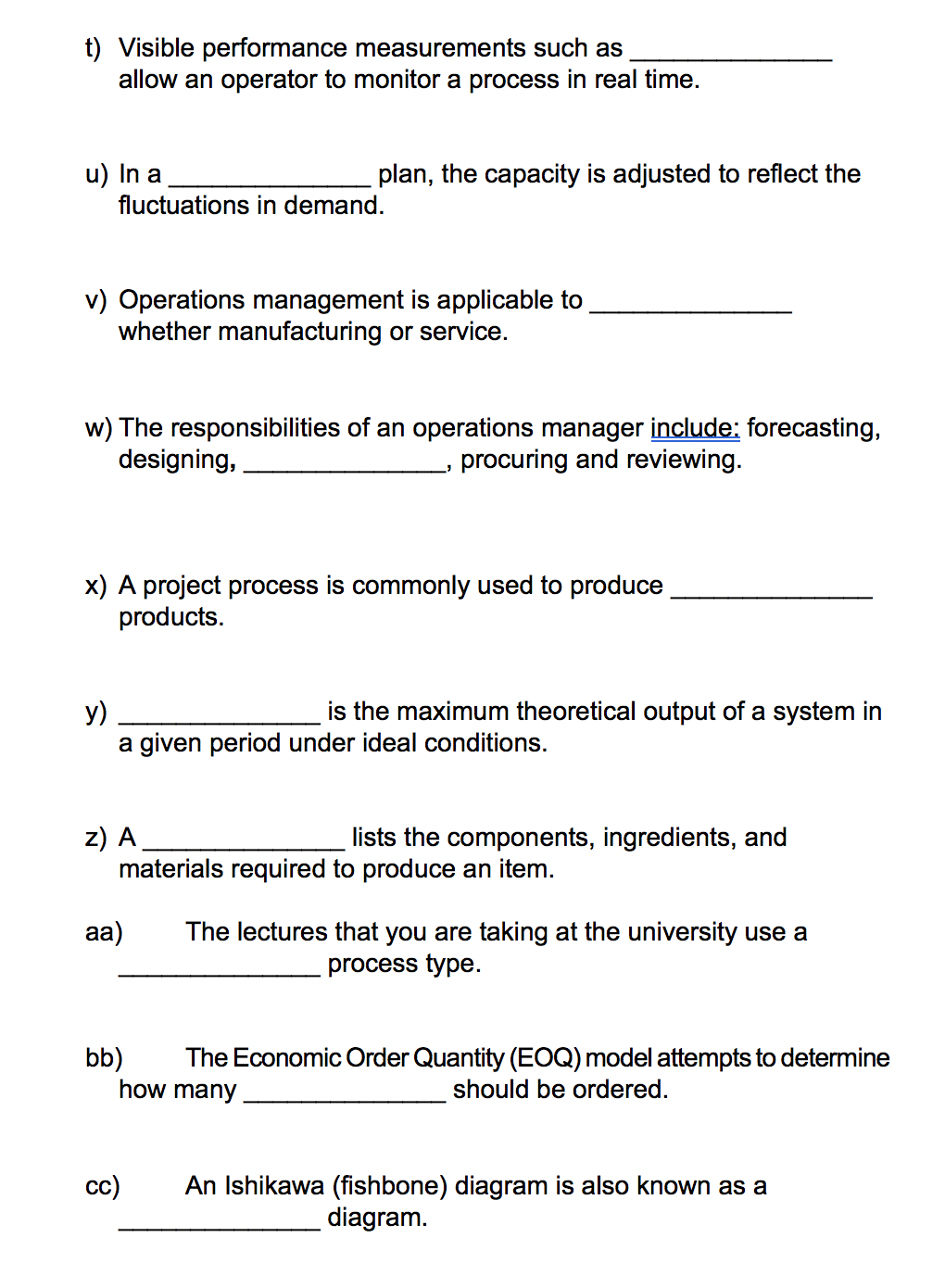
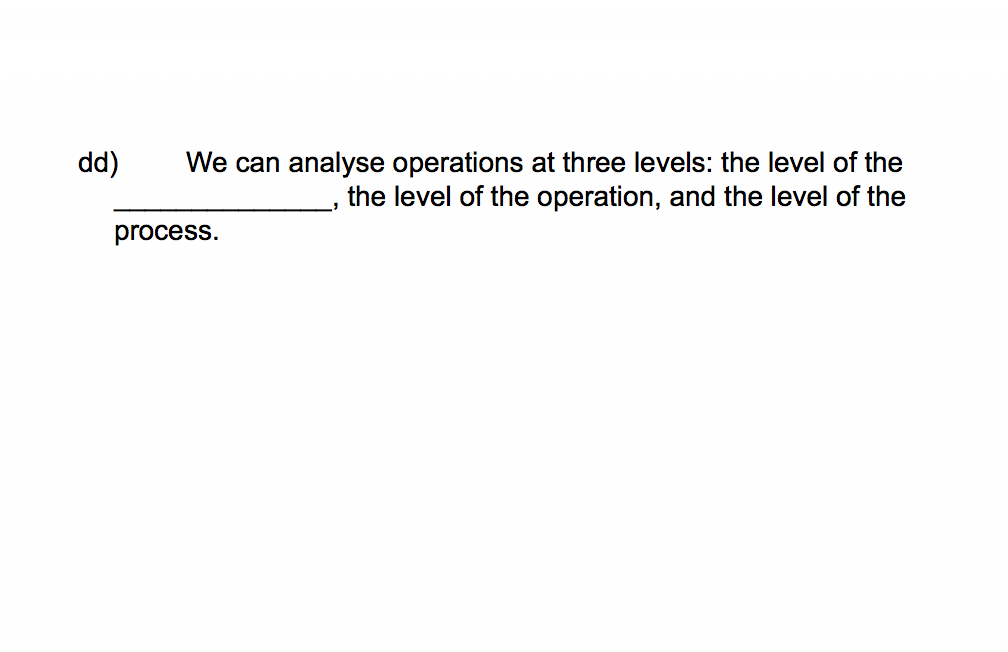
QUESTION 1. 1 2 3 4 5 6 7 8 10 11 12 13 14 15 16 17 18 19 20 21 22 23 24 25 26 27 28 29 30 31 32 33 34 35 all firms batch bill of materials cause and effect chase demand continuous improvement customer define demand management dependability design capacity detail high-variety, low-volume high-volume, low-variety holding inventory how many units should be ordered introduction jobbing operating pareto analysis process qualitative and quantitative quality function deployment release value resources single contract smoothing or decoupling standard deviations statistical process control strategic decisions supply and demand supply network task units visibility (No answer may be used more than once) a) Decisions that are unstructured and have long-term consequences are b) A and outputs. is a group of related tasks with specific inputs c) A mass process is commonly used to produce products. d) The primary cost associated with the level capacity planning is the cost of e) The three primary types of resources transformed by process technology are material, information, and f) A product's life cycle is divided into four stages, which are growth, maturity and decline. g) The six sigma DMAIC methodology stands for measure, analyse, improve and control. h) The two general approaches to forecasting are i) ABC analysis is closely related to j) The EOQ model attempts to determine k) The four 'Vs' used to help us identify an operations characteristics are: the volume (of output), the variety (of the output), the variation (in the demand for their output), and the (which customers have in the creation of their output). 1) The philosophy of zero defects is consistent with the commitment to m)According to the course text books, the most common choice of limits for control charts is usually = 3 n) The four perspectives on operations strategy are: the top down perspective, the operations perspective, the bottom up perspective and the market requirements perspective. o) Inventory is created to compensate for the differences in timing between p) High variety low volume manufacturing, which uses flexible resources shared by many products and has high labour costs, is known as q) There are several different types of inventory an operation may use. These include: buffer/safety; cycle; anticipation; pipeline/transportation; ; and hedge. r) The five main performance objectives of operations management are quality, speed, flexibility and cost. s) can be described as: An approach to product quality design which attempts to translate the voice of the customer into the language of the engineer. t) Visible performance measurements such as allow an operator to monitor a process in real time. u) In a plan, the capacity is adjusted to reflect the fluctuations in demand. v) Operations management is applicable to whether manufacturing or service. w) The sponsibilities of an operations manager include: forecasting, designing, procuring and reviewing. x) A project process is commonly used to produce products. y) is the maximum theoretical output of a system in a given period under ideal conditions. z) A lists the components, ingredients, and materials required to produce an item. aa) The lectures that you are taking at the university use a process type. bb) The Economic Order Quantity (EOQ)model attempts to determine how many should be ordered. cc) An Ishikawa (fishbone) diagram is also known as a diagram. dd) We can analyse operations at three levels: the level of the the level of the operation, and the level of the process. 3
Step by Step Solution
There are 3 Steps involved in it
1 Expert Approved Answer
Step: 1 Unlock

Question Has Been Solved by an Expert!
Get step-by-step solutions from verified subject matter experts
Step: 2 Unlock
Step: 3 Unlock
 Study Help