







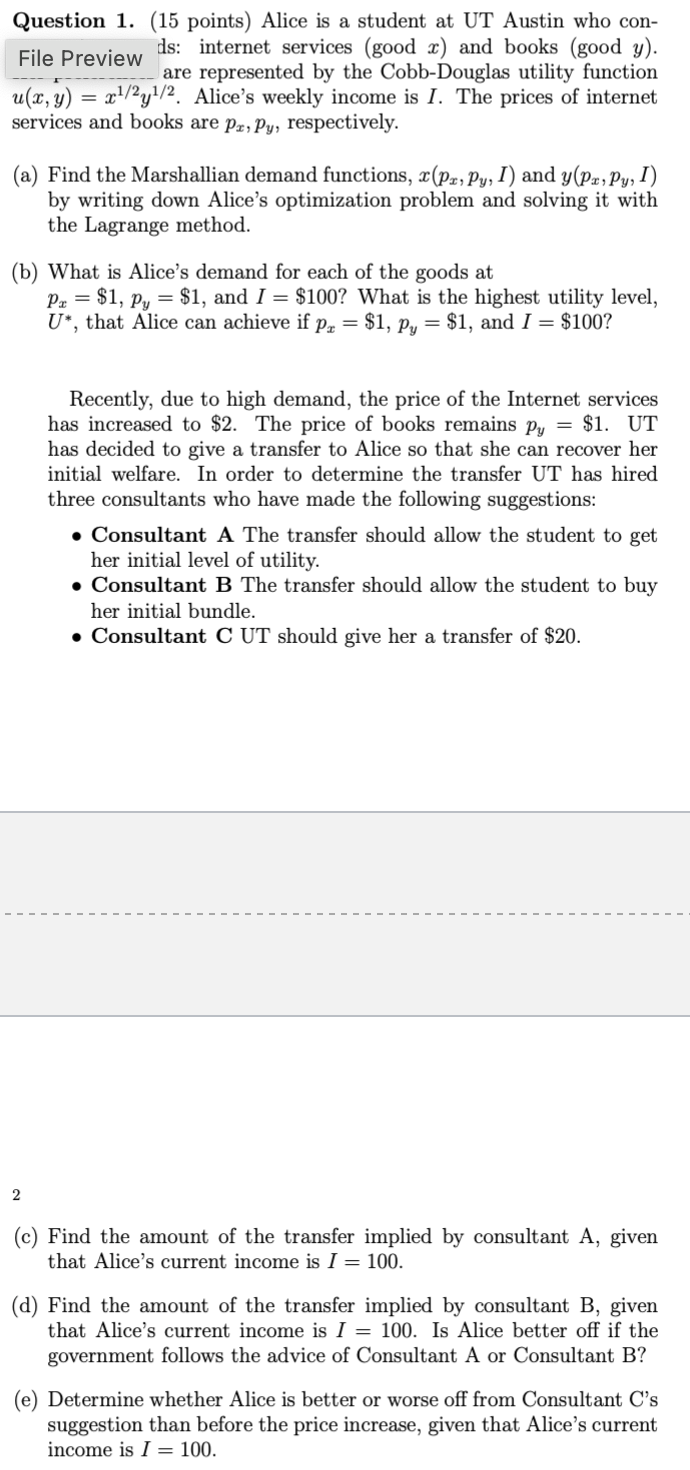
Question: Question 1 . ( 1 5 points ) Alice is a student at UT Austin who con - sumes two goods: internet services ( good
Question points Alice is a student at UT Austin who con
sumes two goods: internet services good x and books good y
Her preferences are represented by the CobbDouglas utility function
ux y xy Alices weekly income is I. The prices of internet
services and books are px py respectively.
a Find the Marshallian demand functions, xpx py I and ypx py I
by writing down Alices optimization problem and solving it with
the Lagrange method.
b What is Alices demand for each of the goods at
px $ py $ and I $ What is the highest utility level,
U that Alice can achieve if px $ py $ and I $
Recently, due to high demand, the price of the Internet services
has increased to $ The price of books remains py $ UT
has decided to give a transfer to Alice so that she can recover her
initial welfare. In order to determine the transfer UT has hired
three consultants who have made the following suggestions:
Consultant A The transfer should allow the student to get
her initial level of utility.
Consultant B The transfer should allow the student to buy
her initial bundle.
Consultant C UT should give her a transfer of $
c Find the amount of the transfer implied by consultant A given that Alice's current income is I
d Find the amount of the transfer implied by consultant B given that Alice's current income is I Is Alice better off if the government follows the advice of Consultant A or Consultant B
e Determine whether Alice is better or worse off from Consultant Cs suggestion than before the price increase, given that Alice's current income is I
Step by Step Solution
There are 3 Steps involved in it
1 Expert Approved Answer
Step: 1 Unlock

Question Has Been Solved by an Expert!
Get step-by-step solutions from verified subject matter experts
Step: 2 Unlock
Step: 3 Unlock
 Study Help