







Question: Question 1 ( 1 6 marks ) Control systems exist in numerous varieties, both in type of applications and level of sophistications. Since most systems
Question marks
Control systems exist in numerous varieties, both in type of applications and level of sophistications. Since most systems are dynamic in nature, to control or regulate against a set of desired parameters is important to ensure good performance and quality standards.
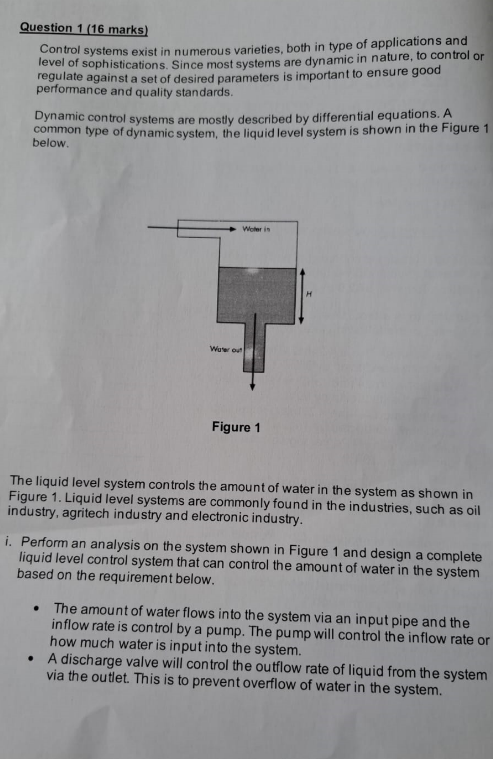
Dynamic control systems are mostly described by differential equations. A common type of dynamic system, the liquid level system is shown in the Figure below.
The liquid level system controls the amount of water in the system as shown in Figure Liquid level systems are commonly found in the industries, such as oil industry, agritech industry and electronic industry.
i Perform an analysis on the system shown in Figure and design a complete liquid level control system that can control the amount of water in the system based on the requirement below.
The amount of water flows into the system via an input pipe and the inflow rate is control by a pump. The pump will control the inflow rate or how much water is input into the system.
A discharge valve will control the outflow rate of liquid from the system via the outlet. This is to prevent overflow of water in the system. The pump can be adjustable to control the inflow rate of the water into the system and the discharge valve can be adjusted to control the outflow rate of the water from the system.
Draw the complete liquid level system that you have designed by adding in the pump and discharge valve and other relevant parts, if applicable.
Indicate clearly the dynamic changing variables involved in the system such as inflow rate, outflow rate and any other changing variables in the system.
ii Model the transfer function of your newly designed liquid level system in part i Show your steps clearly in modeling the transfer function. You may use Laplace Transform to help you in the modelling of the transfer function. Hint: You may use Laplace Transform to help you in the modelling of transfer function
iii. Explain your rationale behind the modelling of the transfer function in ii and describe how you obtain the transfer function. State any assumption that you have made in your modelling process.
b Based on the modelling of the transfer function in a
i Draw the control system block diagram of the liquid level system based on the transfer function that you obtained in part a Show the in put and output of the system clearly in your block diagram.
ii Explain the behavior and dynamics of the system in your block diagram.
iii. Disturbances are commonly found in system. Indicate any disturbance acting on the system in your block diagram. Explain the effect of the disturbances on the system.
iv Parameter variations often exist in dynamic system. Indicate any parameter variation affecting the system in your block diagram. Explain the effect of the parameter variations on the system.
c Determine the output of the liquid level system ie height of the water level Show your steps clearly. State your assumptions in your computation. Hint: You may use Inverse Laplace Transform to help you Question marks
Control systems exist in numerous varieties, both in type of applications and level of sophistications. Since most systems are dynamic in nature, to control or regulate against a set of desired parameters is important to ensure good performance and quality standards.
Dynamic control systems are mostly described by differential equations. A common type of dynamic system, the liquid level system is shown in the Figure below.
The liquid level system controls the amount of water in the system as shown in Figure Liquid level systems are commonly found in the industries, such as oil industry, agritech industry and electronic industry.
i Perform an analysis on the system shown in Figure and design a complete liquid level control system that can control the amount of water in the system based on the requirement below.
The amount of water flows into the system via an input pipe and the inflow rate is control by a pump. The pump will control the inflow rate or how much water is input into the system.
A discharge valve will control the outflow rate of liquid from the system via the outlet. This is to prevent overflow of water in the system. Question marks
Control systems exist in numerous varieties, both in type of applications and level of sophistications. Since most systems are dynamic in nature, to control or regulate against a set of desired parameters is important to ensure good performance and quality standards.
Dynamic control systems are mostly described by differential equations. A common type of dynamic system, the liquid level system is shown in the Figure below.
The liquid level system controls the amount of water in the system as shown in Figure Liquid level systems are commonly found in the industries, such as oil industry, agritech industry and electronic industry.
i Perform an analysis on the system shown in Figure
Step by Step Solution
There are 3 Steps involved in it
1 Expert Approved Answer
Step: 1 Unlock

Question Has Been Solved by an Expert!
Get step-by-step solutions from verified subject matter experts
Step: 2 Unlock
Step: 3 Unlock
 Study Help