







Question: QUESTION 1 ( 1 7 MARKS ) Examine the information provided below and respond to the following question. Competitive prionties represent critical operational dimensions essential
QUESTION
MARKS
Examine the information provided below and respond to the following question.
Competitive prionties represent critical operational dimensions essential for meeting the diverse needs of both internal and extemal customers, thereby shaping operations strategy and driving business performance Pakhomova A range of studies have explored the concept of competitive priorities in operations management. However, there is currently no consensus on the most effective approach to emphasize competitive priorities. Notably, Jitpaiboon emphasised the significance of cost and quality, while Pakhomova advocated for achieving operational excellence across multiple priorities. Furthermore, Idris expanded this framework by identifying six priorties in the service sector, including cost, flexibility, delivery, and various aspects of quality. Collectively, these studies underscore the dynamic nature of competitive priorities and their profound impact on organizational performance.
Scholars commonly recognise cost, quality, flexibility, delivery, and innovativeness as fundamental dimensions of competitive priorities across industries Durach Wiengarten, & Humphreys, ; Idris & Mohammad, ; Jitpaiboon, Gu & Truong, ; Pakhomova,
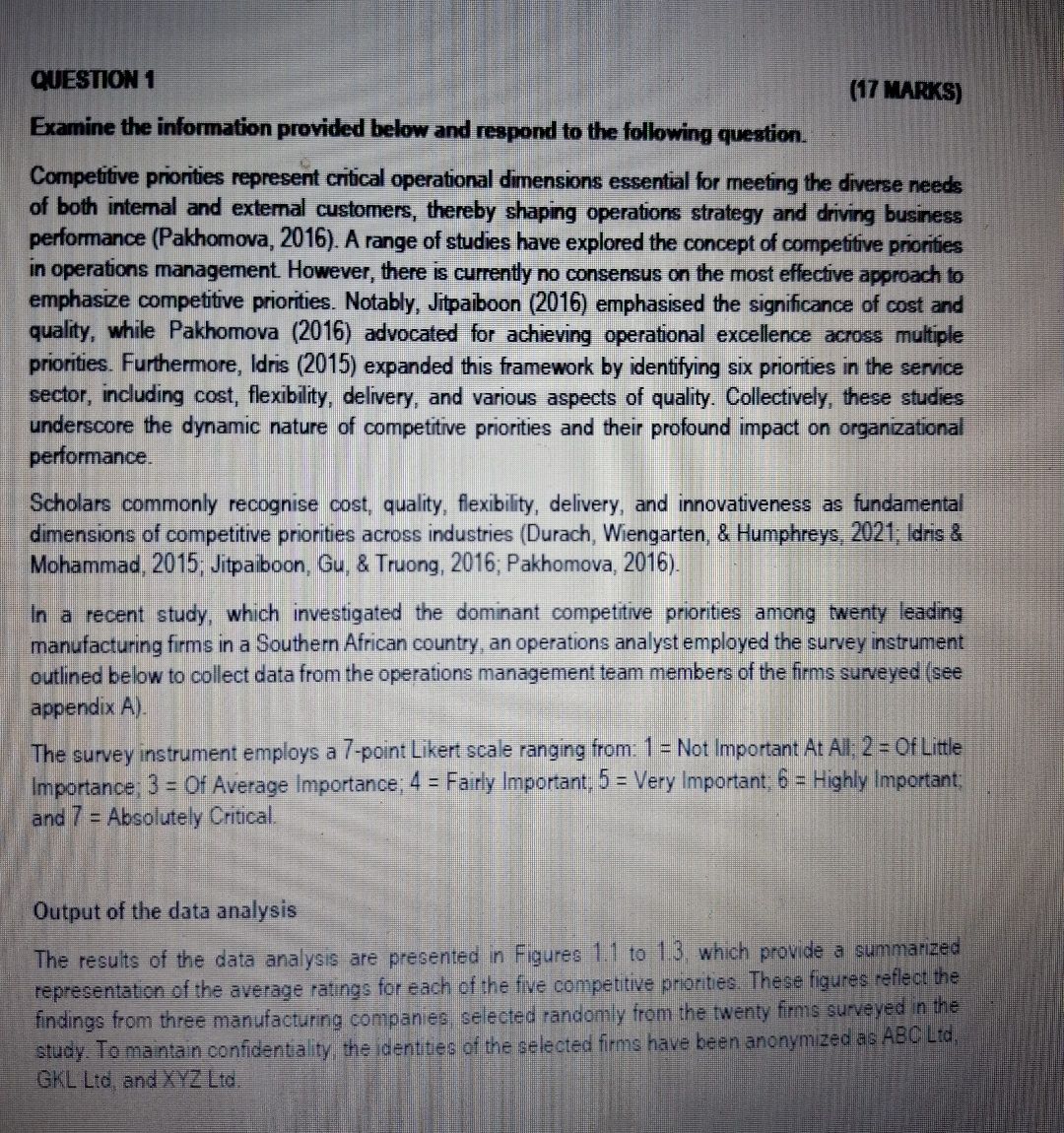
In a recent study, which investigated the dominant compettive priorities among twenty leading manufacturing firms in a Southern African country, an operations analyst employed the survey instrument outlined below to collect data from the operations management team members of the firms surveyed see appendix A
The survey instrument employs a point Likert scale ranging from: Not Important At All; Of Little Importance; Of Average Importance; Fairly Important; Very Important; Highly Important; and Absolutely Critical.
Output of the data analysis
The results of the data analysis are presented in Figures to which provide a summarized representation of the average ratings for each of the five competitive priorities. These figures reflect the findings from three manufacturing companies, selected randomly from the twenty firms surveyed in the study. To ma intain confidentality, the identtes of the selected firms have been anonymized as ABC Lid, GKL Ltd and XYZ Ltd
Figure : Summary of ratings from the survey of CXL Limited
REQURED
Discuss each of the five competitive prionities investigated by the operations analyst, emphasising their significance in operations strategy and organisational pefformance.
marks
What insights can be derived from the results of the survey regarding the competitive prionties of the three randomy selected manufacturing fims in the Southem African country?
marks
According to Heizer, Fiender and Munson fims acheve their misions in three conceptual ways. cifferentiation, cost ieadership, and response. This means operations managers are called on to defver goods and services that are better, or at least different, cheaper, and more responsive. Operations managers translate these strategic concepts into tangible tasks to be accomplished. Any one or combination of these twee strategic concepts can generate a system that has a unique advantage over competiors.
Considering these strategic concepts and the findings from the survey discuss the competitive strutegles employed oy the trief sefectea leading companies in the manutacturing sector of the Southetr Arrican pountry, mark
Step by Step Solution
There are 3 Steps involved in it
1 Expert Approved Answer
Step: 1 Unlock

Question Has Been Solved by an Expert!
Get step-by-step solutions from verified subject matter experts
Step: 2 Unlock
Step: 3 Unlock
 Study Help