







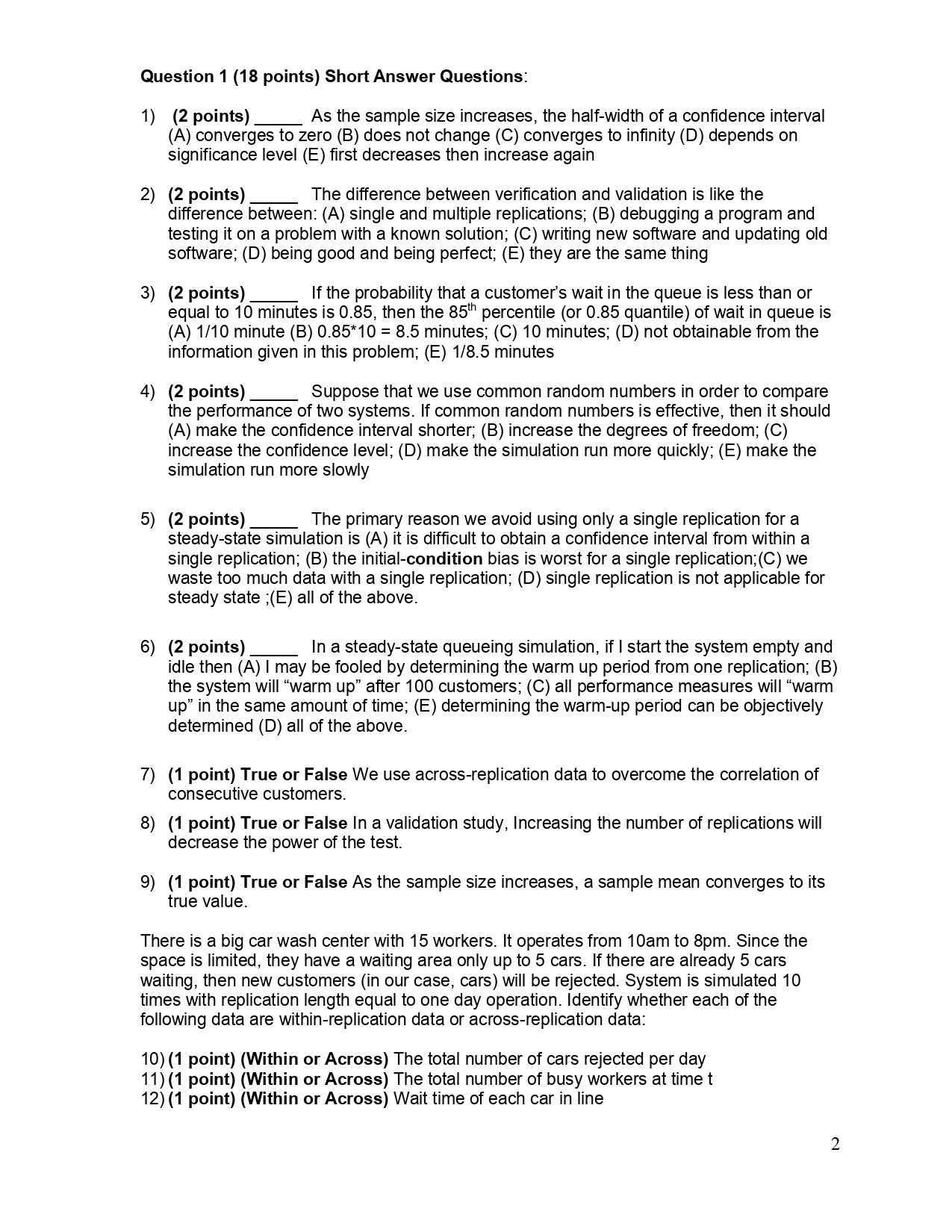
Question: Question 1 ( 1 8 points ) Short Answer Questions: 1 ) ( 2 points ) As the sample size increases, the half - width
Question points Short Answer Questions:
points As the sample size increases, the halfwidth of a confidence interval A converges to zero B does not change C converges to infinity D depends on significance level E first decreases then increase again
points The difference between verification and validation is like the difference between: A single and multiple replications; B debugging a program and testing it on a problem with a known solution; C writing new software and updating old software; D being good and being perfect; E they are the same thing
points If the probability that a customer's wait in the queue is less than or equal to minutes is then the text th percentile or quantile of wait in queue is A minute Bstar minutes; C minutes; D not obtainable from the information given in this problem; E minutes
points Suppose that we use common random numbers in order to compare the performance of two systems. If common random numbers is effective, then it should A make the confidence interval shorter; B increase the degrees of freedom; C increase the confidence level; D make the simulation run more quickly; E make the simulation run more slowly
points The primary reason we avoid using only a single replication for a steadystate simulation is A it is difficult to obtain a confidence interval from within a single replication; B the initialcondition bias is worst for a single replication;C we waste too much data with a single replication; D single replication is not applicable for steady state;E all of the above.
points In a steadystate queueing simulation, if I start the system empty and idle then A I may be fooled by determining the warm up period from one replication; B the system will "warm up after customers; C all performance measures will "warm up in the same amount of time; E determining the warmup period can be objectively determined D all of the above.
point True or False We use acrossreplication data to overcome the correlation of consecutive customers.
point True or False In a validation study, Increasing the number of replications will decrease the power of the test.
point True or False As the sample size increases, a sample mean converges to its true value.
There is a big car wash center with workers. It operates from am to pm Since the space is limited they have a waiting area only up to cars. If there are already cars waiting, then new customers in our case, cars will be rejected. System is simulated times with replication length equal to one day operation. Identify whether each of the following data are withinreplication data or acrossreplication data:
pointWithin or Across The total number of cars rejected per day
pointWithin or Across The total number of busy workers at time t
pointWithin or Across Wait time of each car in line
Step by Step Solution
There are 3 Steps involved in it
1 Expert Approved Answer
Step: 1 Unlock

Question Has Been Solved by an Expert!
Get step-by-step solutions from verified subject matter experts
Step: 2 Unlock
Step: 3 Unlock
 Study Help