Question: Question 1 (1 point) continues to be a technological force and opportunity that revolutionizes Canadian businesses and their HRM practices. Email Automation The North American
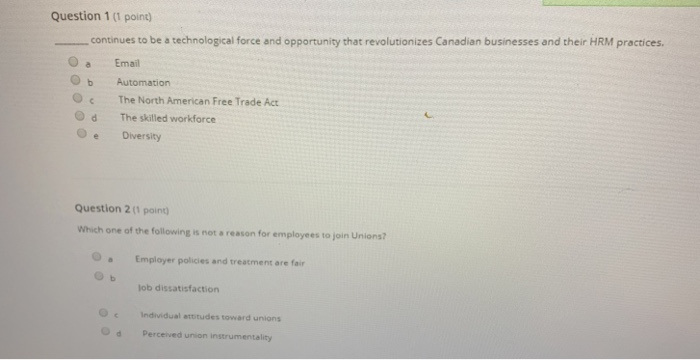
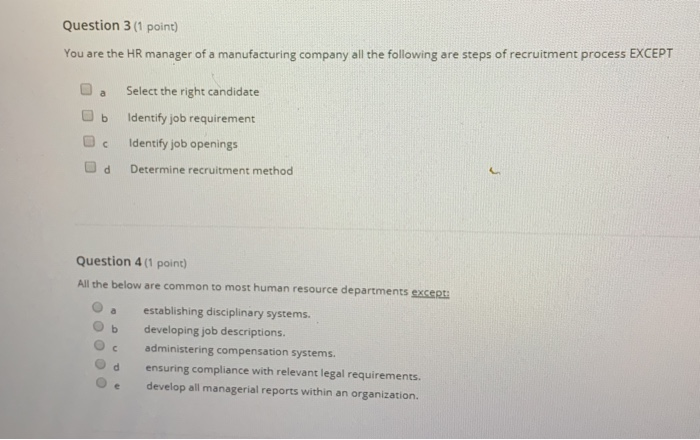
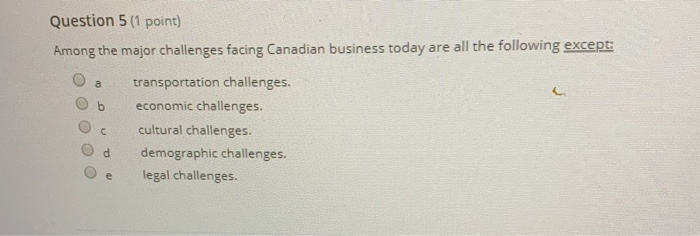
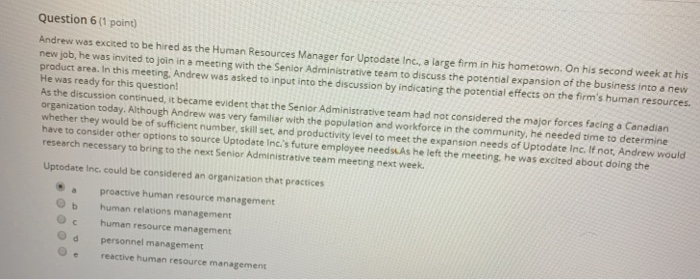
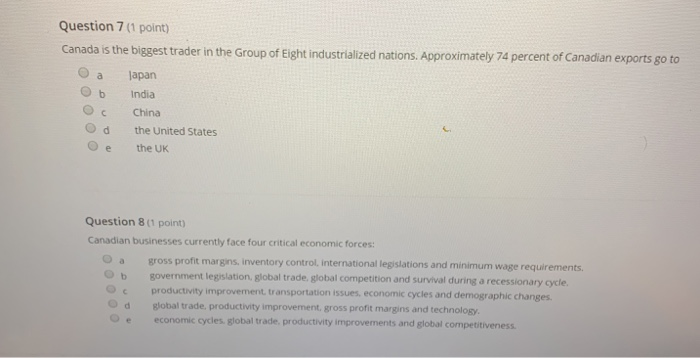
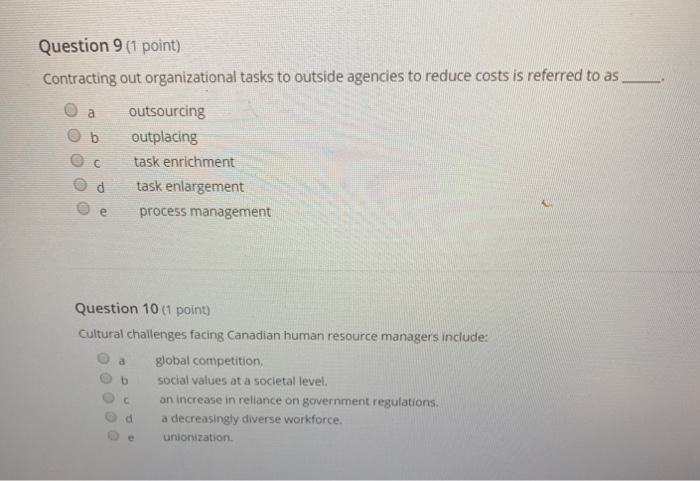
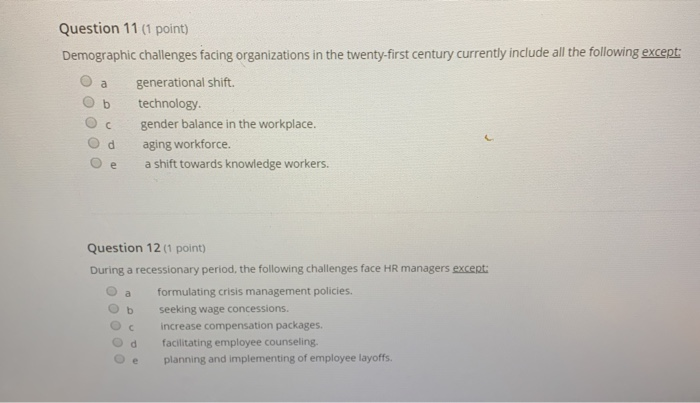
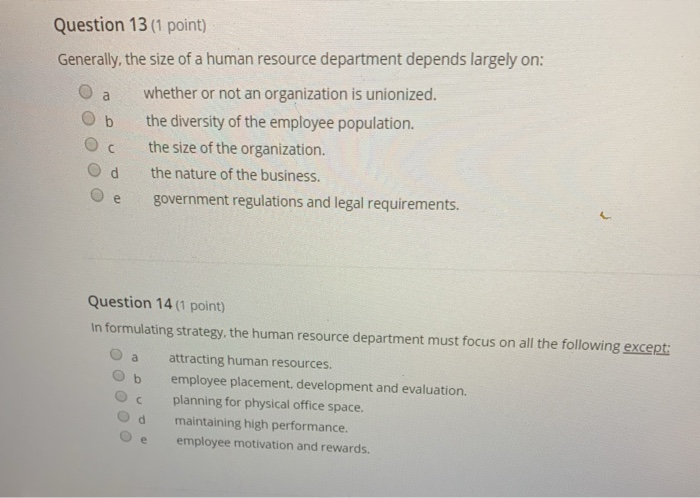
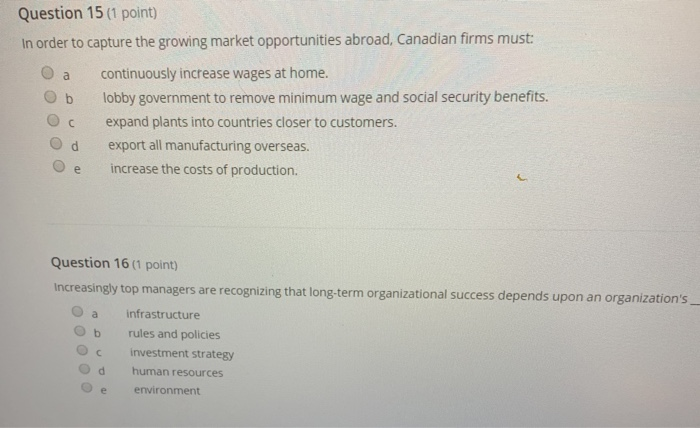
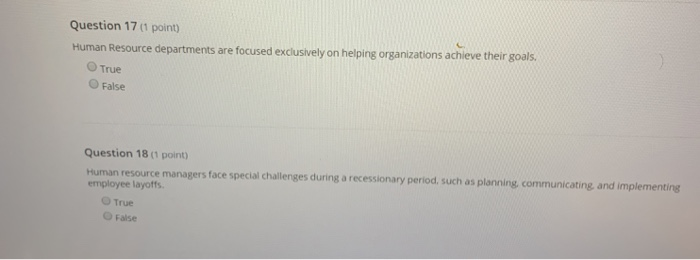
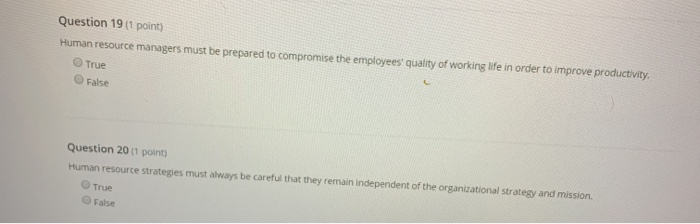
Question 1 (1 point) continues to be a technological force and opportunity that revolutionizes Canadian businesses and their HRM practices. Email Automation The North American Free Trade Act The skilled workforce Diversity b Question 2 (1 point) Which one of the following is not a reason for employees to join Unions? Employer policies and treatment are fair Job dissatisfaction Individual attitudes toward unions Perceived union instrumentality Question 3 (1 point) You are the HR manager of a manufacturing company all the following are steps of recruitment process EXCEPT b Select the right candidate Identify job requirement Identify job openings d Determine recruitment method Question 4 (1 point) All the below are common to most human resource departments except: a b establishing disciplinary systems. developing job descriptions. administering compensation systems. ensuring compliance with relevant legal requirements. develop all managerial reports within an organization. d Question 5 (1 point) Among the major challenges facing Canadian business today are all the following except: a b transportation challenges. economic challenges. cultural challenges. demographic challenges. legal challenges. d e Question 6 (1 point) Andrew was excited to be hired as the Human Resources Manager for Uptodate Inc., a large firm in his hometown. On his second week at his new job, he was invited to join in a meeting with the Senior Administrative team to discuss the potential expansion of the business into a new product ares. In this meeting, Andrew was asked to input into the discussion by indicating the potential effects on the firm's human resources. He was ready for this question As the discussion continued, it became evident that the Senior Administrative team had not considered the major forces facing a Canadian organization today. Although Andrew was very familiar with the population and workforce in the community, he needed time to determine whether they would be of sufficient number, skill set, and productivity level to meet the expansion needs of Uptodate inc. If not, Andrew would have to consider other options to source Uptodate Inc's future employee needsAs he left the meeting, he was excited about doing the research necessary to bring to the next Senior Administrative team meeting next week. Uptodate Inc. could be considered an organization that practices proactive human resource management human relations management human resource management personnel management reactive human resource management e a Question 7 (1 point) Canada is the biggest trader in the Group of Eight industrialized nations. Approximately 74 percent of Canadian exports go to Japan 6 India China d the United States the UK Question 8 (1 point) Canadian businesses currently face four critical economic forces: a gross profit margins. Inventory control international legislations and minimum wage requirements, government legislation, global trade, global competition and survival during a recessionary cycle. productivity improvement transportation issues, economic cycles and demographic changes. global trade productivity improvement, gross profit margins and technology economic cycles global trade productivity improvements and global competitiveness. 000 a Question 9 (1 point) Contracting out organizational tasks to outside agencies to reduce costs is referred to as outsourcing b outplacing task enrichment task enlargement process management e a Question 10 (1 point) Cultural challenges facing Canadian human resource managers include: global competition b social values at a societal level. an increase in reliance on government regulations. a decreasingly diverse workforce. unionization C e a Question 11 (1 point) Demographic challenges facing organizations in the twenty-first century currently include all the following except: generational shift. technology gender balance in the workplace. aging workforce. a shift towards knowledge workers. b C d Question 12 (1 point) During a recessionary period, the following challenges face HR managers except: formulating crisis management policies. b seeking wage concessions. increase compensation packages. facilitating employee counseling. planning and implementing of employee layoffs. C d a Question 13 (1 point) Generally, the size of a human resource department depends largely on: whether or not an organization is unionized. b the diversity of the employee population. the size of the organization. the nature of the business. government regulations and legal requirements. e a Question 14 (1 point) In formulating strategy, the human resource department must focus on all the following except: attracting human resources. employee placement, development and evaluation. planning for physical office space. maintaining high performance. employee motivation and rewards. b C d a Question 15 (1 point) In order to capture the growing market opportunities abroad, Canadian firms must: continuously increase wages at home. lobby government to remove minimum wage and social security benefits. expand plants into countries closer to customers. export all manufacturing overseas. increase the costs of production. d e a Question 16 (1 point) Increasingly top managers are recognizing that long-term organizational success depends upon an organization's infrastructure rules and policies investment strategy human resources environment b C d e Question 17 1 point) Human Resource departments are focused exclusively on helping organizations achieve their goals. True False Question 18 (1 point) Human resource managers face special challenges during a recessionary period, such as planning communicating and implementing employee layoffs O True O False Question 19 (1 point) Human resource managers must be prepared to compromise the employees' quality of working life in order to improve productivity. True False Question 2011 point) Human resource strategies must always be careful that they remain independent of the organizational strategy and mission O True False









 Study Help