







Question: Question 1 (1 point) If an activity generates external costs, decision makers generating the activity will a) be faced with its full costs, b) not
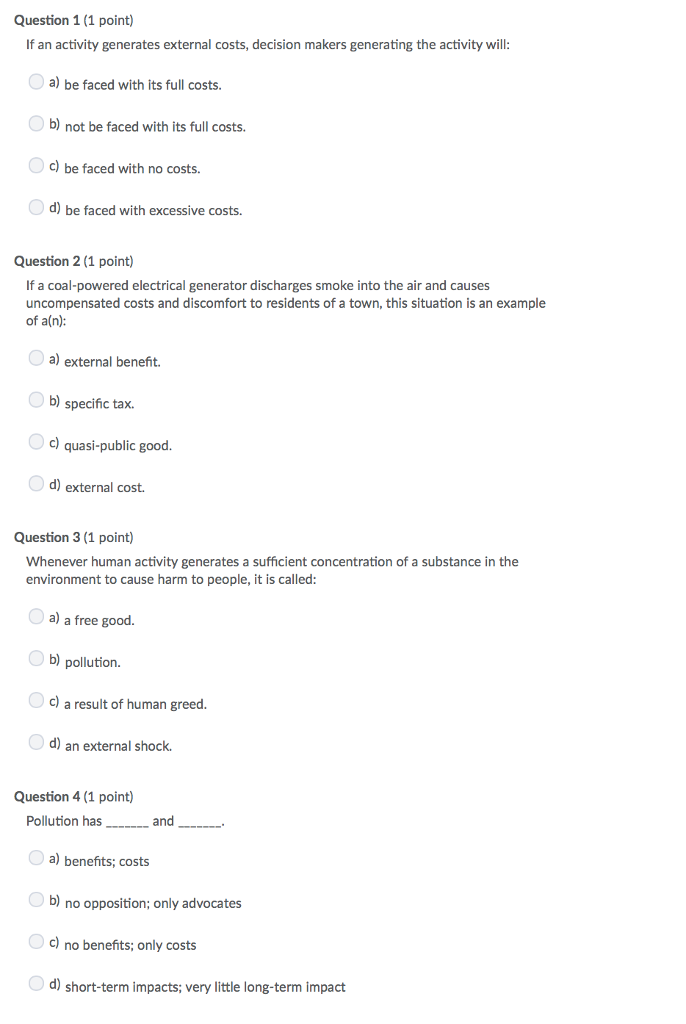
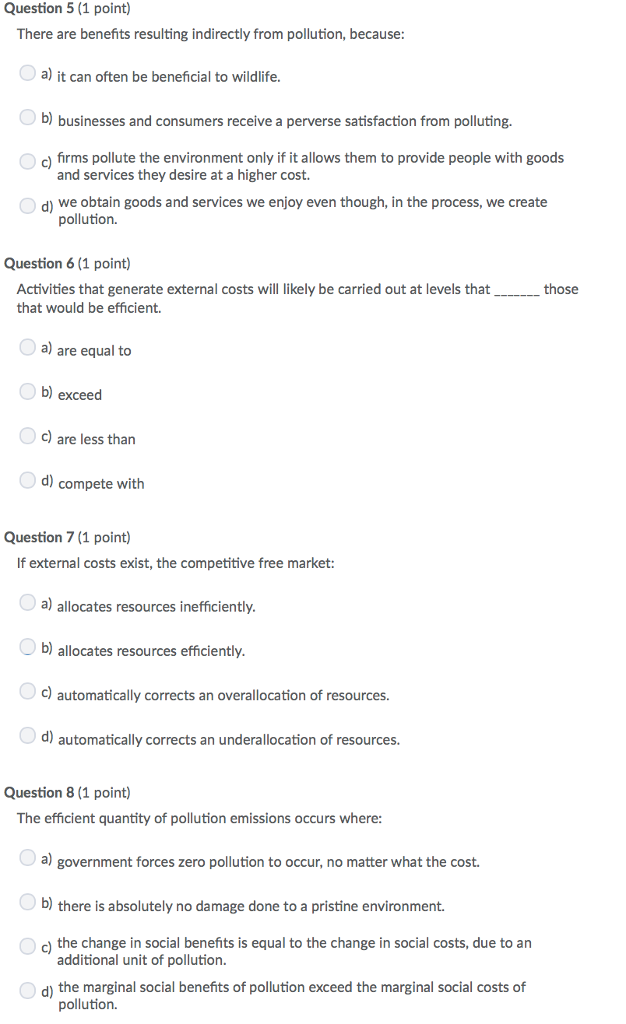
Question 1 (1 point) If an activity generates external costs, decision makers generating the activity will a) be faced with its full costs, b) not be faced with its full costs. C) be faced with no costs. d) be faced with excessive costs. Question 2 (1 point) If a coal-powered electrical generator discharges smoke into the air and causes uncompensated costs and discomfort to residents of a town, this situation is an example of a(n): a) external benefit. b) specific tax. C) quasi-public good d) external cost. Question 3 (1 point) Whenever human activity generates a sufficient concentration of a substance in the environment to cause harm to people, it is called a) a free good. b) pollution. c) a result of human greed d) an external shock Question 4 (1 point) Pollution hasand a) benefits; costs b) no opposition; only advocates C) no benefits; only costs d) short-term impacts; very little long-term impact Question 5 (1 point) There are benefits resulting indirectly from pollution, because a) it can often be beneficial to wildlife. b) businesses and consumers receive a perverse satisfaction from polluting. c) firms pollute the environment only if it allows them to provide people with goods and services they desire at a higher cost. d) We obtain goods and services we enjoy even though, in the process, we create pollution. Question 6 (1 point) Activities that generate external costs will likely be carried out at levels that that would be efficient. those a) are equal to b) exceed c) are less than compete with Question 7 (1 point) If external costs exist, the competitive free market: a allocates resources inefficiently b) allocates resources efficient c) automatically corrects an overallocation of resources. d) automatically corrects an underallocation of resources. Question 8 (1 point) The efficient quantity of pollution emissions occurs where: a) government forces zero pollution to occur, no matter what the cost. b) there is absolutely no damage done to a pristine environment. the change in social benefits is equal to the change in social costs, due to arn additional unit of pollution. d) the marginal social benefits of pollution exceed the marginal social costs of pollution
Step by Step Solution
There are 3 Steps involved in it

Get step-by-step solutions from verified subject matter experts
 Study Help