







Question: Question 1 (1 point) On a typical project, when are the risk lowest and impact (amount at stake) highest)? O a) During the concept phase
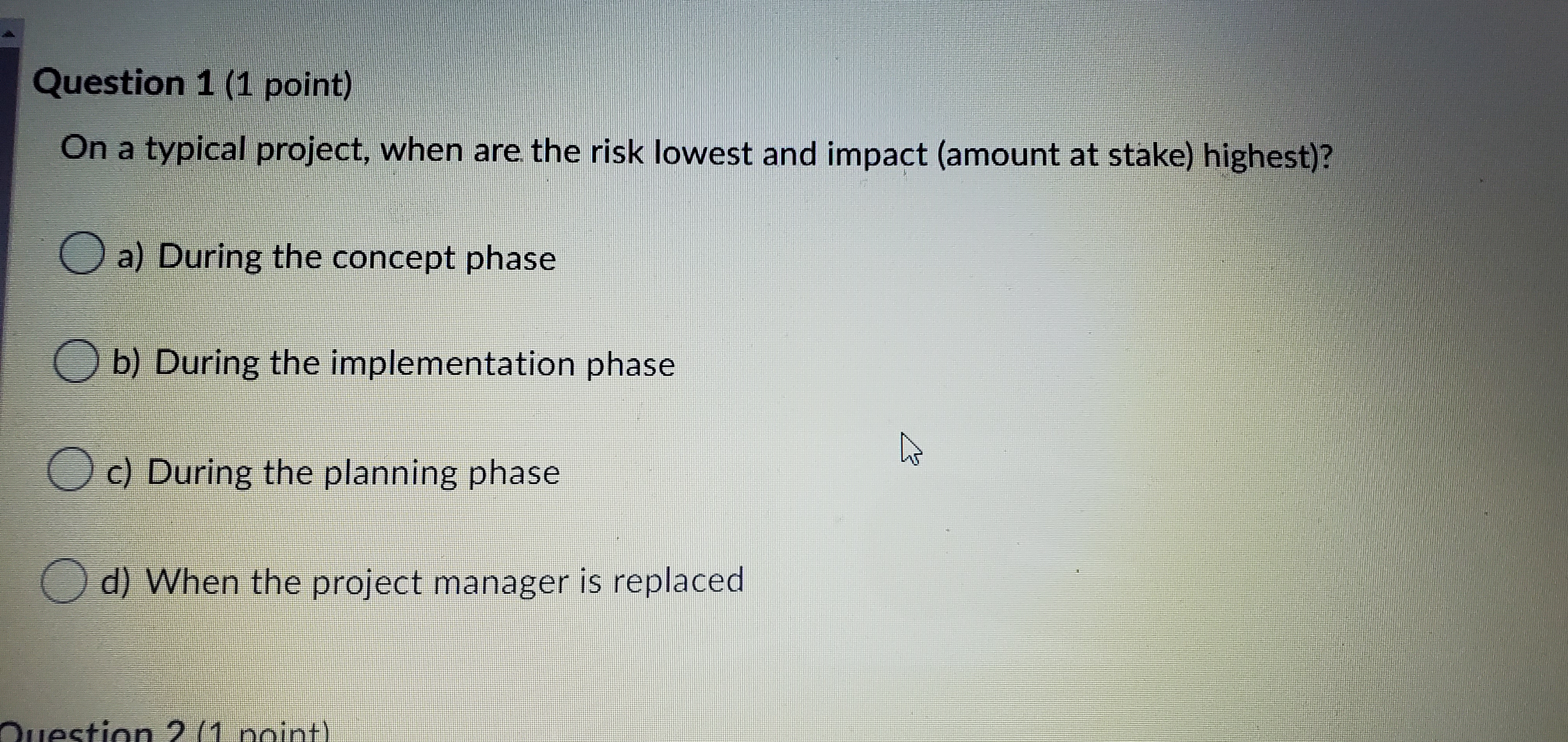
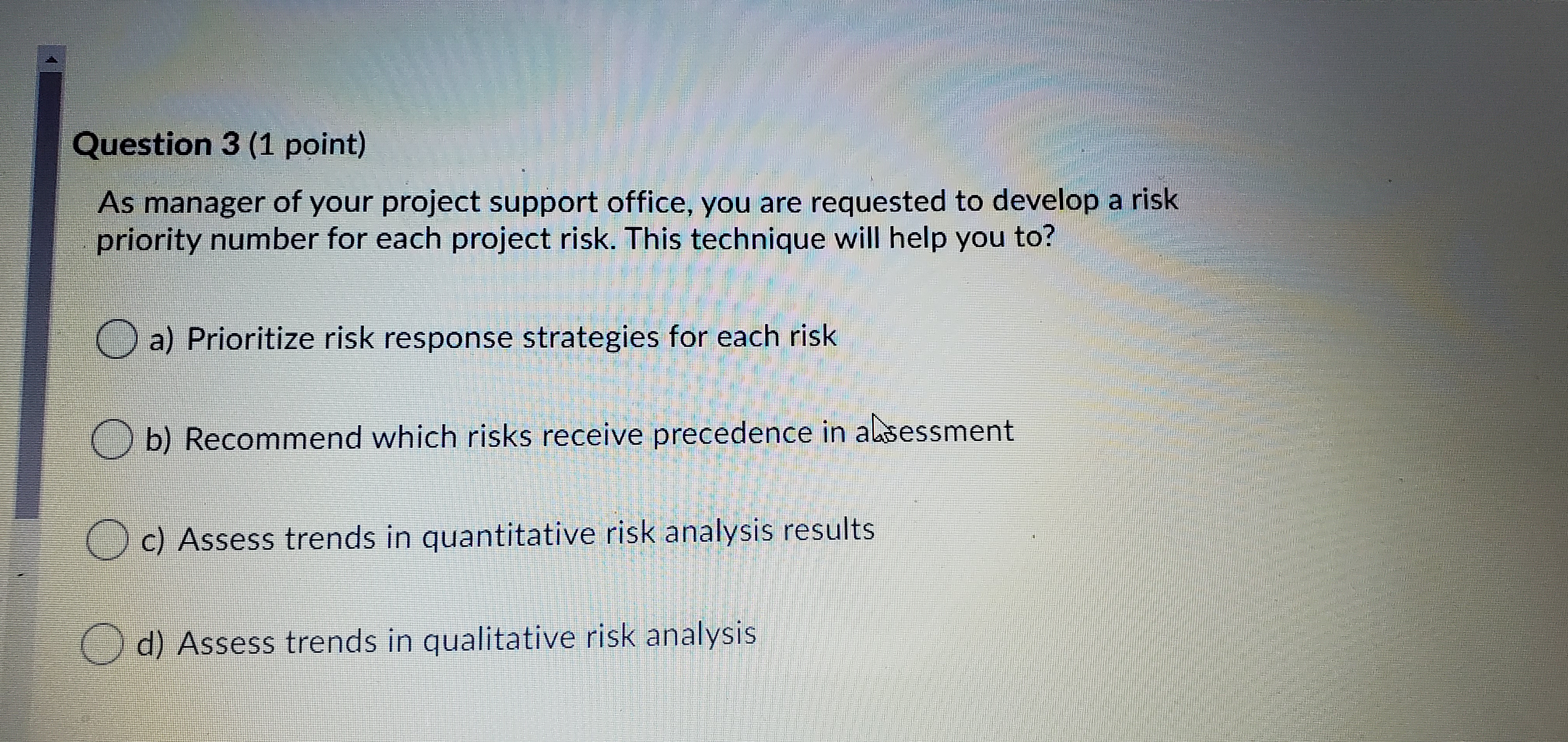
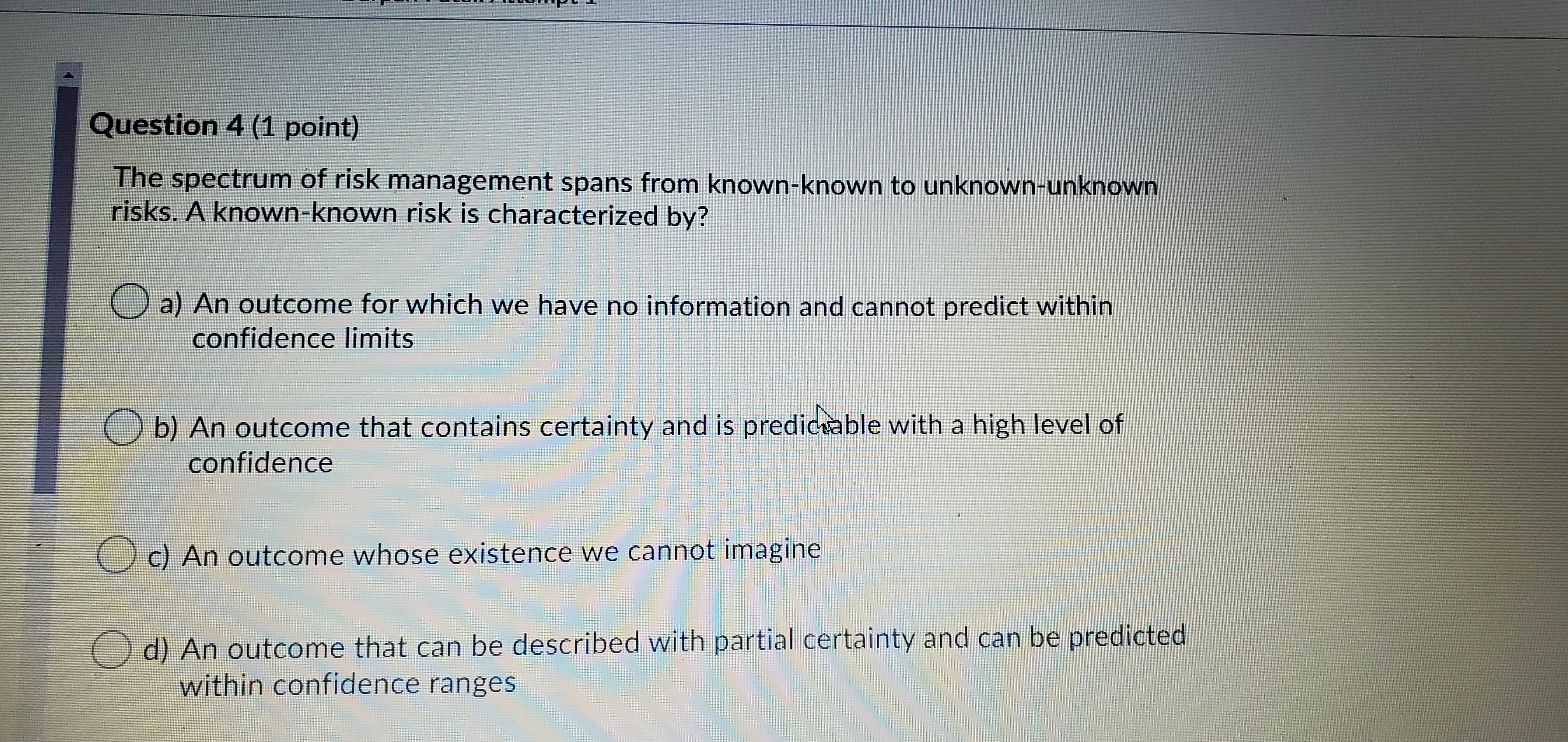
Question 1 (1 point) On a typical project, when are the risk lowest and impact (amount at stake) highest)? O a) During the concept phase ( b) During the implementation phase O c) During the planning phase O d) When the project manager is replaced "+ )Question 2 (1 point) You are working on identifying potential felt to your project to want to dinelogs comprehensive lat of riot: that can be attreated boter through qualitative and quantitative risk analysis Although a rusher of techniques can be used the technique that is not part of risk identification in' al Alll are acces Owl Reviewing lessons learned d Interviewing P lakeholders On Using a brainstor heholdersQuestion 3 (1 point) As manager of your project support office, you are requested to develop a risk priority number for each project risk. This technique will help you to? (a) Prioritize risk response strategies for each risk (b) Recommend which risks receive precedence in alsessment c) Assess trends in quantitative risk analysis results d) Assess trends in qualitative risk analysisQuestion 4 (1 point) The spectrum of risk management spans from known-known to unknown-unknown risks. A known-known risk is characterized by? Oa) An outcome for which we have no information and cannot predict within confidence limits ()b) An outcome that contains certainty and is predictable with a high level of confidence O c) An outcome whose existence we cannot imagine (d) An outcome that can be described with partial certainty and can be predicted within confidence ranges
Step by Step Solution
There are 3 Steps involved in it

Get step-by-step solutions from verified subject matter experts
 Study Help