







Question: Question 1 (1 point) Which statement concerning an object in equilibrium is FALSE ('1 The object may be moving at constant speed in a circle
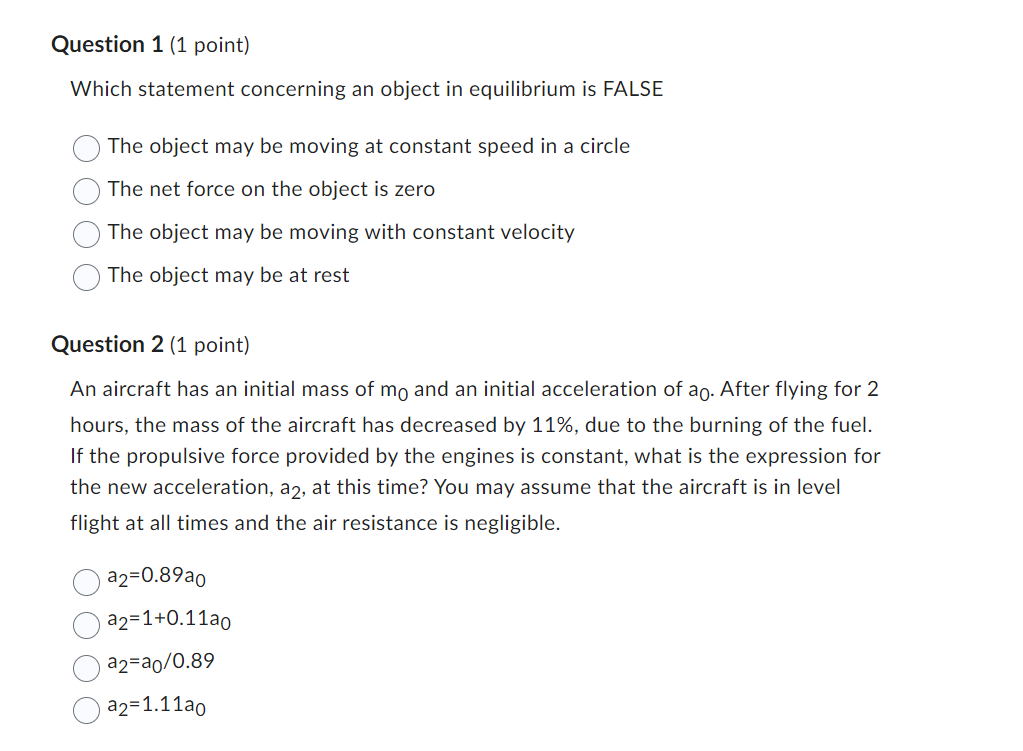
![a circle \\._./ ['5'] The net force on the object is zero](https://dsd5zvtm8ll6.cloudfront.net/si.experts.images/questions/2024/09/66fa69434b6de_97966fa694338337.jpg)
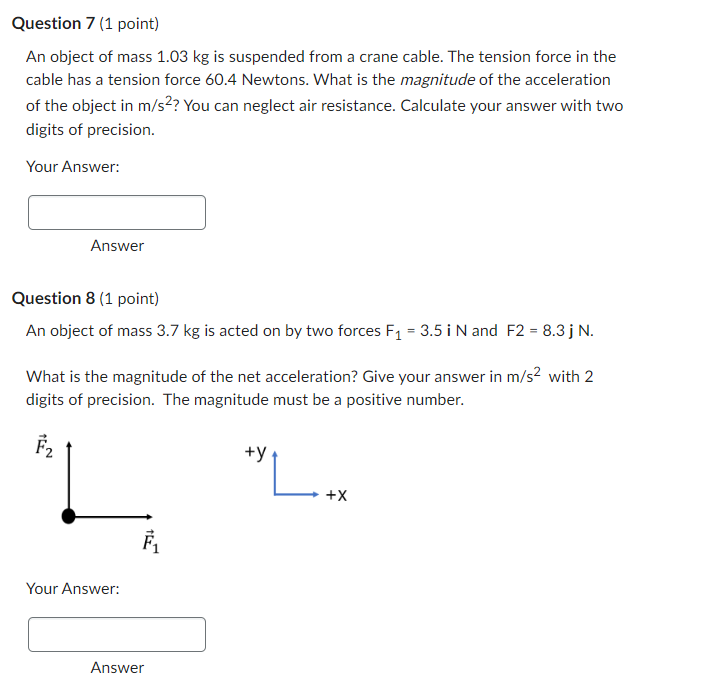
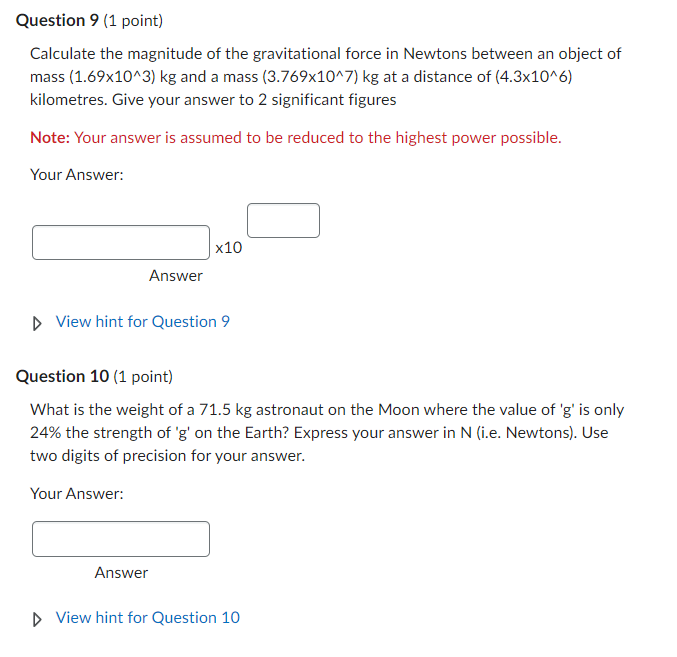
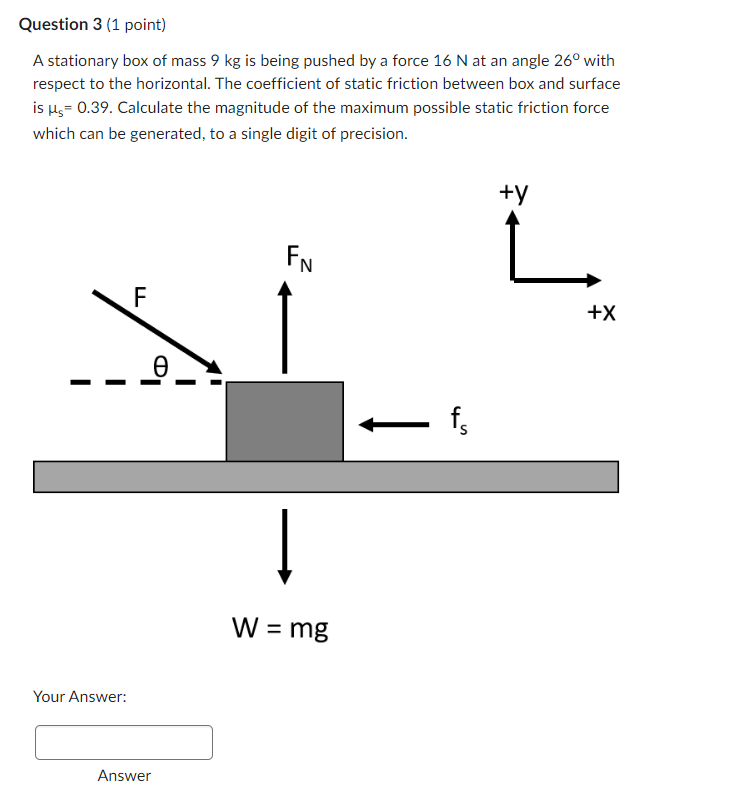
Question 1 (1 point) Which statement concerning an object in equilibrium is FALSE (\"'1 The object may be moving at constant speed in a circle \\._./ ['5'] The net force on the object is zero \\._./ (\"'1 The object may be moving with constant velocity \\H/ (\"'1 The object may be at rest \\u/ Question 2 (1 point} An aircraft has an initial mass of mo and an initial acceleration of a0. After flying for 2 hours. the mass of the aircraft has decreased by 11%, due to the burning of the fuel. If the propulsive force provided by the engines is constant, what is the expression for the new acceleration. a2, at this time? You may assume that the aircraft is in level flight at all times and the air resistance is negligible. (PK) 32:0.8930 [\\] a2=1+0.1130 (x) 32:1.1130 Question 3 {1 point] Astationary box of mass 9 kg is being pushed by a force 16 N at an angle 26\" with respect to the horizontal. The coefficient of static friction between box and Surface is p.5= 0.39. Calculate the magnitude of the maximum possible static friction force which can be generated, to a single digit of precision. \"W +X Your Answer: :] Answer Question 4 (1 point) A 15.7 kg boulder lies at the bottom of a hill. The hill is inclined at 32 degrees to the horizontal. A man applies a force to the boulder in a direction parallel to the incline such that the boulder rolls up the hill with constant velocity. Neglecting friction, what is the magnitude of the force applied to the boulder? Give your answer in Newtons, to 2 digits of precision. Your Answer: Answer D View hint for Question 4 Question 5 (1 point) You push your water bottle, mass 0.43 kg across the desk with a force of -7.2 i N. Calculate the acceleration in m/s. Neglect friction forces and give your answer with two digits of precision. (You do not need to include a unit vector i in your answer) Your Answer: Answer D View hint for Question 5 Question 6 (1 point) An object of mass 66 is acted on by two forces F1 = -28 i N and F2 - -4.5 i N. What is the net acceleration? Give your answer in m/s with two digits of precision. You do not need to enter the unit vector, or the units. Your Answer: Answer D View hint for Question 6Question 7 (1 point) An object of mass 1.03 kg is suspended from a crane cable. The tension force in the cable has a tension force 60.4 Newtons. What is the magnitude of the acceleration of the object in m/s? You can neglect air resistance. Calculate your answer with two digits of precision. Your Answer: Answer Question 8 (1 point) An object of mass 3.7 kg is acted on by two forces F1 = 3.5 i N and F2 = 8.3 j N. What is the magnitude of the net acceleration? Give your answer in m/s with 2 digits of precision. The magnitude must be a positive number. F2 +y +X Your Answer: AnswerQuestion 9 (1 point) Calculate the magnitude of the gravitational force in Newtons between an object of mass (1.69x10*3) kg and a mass (3.769x10^7) kg at a distance of (4.3x10^6) kilometres. Give your answer to 2 significant figures Note: Your answer is assumed to be reduced to the highest power possible. Your Answer: x10 Answer D View hint for Question 9 Question 10 (1 point) What is the weight of a 71.5 kg astronaut on the Moon where the value of 's' is only 24% the strength of 's' on the Earth? Express your answer in N (i.e. Newtons). Use two digits of precision for your answer. Your Answer: Answer View hint for Question 10
Step by Step Solution
There are 3 Steps involved in it

Get step-by-step solutions from verified subject matter experts
 Study Help