Question: Question 1 (1 point) Your classmate has missed several lectures and has asked if he can borrow your notes. You scan a copy using an
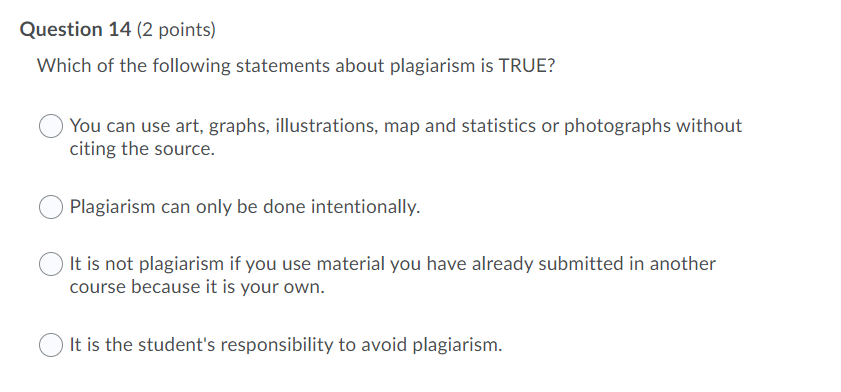
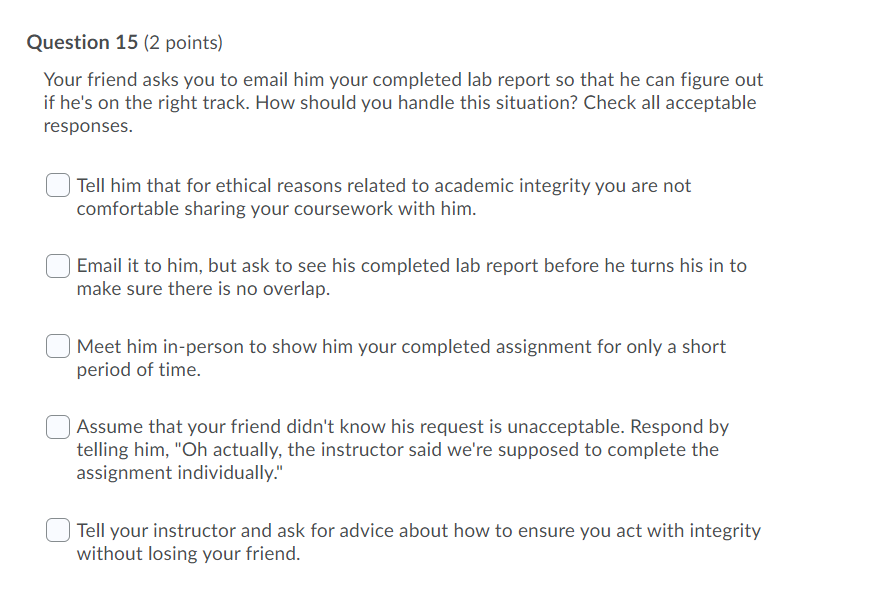
Question 1 (1 point) Your classmate has missed several lectures and has asked if he can borrow your notes. You scan a copy using an app on your phone and send the classmate the notes from the last three lectures. This is an example of academic integrity. True False Question 2 (1 point) After writing a difficult exam, you leave the examination room and you see several of your classmates who have also finished the exam discussing the questions and possible correct answers on the exam. You walk over and join in the conversation. This is a violation of academic integrity. True False Question 3 (1 point) You ask your friend to review the essay you wrote for your psychology class. Your friend identifies and corrects a few grammar and spelling errors. You edit your work based on his feedback and submit the revised essay. This is a violation of academic integrity. True False Question 4 (1 point) You buy a plagiarism-free essay from the website originalessaysforyou.ca. This is a violation of academic integrity. True False Question 5 (1 point) Your math instructor has assigned 20% of the course grade to the completion of all of the problems included in the textbook. You know that instructors from across Canada and the United States use the same textbook, and assign students the problems as homework. You decide to make some money by selling your completed problems online. This is a violation of academic integrity. True False Question 6 (1 point) You ask your friend to look over your English essay. She finds many awkward phrases and develops new arguments. You incorporate her suggestions into your essay and submit your essay for marking. This is a violation of academic integrity. True False Question 7 (1 point) For your political science class, you need to complete an online tutorial about conducting library research. Your instructor has permitted collaboration. You go to the computer lab to complete the assignment and you run into one of your classmates. The two of you sit next to each other, discussing the tutorial questions as you go. You share your answers with him. This is a violation of academic integrity. True False Question 8 (1 point) You and a group of classmates started a private Facebook study group to share resources and brainstorm ideas for a course. Following the first exam, you and several members of the private group post the questions from the exam as you remember them. The group members then discuss the answers with students who did not take the exam. This is a violation of academic integrity. True False Question 9 (1 point) Explaining Your Essay: You and a friend are in the same class. Before the essay is due, your friend asks to see your essay to make sure that he's on the right track. You tell him that you are not allowed to share your assignment with him, but offer to clarify some concepts and ideas he might be having troubles with. This is violation of academic integrity. True False Question 10 (1 point) In one of your geography classes, you have been asked to work in pairs to complete a research assignment. You do most of the research and your partner does most of the writing. You notice that a large section of the work is not cited. You figure since you did not write this section, you have not plagiarized. You turn the assignment in with both of your names on it, taking equal credit for the work. This is a violation of academic integrity. True False Question 11 (2 points) A group research project is due tomorrow, but the members of the group have been unable to gather all of the required data. One group member says that he read some statistics a while back that would support their thesis, but he can't remember the statistics precisely or the source. He suggests using what he remembers and crediting a researcher he thinks was the author. Another student in the group agrees because she thinks the instructor rarely checks sources anyway. The last group member thinks that the statistics should be included, but not cited since they are not sure who to credit. What would you do? Use the statistics and cite the reference as remembered, because the instructor rarely checks sources. Use the statistics and cite the reference after confirming the information and the source. Use the statistics but leave out the reference. It is a bad idea to attribute information to the wrong source. Use the statistics and cite the reference as remembered, which may or may not be correct. Question 12 (2 points) What are the possible consequences, official and unofficial, of academic dishonesty at Langara? Check all that apply. Loss of friendship Damage to Langara's reputation Decreased value and credibility of your credential | Zero on an assignment Failure of a course Suspension Denial of a credential Financial loss Question 13 (2 points) Which of the following is the MOST important reason for having academic integrity? It demonstrates responsibility when it comes to your academic achievements and accomplishments It demonstrates that you respect the work of others It builds trust and encourages an environment where ideas can be shared All of the above Question 14 (2 points) Which of the following statements about plagiarism is TRUE? You can use art, graphs, illustrations, map and statistics or photographs without citing the source. Plagiarism can only be done intentionally. It is not plagiarism if you use material you have already submitted in another course because it is your own. It is the student's responsibility to avoid plagiarism. Question 15 (2 points) Your friend asks you to email him your completed lab report so that he can figure out if he's on the right track. How should you handle this situation? Check all acceptable responses. Tell him that for ethical reasons related to academic integrity you are not comfortable sharing your coursework with him. Email it to him, but ask to see his completed lab report before he turns his in to make sure there is no overlap. Meet him in-person to show him your completed assignment for only a short period of time. Assume that your friend didn't know his request is unacceptable. Respond by telling him, "Oh actually, the instructor said we're supposed to complete the assignment individually." Tell your instructor and ask for advice about how to ensure you act with integrity without losing your friend




