







Question: QUESTION 1 1 points Save Answer On the rst sampling occasion you capture 54 animals. On the second sampling occasion you capture 38 animals, and
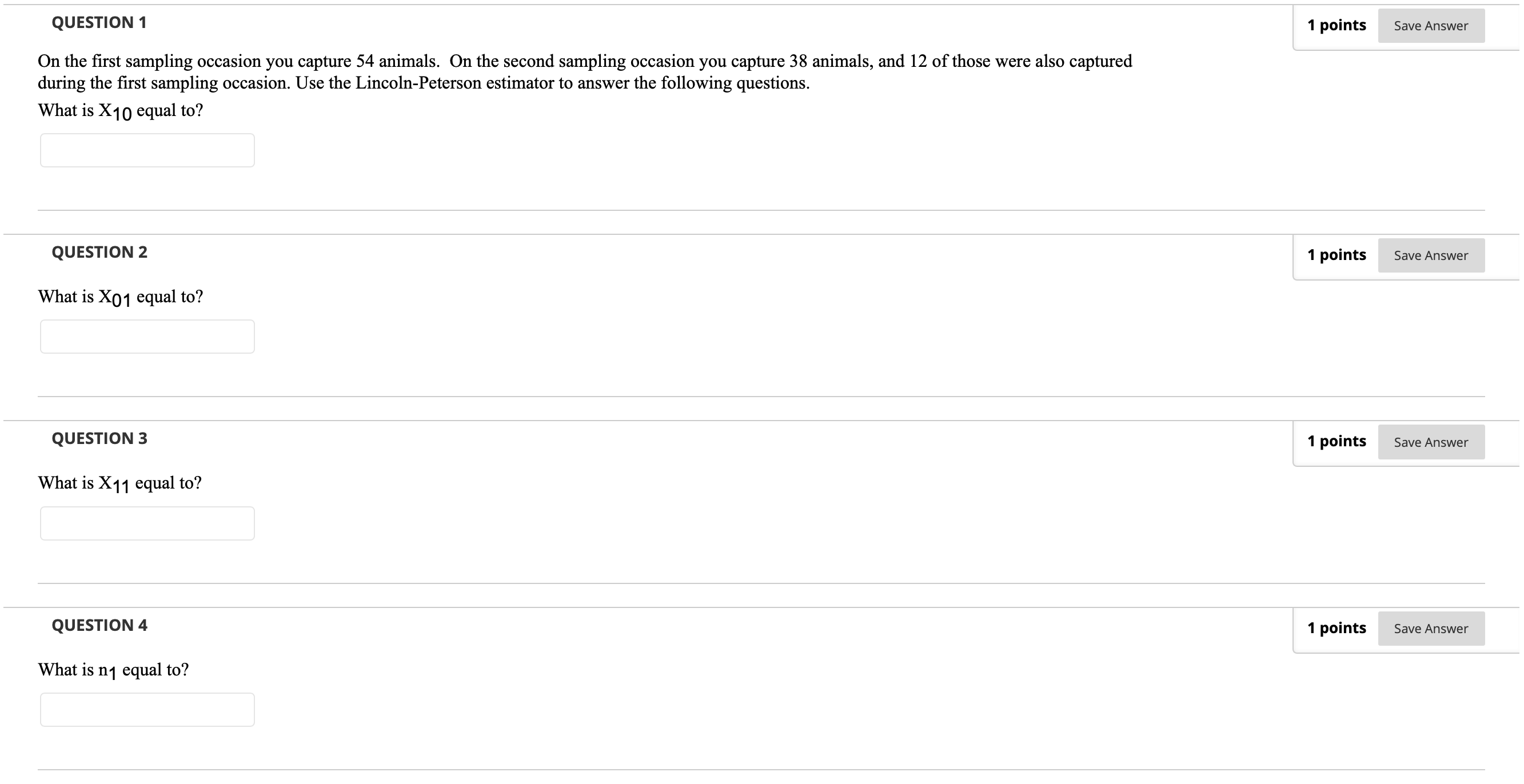
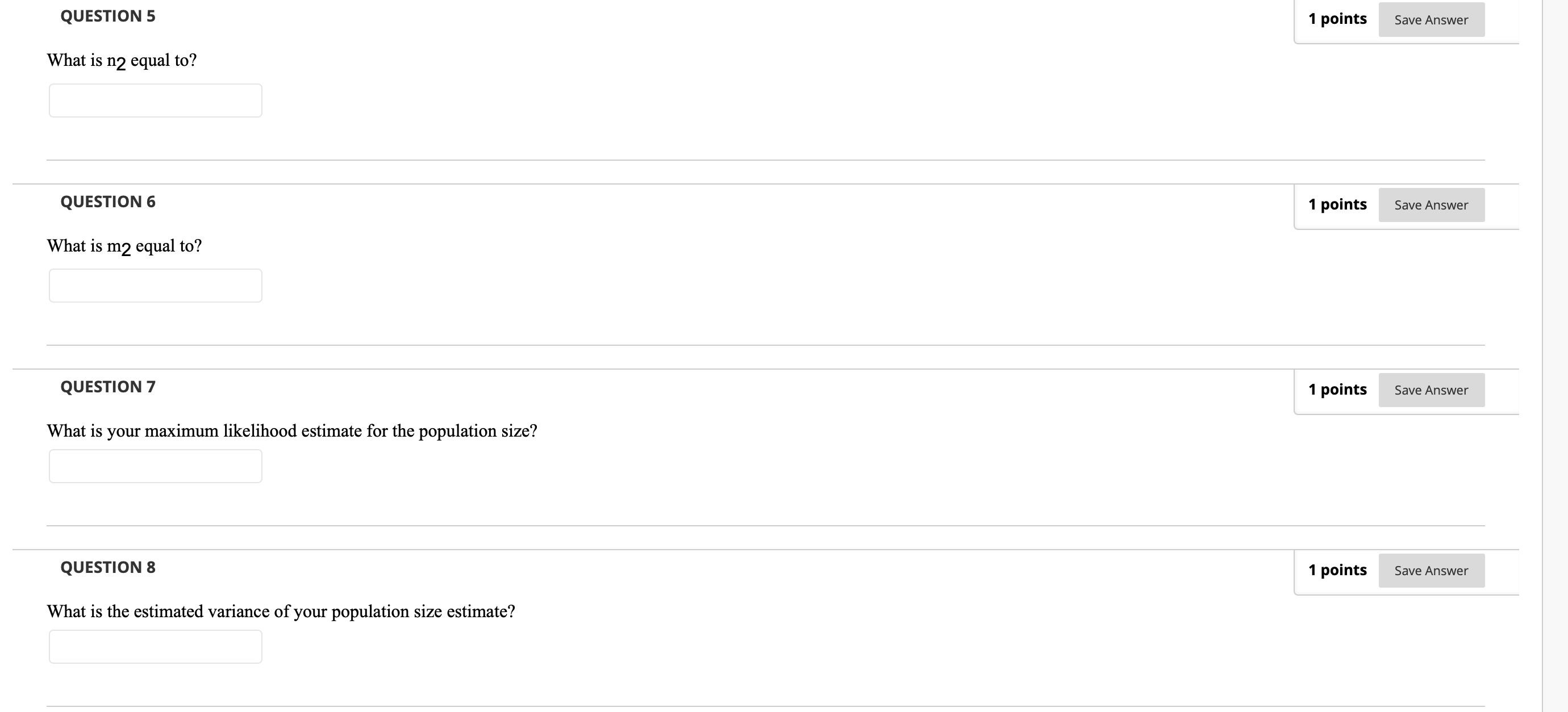
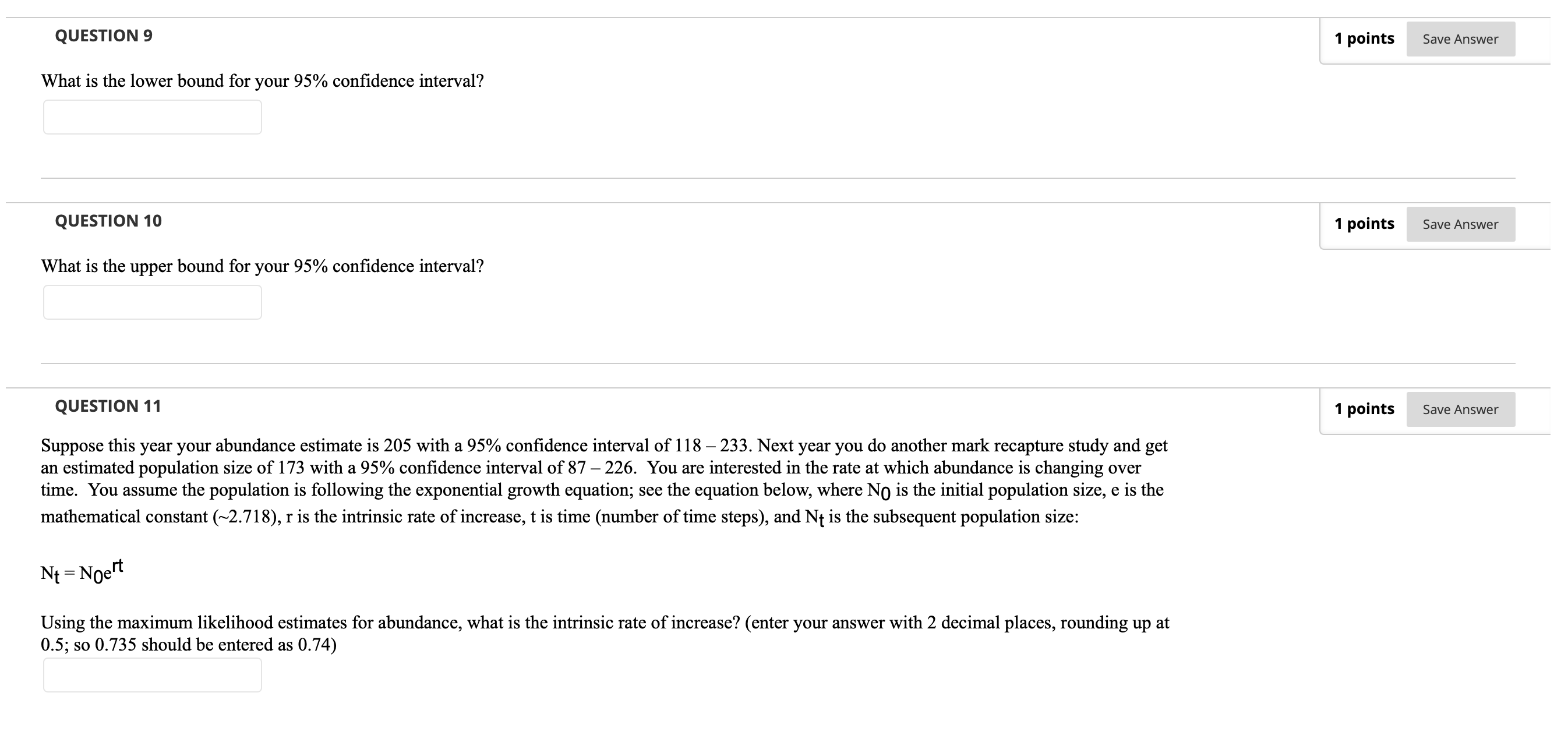
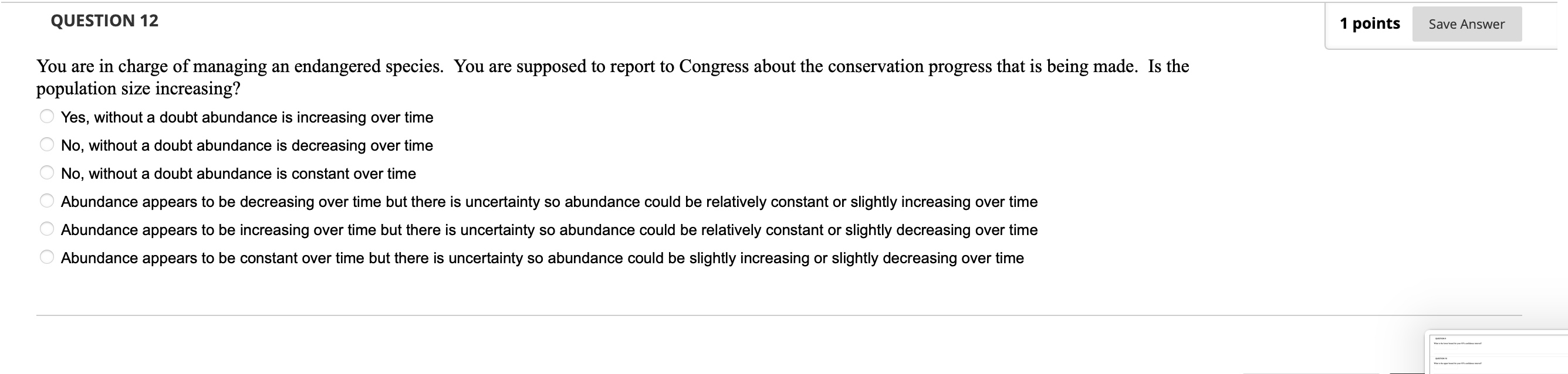
QUESTION 1 1 points Save Answer On the rst sampling occasion you capture 54 animals. On the second sampling occasion you capture 38 animals, and 12 of those were also captured during the rst sampling occasion. Use the Lincoln-Peterson estimator to answer the following questions. What is X10 equal to? QUESTION 2 1 points Save Answer What is X01 equal to? QUESTION 3 1 points Save Answer What is X11 equal to? QUESTION 4 1 points Save Answer What is n1 equal to? QUESTION 5 1 points Save Answer What is 112 equal to? QUESTION 6 1 points Save Answer What is m2 equal to? QUESTION 7 1 points Save Answer What is your maximum likelihood estimate for the population size? QUESTION 8 1 points save Answer What is the estimated vatiance of your population size estimate? QUESTION 9 1 points Save Answer What is the lower bound for your 95% condence interval? QUESTION 10 1 points Save Answer What is the upper bound for your 95% condence interval? QUESTION 11 1 points Save Answer Suppose this year your abundance estimate is 205 with a 95% condence interval of 118 233. Next year you do another mark recapture study and get an estimated population size of 173 with a 95% condence interval of 87 7 226. You are interested in the rate at which abundance is changing over time. You assume the population is following the exponential growth equation; see the equation below, Where No is the initial population size, e is the mathematical constant (~2.718), r is the intrinsic rate of increase, t is time (number of time steps), and Nt is the subsequent population size: N1 = Noe"t Using the maximum likelihood estimates for abundance, what is the intrinsic rate of increase? (enter your answer with 2 decimal places, rounding up at 0.5; so 0.735 should be entered as 0.74) QUESTION 12 1 points Save Answer You are in chm'ge of managing an endangered species. You are supposed to report to Congress about the conservation progress that is being made. Is the population size increasing? Yes, without a doubt abundance is increasing over time No, without a doubt abundance is decreasing over time No, without a doubt abundance is constant over time Abundance appears to be decreasing over time but there is uncertainty so abundance could be relatively constant or slightly increasing over time Abundance appears to be increasing over time but there is uncertainty so abundance could be relatively constant or slightly decreasing over time Abundance appears to be constant over time but there is uncertainty so abundance could be slightly increasing or slightly decreasing over time
Step by Step Solution
There are 3 Steps involved in it

Get step-by-step solutions from verified subject matter experts
 Study Help