







Question: Question 1 1 pts Suppose a stock had an initial price of $42 per share, paid a dividend of $1.83 per share during the year,
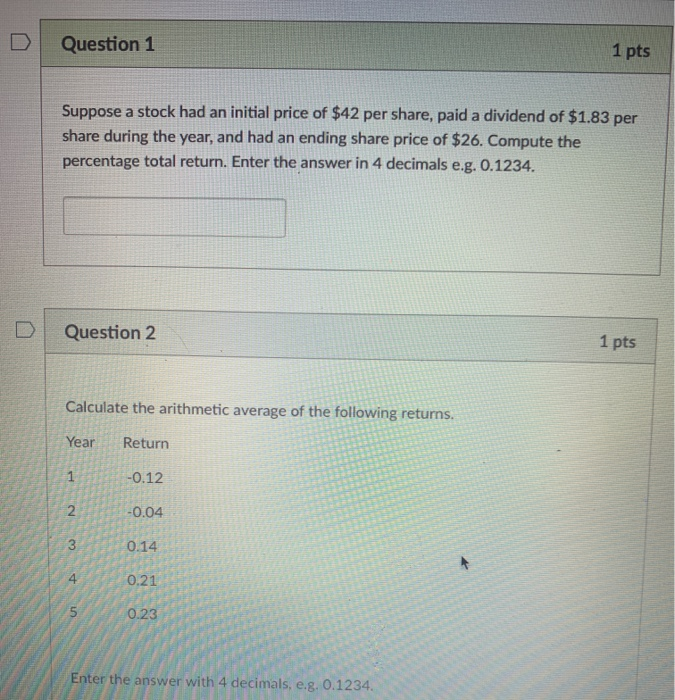
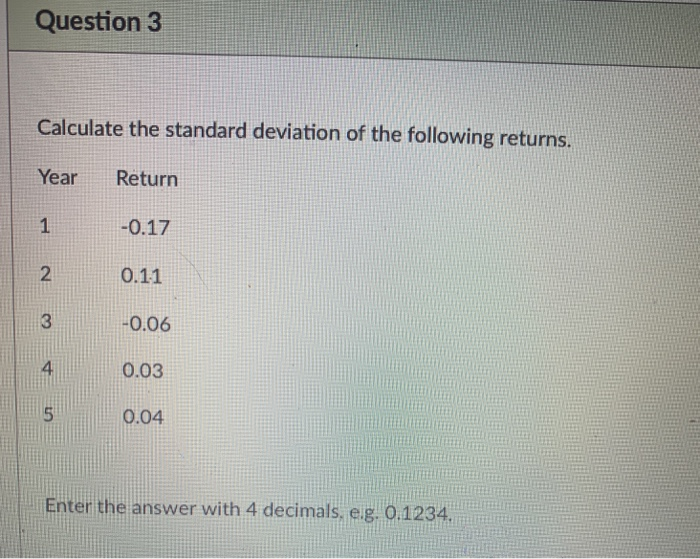
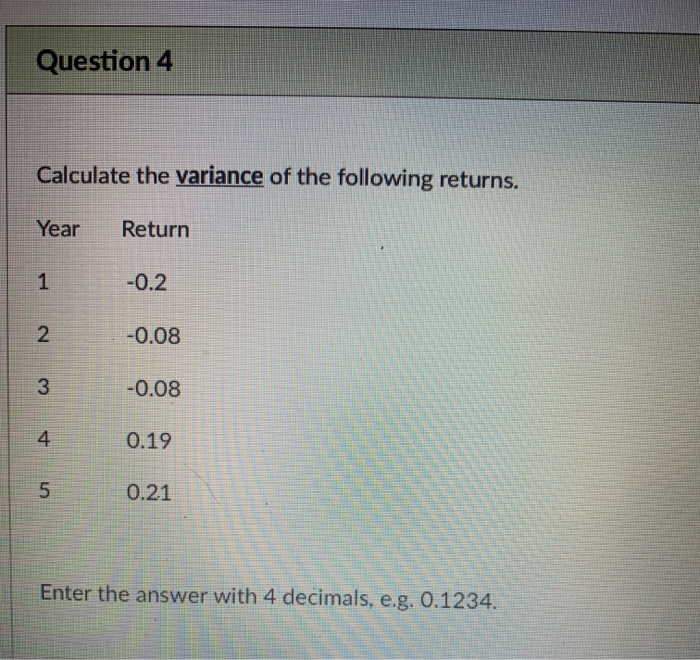
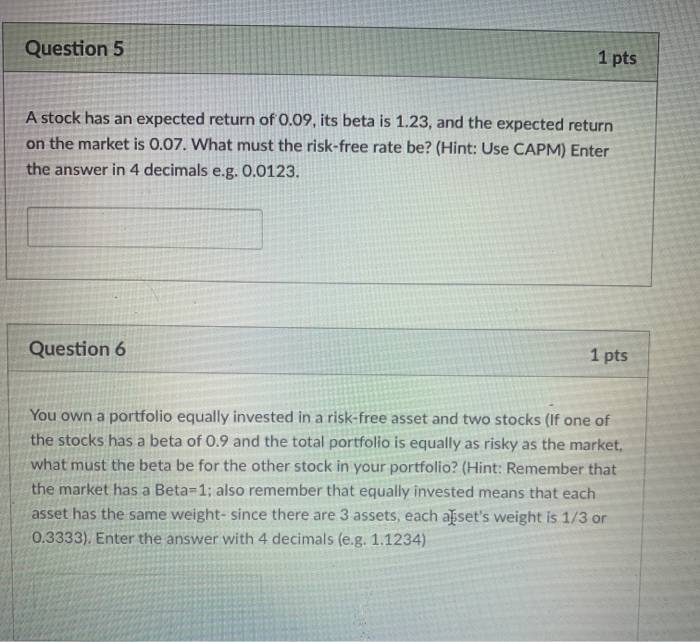
Question 1 1 pts Suppose a stock had an initial price of $42 per share, paid a dividend of $1.83 per share during the year, and had an ending share price of $26. Compute the percentage total return. Enter the answer in 4 decimals e.g. 0.1234. Question 2 1 pts Calculate the arithmetic average of the following returns. Year Return -0.12 1 2 3 -0.04 0.14 4 0.21 un 0.23 Enter the answer with 4 decimals, e.g. 0.1234. Question 3 Calculate the standard deviation of the following returns. Year Return 1 -0.17 2 0.11 3 -0.06 4 0.03 0.04 Enter the answer with 4 decimals, e.g. 0.1234. Question 4 Calculate the variance of the following returns. Year Return 1 -0.2 -0.08 N 3 -0.08 4 0.19 5 0.21 Enter the answer with 4 decimals, e.g. 0.1234. Question 5 1 pts A stock has an expected return of 0.09, its beta is 1.23, and the expected return on the market is 0.07. What must the risk-free rate be? (Hint: Use CAPM) Enter the answer in 4 decimals e.g. 0.0123. Question 6 1 pts You own a portfolio equally invested in a risk-free asset and two stocks (If one of the stocks has a beta of 0.9 and the total portfolio is equally as risky as the market, what must the beta be for the other stock in your portfolio? (Hint: Remember that the market has a Beta=1; also remember that equally invested means that each asset has the same weight- since there are 3 assets, each aliset's weight is 1/3 or 0.3333). Enter the answer with 4 decimals (e.g. 1.1234)
Step by Step Solution
There are 3 Steps involved in it

Get step-by-step solutions from verified subject matter experts
 Study Help