







Question: Question 1. (1) Write the following statement using logic symbols and quantifiers if necessary. Let A, B be two sets. Any element of a set
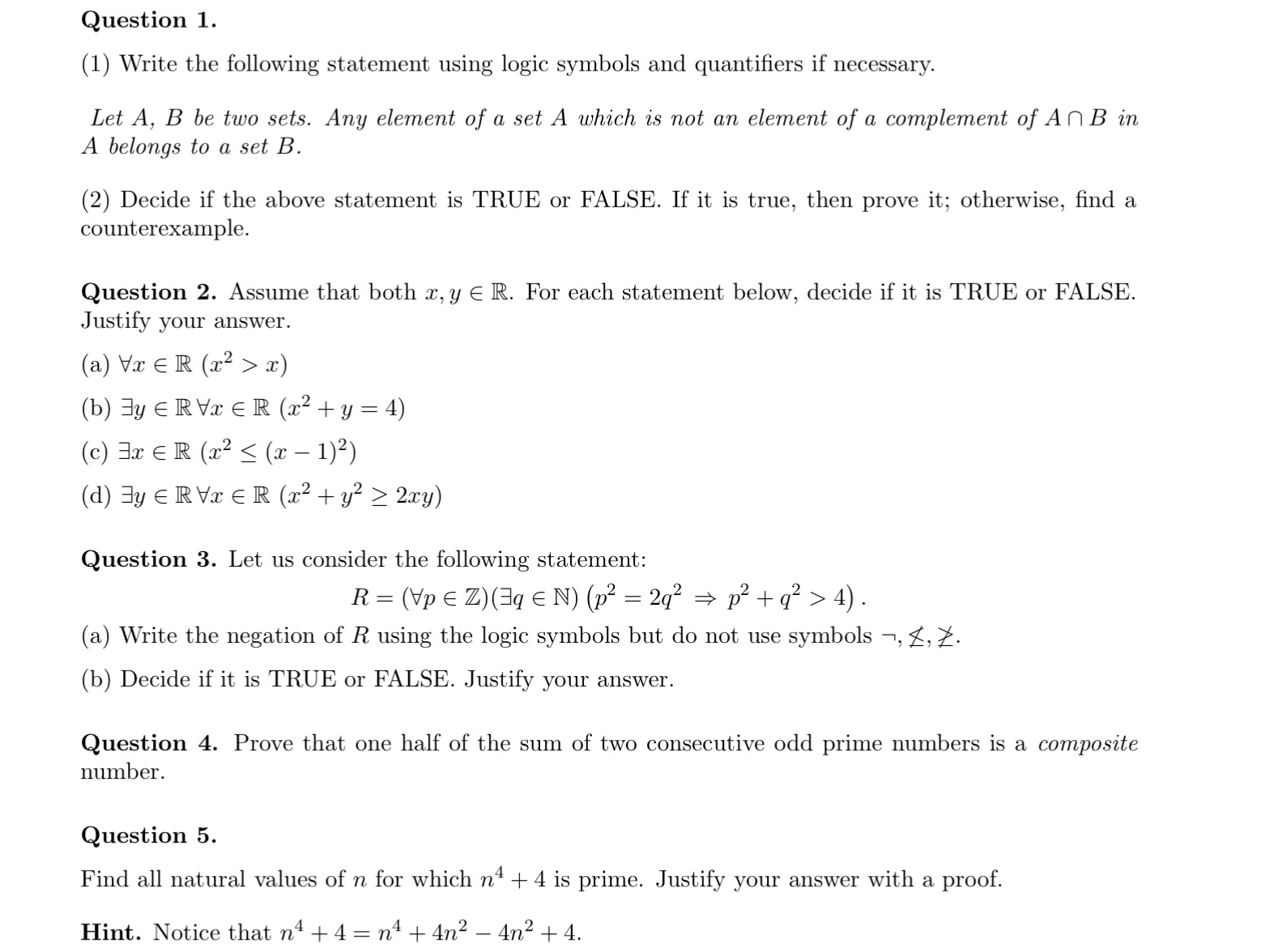
Question 1. (1) Write the following statement using logic symbols and quantifiers if necessary. Let A, B be two sets. Any element of a set A which is not an element of a complement of AN B in A belongs to a set B. (2) Decide if the above statement is TRUE or FALSE. If it is true, then prove it; otherwise, find a counterexample. Question 2. Assume that both z,y R. For each statement below, decide if it is TRUE or FALSE. Justify your answer. (a) Vz R (22 > 1) (b) IyeRVz R (22 +y =4) (c) Iz eR (22 2xy) Question 3. Let us consider the following statement: R=(VpeZ)(FqeN)(p'=2" = p* +* > 4). (a) Write the negation of R using the logic symbols but do not use symbols , , 2. (b) Decide if it is TRUE or FALSE. Justify your answer. Question 4. Prove that one half of the sum of two consecutive odd prime numbers is a composite number. Question 5. Find all natural values of n for which n' + 4 is prime. Justify your answer with a proof. Hint. Notice that n* +4 = n? + 4n? 40?2 + 4
Step by Step Solution
There are 3 Steps involved in it

Get step-by-step solutions from verified subject matter experts
 Study Help