







Question: Question 1 (10 marks) A study of exercise frequency among Canadian lawyers was conducted and resulted in a 90% confidence interval of (281, 292) for
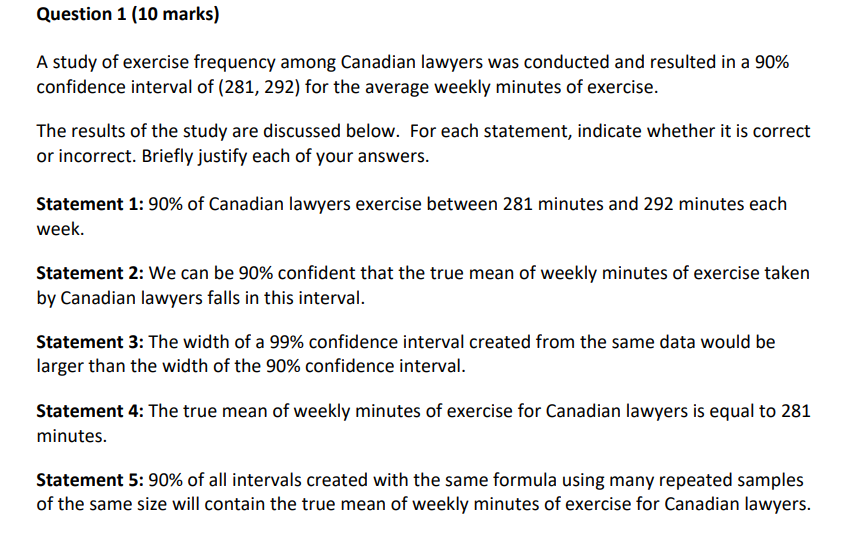
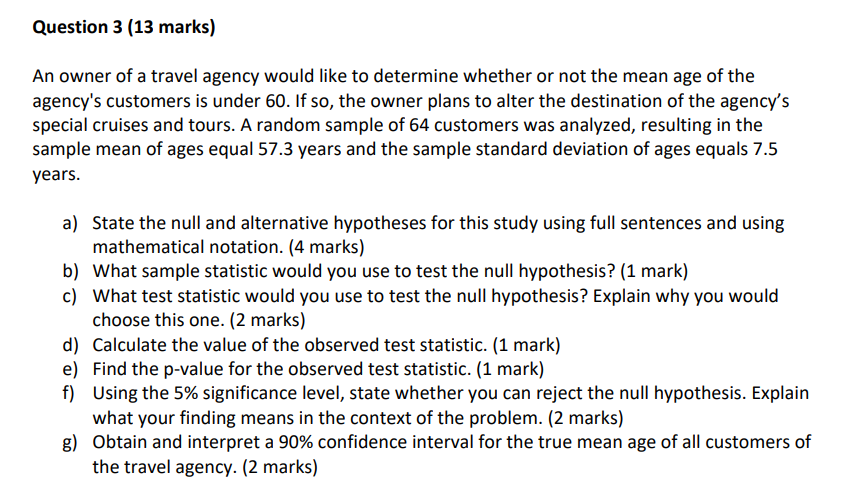
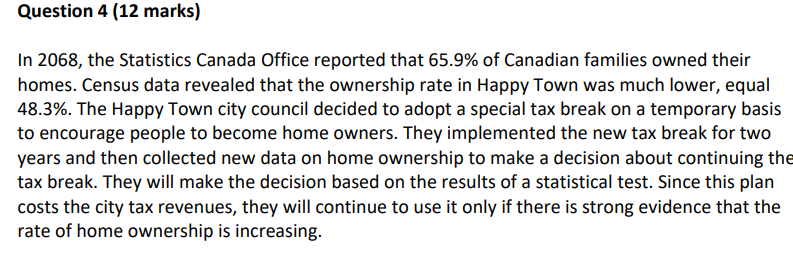
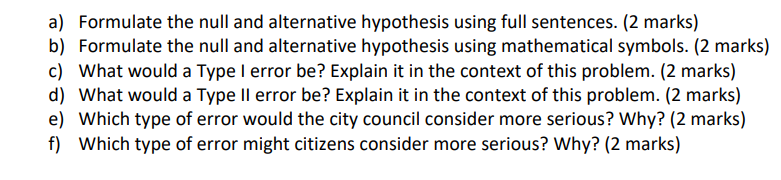
Question 1 (10 marks) A study of exercise frequency among Canadian lawyers was conducted and resulted in a 90% confidence interval of (281, 292) for the average weekly minutes of exercise. The results of the study are discussed below. For each statement, indicate whether it is correct or incorrect. Briefly justify each of your answers. Statement 1: 90% of Canadian lawyers exercise between 281 minutes and 292 minutes each week. Statement 2: We can be 90% confident that the true mean of weekly minutes of exercise taken by Canadian lawyers falls in this interval. Statement 3: The width of a 99% confidence interval created from the same data would be larger than the width of the 90% confidence interval. Statement 4: The true mean of weekly minutes of exercise for Canadian lawyers is equal to 281 minutes. Statement 5: 90% of all intervals created with the same formula using many repeated samples of the same size will contain the true mean of weekly minutes of exercise for Canadian lawyers. Question 3 (13 marks) An owner of a travel agency would like to determine whether or not the mean age of the agency's customers is under 60. If so, the owner plans to alter the destination of the agency's special cruises and tours. A random sample of 64 customers was analyzed, resulting in the sample mean of ages equal 57.3 years and the sample standard deviation of ages equals 7.5 years. a) State the null and alternative hypotheses for this study using full sentences and using mathematical notation. (4 marks) b) What sample statistic would you use to test the null hypothesis? (1 mark) ) What test statistic would you use to test the null hypothesis? Explain why you would choose this one. (2 marks) d) Calculate the value of the observed test statistic. (1 mark) e) Find the p-value for the observed test statistic. (1 mark) f) Using the 5% significance level, state whether you can reject the null hypothesis. Explain what your finding means in the context of the problem. (2 marks) g) Obtain and interpret a 90% confidence interval for the true mean age of all customers of the travel agency. (2 marks) Question 4 (12 marks) In 2068, the Statistics Canada Office reported that 65.9% of Canadian families owned their homes. Census data revealed that the ownership rate in Happy Town was much lower, equal 48.3%. The Happy Town city council decided to adopt a special tax break on a temporary basis to encourage people to become home owners. They implemented the new tax break for two years and then collected new data on home ownership to make a decision about continuing the tax break. They will make the decision based on the results of a statistical test. Since this plan costs the city tax revenues, they will continue to use it only if there is strong evidence that the rate of home ownership is increasing. Formulate the null and alternative hypothesis using full sentences. (2 marks) Formulate the null and alternative hypothesis using mathematical symbols. (2 marks) What would a Type | error be? Explain it in the context of this problem. (2 marks) What would a Type Il error be? Explain it in the context of this problem. (2 marks) Which type of error would the city council consider more serious? Why? (2 marks) Which type of error might citizens consider more serious? Why? (2 marks)
Step by Step Solution
There are 3 Steps involved in it

Get step-by-step solutions from verified subject matter experts
 Study Help