Question: Question 1 10 points Save Answer Contingency reserves are among the most common methods to mitigate project risks. The reserve is defined as the specific
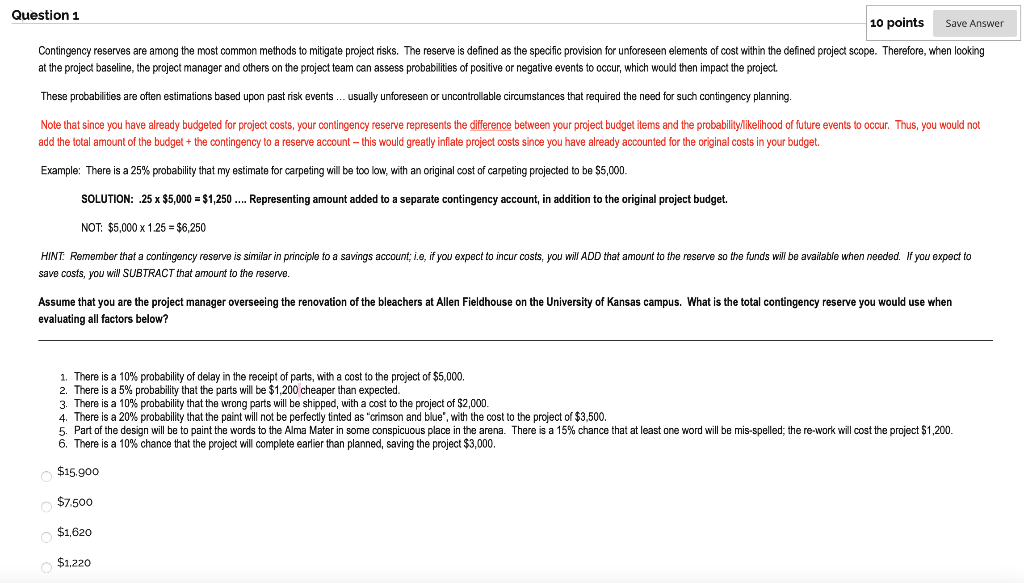
Question 1 10 points Save Answer Contingency reserves are among the most common methods to mitigate project risks. The reserve is defined as the specific provision for unforeseen elements of cost within the defined project scope. Therefore, when looking at the project baseline, the project manager and others on the project team can assess probabilities of positive or negative events to occur, which would then impact the project. These probabilities are often estimations based upon past risk events usually unforeseen or uncontrollable circumstances that required the need for such contingency planning. Note that since you have already budgeted for project costs, your contingency reserve represents the difference between your project budget items and the probability/likelihood of future events to occur. Thus, you would not add the total amount of the budget + the contingency to a reserve account - this would greatly inflate project costs since you have already accounted for the original costs in your budget. Example: There is a 25% probability that my estimate for carpeting will be too low, with an original cost of carpeting projected to be $5,000. SOLUTION: .25 x $5,000 = $1,250 .... Representing amount added to a separate contingency account, in addition to the original project budget. NOT: $5,000 x 1.25 = $6,250 HINT: Remember that a contingency reserve is similar in principle to a savings account: 1.0, if you expect to incur costs, you will ADD that amount to the reserve so the funds will be available when needed. If you expect to save costs, you will SUBTRACT that amount to the reserve. Assume that you are the project manager overseeing the renovation of the bleachers at Allen Fieldhouse on the University of Kansas campus. What is the total contingency reserve you would use when evaluating all factors below? 1. There is a 10% probability of delay in the receipt of parts, with a cost to the project of $5,000. 2. There is a 5% probability that the parts will be $1,200 cheaper than expected. 3. There is a 10% probability that the wrong parts will be shipped, with a cost to the project of $2,000. 4. There is a 20% probability that the paint will not be perfectly tinted as "crimson and blue", with the cost to the project of $3,500. 5. Part of the design will be to paint the words to the Alma Mater in some conspicuous place in the arena. There is a 15% chance that at least one word will be mis-spelled; the re-work will cost the project $1,200. 6. There is a 10% chance that the project will complete earlier than planned, saving the project $3,000. $15.900 $7.500 $1,620 $1,220









 Study Help