







Question: QUESTION 1 10 points Save Answer When applying the MIRR approach to determine the external rate of return of a project, which of the following
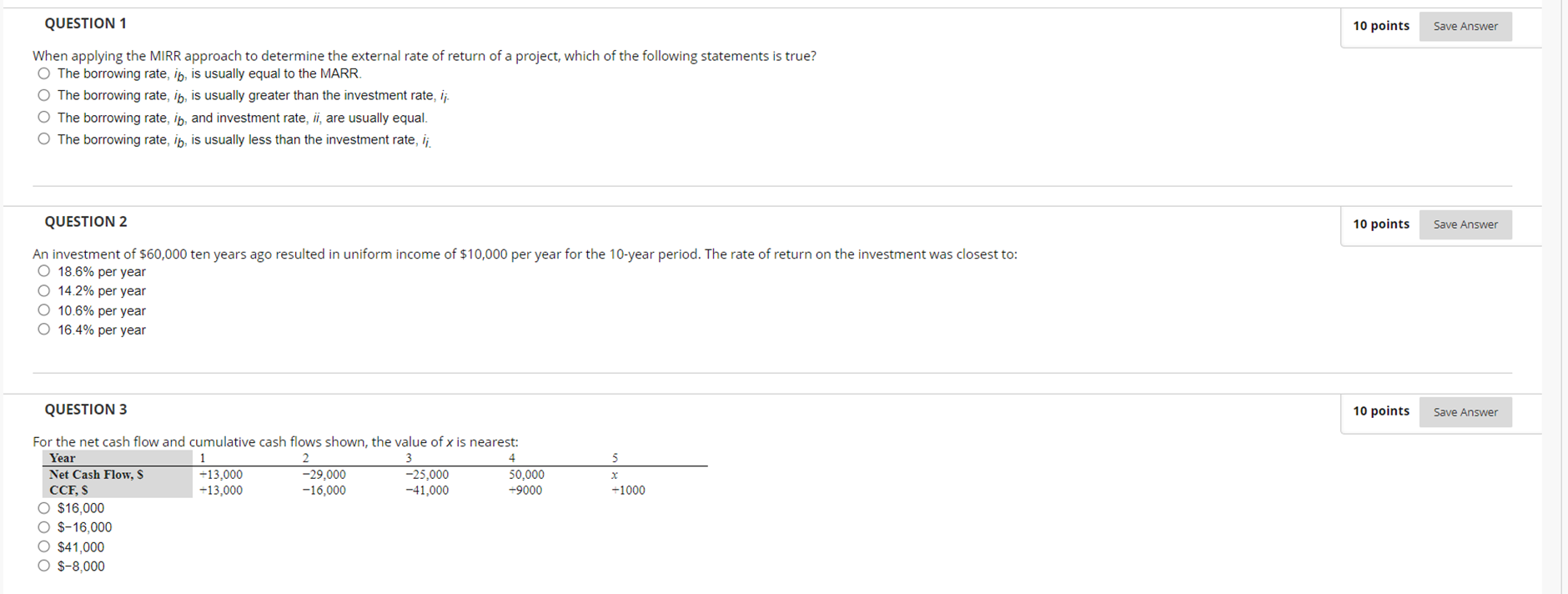
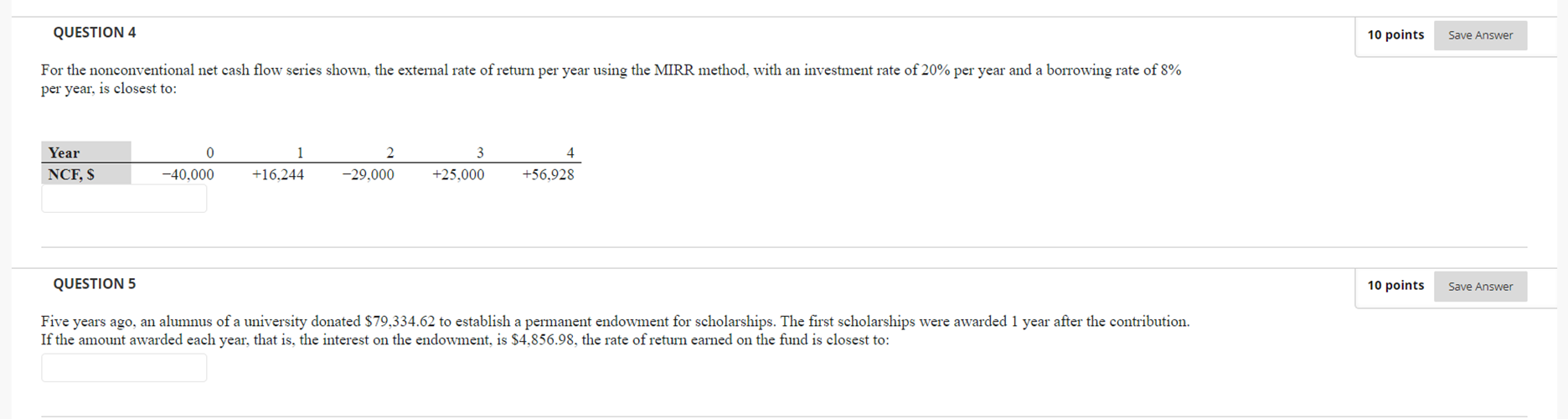
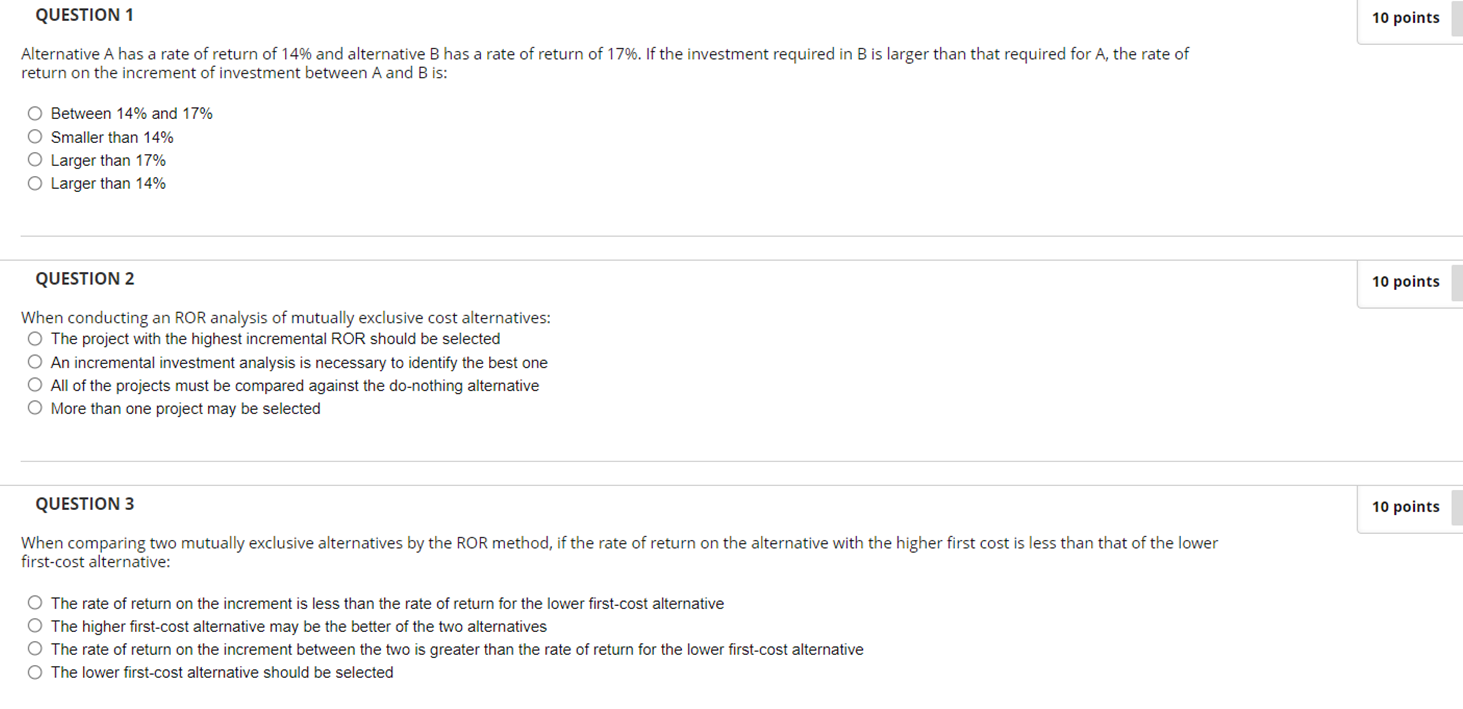
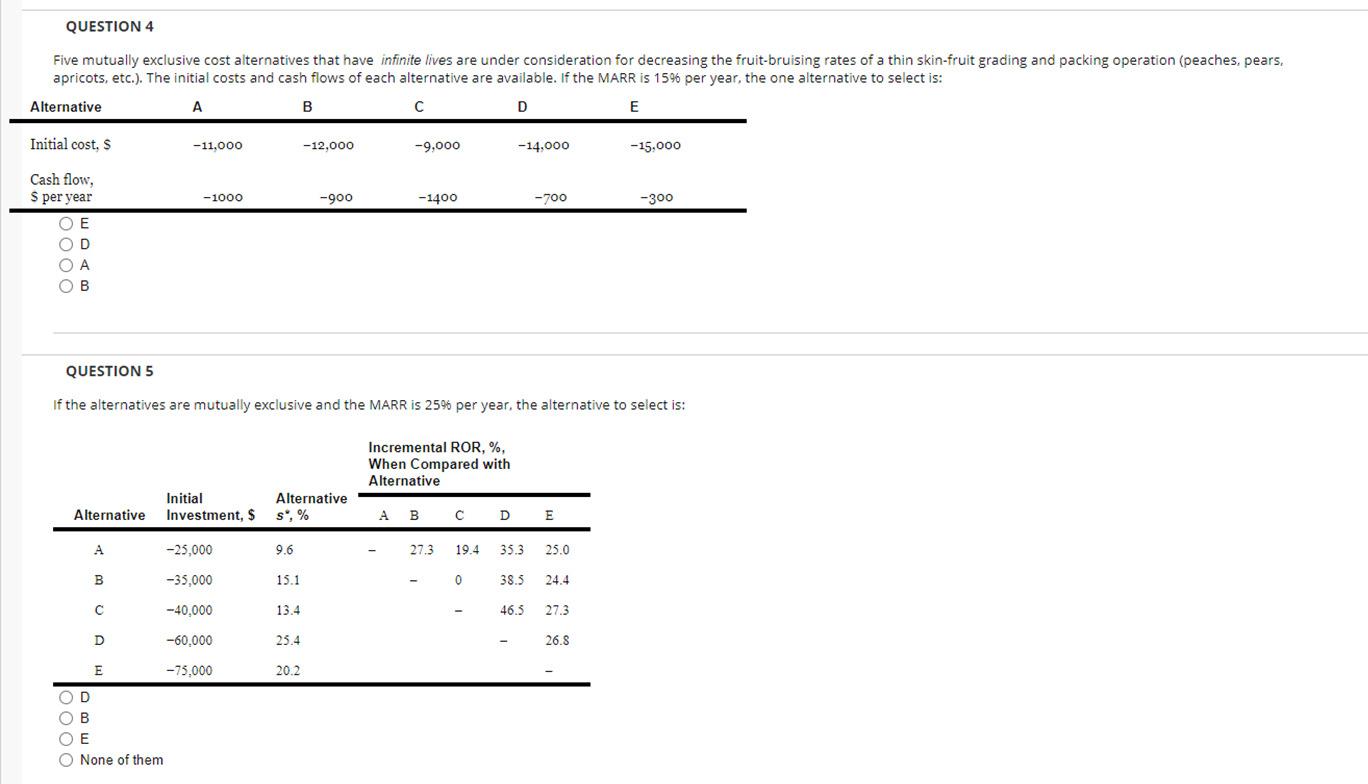
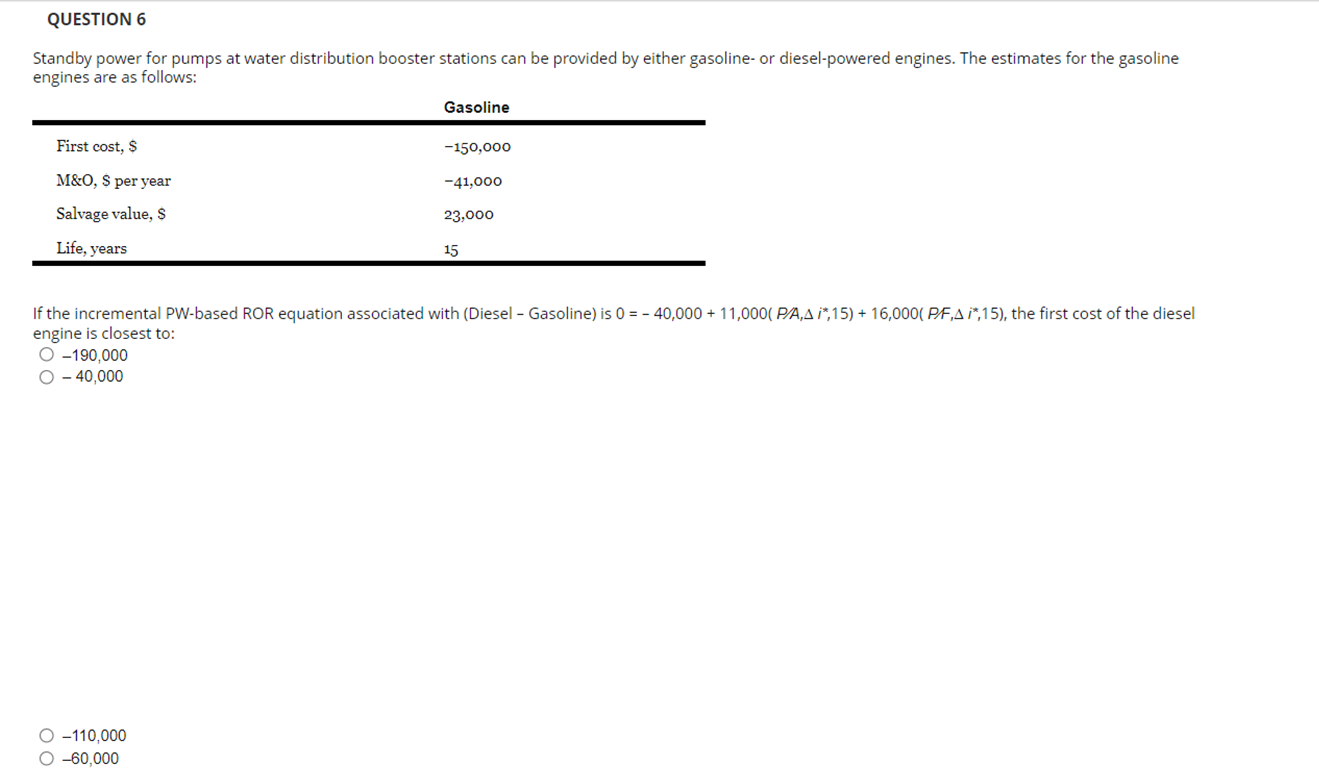
QUESTION 1 10 points Save Answer When applying the MIRR approach to determine the external rate of return of a project, which of the following statements is true? O The borrowing rate, ib, is usually equal to the MARR. O The borrowing rate, ib, is usually greater than the investment rate, ij. The borrowing rate, in, and investment rate, ii, are usually equal. O The borrowing rate, ib, is usually less than the investment rate, ij QUESTION 2 10 points Save Answer An investment of $60,000 ten years ago resulted in uniform income of $10,000 per year for the 10-year period. The rate of return on the investment was closest to: O 18.6% per year O 14.2% per year O 10.6% per year O 16.4% per year QUESTION 3 10 points Save Answer For the net cash flow and cumulative cash flows shown, the value of x is nearest: Year 1 2 3 5 Net Cash Flow, S +13,000 -29,000 -25,000 50,000 x CCF, S +13,000 -16,000 -41,000 +9000 +1000 O $16,000 O $-16,000 O $41,000 O $-8,000QUESTION 4 10 points Save Answer For the nonconventional net cash flow series shown, the external rate of return per year using the MIRR method, with an investment rate of 20% per year and a borrowing rate of 8% per year, is closest to: Year 0 2 3 NCF, $ -40.000 +16,244 -29,000 +25.000 +56.928 QUESTION 5 10 points Save Answer Five years ago, an alumnus of a university donated $79,334.62 to establish a permanent endowment for scholarships. The first scholarships were awarded 1 year after the contribution. If the amount awarded each year, that is, the interest on the endowment, is $4,856.98, the rate of return earned on the fund is closest to:QUESTION 1 10 points Alternative A has a rate of return of 14% and alternative B has a rate of return of 17%. If the investment required in B is larger than that required for A, the rate of return on the increment of investment between A and B is: Between 14% and 17% O Smaller than 14% O Larger than 17% O Larger than 14% QUESTION 2 10 points When conducting an ROR analysis of mutually exclusive cost alternatives: O The project with the highest incremental ROR should be selected O An incremental investment analysis is necessary to identify the best one O All of the projects must be compared against the do-nothing alternative O More than one project may be selected QUESTION 3 10 points When comparing two mutually exclusive alternatives by the ROR method, if the rate of return on the alternative with the higher first cost is less than that of the lower first-cost alternative: The rate of return on the increment is less than the rate of return for the lower first-cost alternative O The higher first-cost alternative may be the better of the two alternatives The rate of return on the increment between the two is greater than the rate of return for the lower first-cost alternative O The lower first-cost alternative should be selectedQUESTION 4 Five mutually exclusive cost alternatives that have infinite lives are under consideration for decreasing the fruit-bruising rates of a thin skin-fruit grading and packing operation (peaches, pears, apricots, etc.). The initial costs and cash flows of each alternative are available. If the MARR is 15% per year, the one alternative to select is: Alternative A B C D E Initial cost, $ -11,000 -12,000 -9,000 -14,000 -15,000 Cash flow, $ per year -1000 -900 -1400 -700 -300 OE OD OA O B QUESTION 5 If the alternatives are mutually exclusive and the MARR is 25% per year, the alternative to select is: Incremental ROR, %, When Compared with Alternative Initial Alternative Alternative Investment, $ S', % A B C D E A -25,000 9.6 27.3 19.4 35.3 25.0 B -35,000 15.1 0 38.5 24.4 C -40,000 13.4 46.5 27.3 D -60,000 25.4 26.8 E -75,000 20.2 OD OB OE O None of themQUESTION 6 Standby power for pumps at water distribution booster stations can be provided by either gasoline or diesel-powered engines. The estimates for the gasoline engines are as follows: Gasoline First cost, S 150,000 MW, 5 per year -41.,ooo Salvage. value, 3 23,000 Life,yea.rs 15 If the incremental PW-based ROR equation associated with (Diesel Gasoline) is 0 = 40,000 + 11,000( BAA i",15) + 16,000( BEA 1".1 5], the first cost of the diesel engine is closest to: 0 490000 0 40000 0 410,000 C) 450,000
Step by Step Solution
There are 3 Steps involved in it

Get step-by-step solutions from verified subject matter experts
 Study Help