







Question: QUESTION 1 100 points Save Answer 1. Sulloway and Zweigenhaft (2010) examined the relationship between birth order and risk taking among major league baseball players.
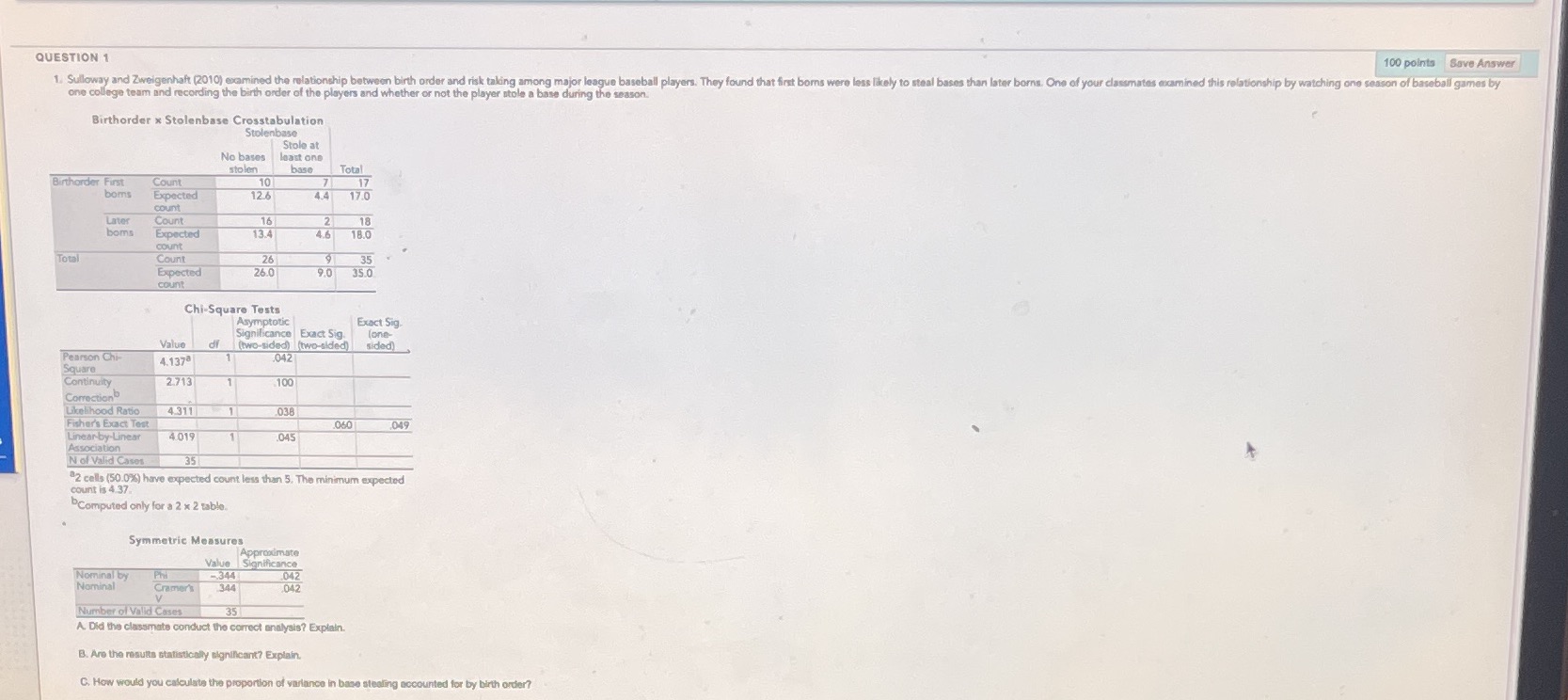
QUESTION 1 100 points Save Answer 1. Sulloway and Zweigenhaft (2010) examined the relationship between birth order and risk taking among major league baseball players. They found that first borns were less likely to steal bases than later borns. One of your classmates examined this relationship by watching one season of baseball games by one college team and recording the birth order of the players and whether or not the player stole a base during the season. Birthorder x Stolenbase Crosstabulation Stolenbase Stole at No bases least one stolen base Total Birthorder First Count 10 bom Expected 12 6 4.4 17.0 count Later Count 16 2 18 boms Expected 13.4 4.6 180 count Tota Count 26 9 35 Expected 26.0 9.0 350 count Chi-Square Tests Asymptotic Exact Sig Significance Exact Sig. (one Value (two-sided) (two-sided) sided) Pearson Chi 4.137 042 Square Continuity 2.713 100 Correction Likelihood Ratio 4.311 .038 Fisher's Exact Test 060 Linear-by Linear 4.019 .045 Association N of Valid Cas #2 cells (50.0%%) have expected count less than 5. The minimum expected count is 4.37. Computed only for a 2 x 2 table. Symmetric Measures Approximate Value Significance Nominal by Phi - 344 042 Nominal Cramer's 344 042 Number of Valid Cases A. Did the classmate conduct the correct analysis? Explain. B. Are the results statistically significant? Explain. C. How would you calculate the proportion of variance in base stealing accounted for by birth order
Step by Step Solution
There are 3 Steps involved in it

Get step-by-step solutions from verified subject matter experts
 Study Help