







Question: QUESTION 1 1.1 Engineering Quality Planning and Management makes use of discipline specific terminology or jargon to precisely define activities, concepts, and principles as applied
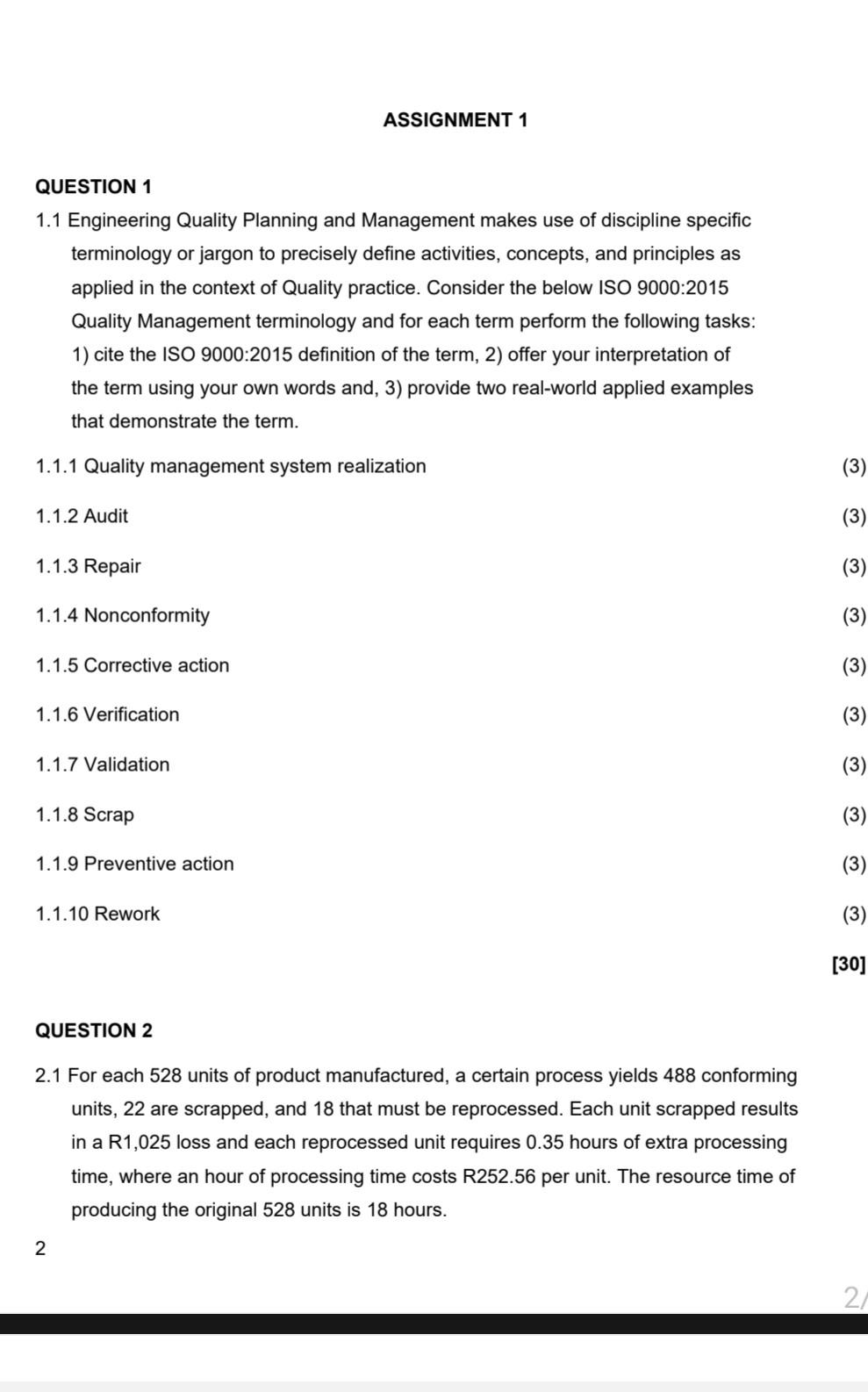
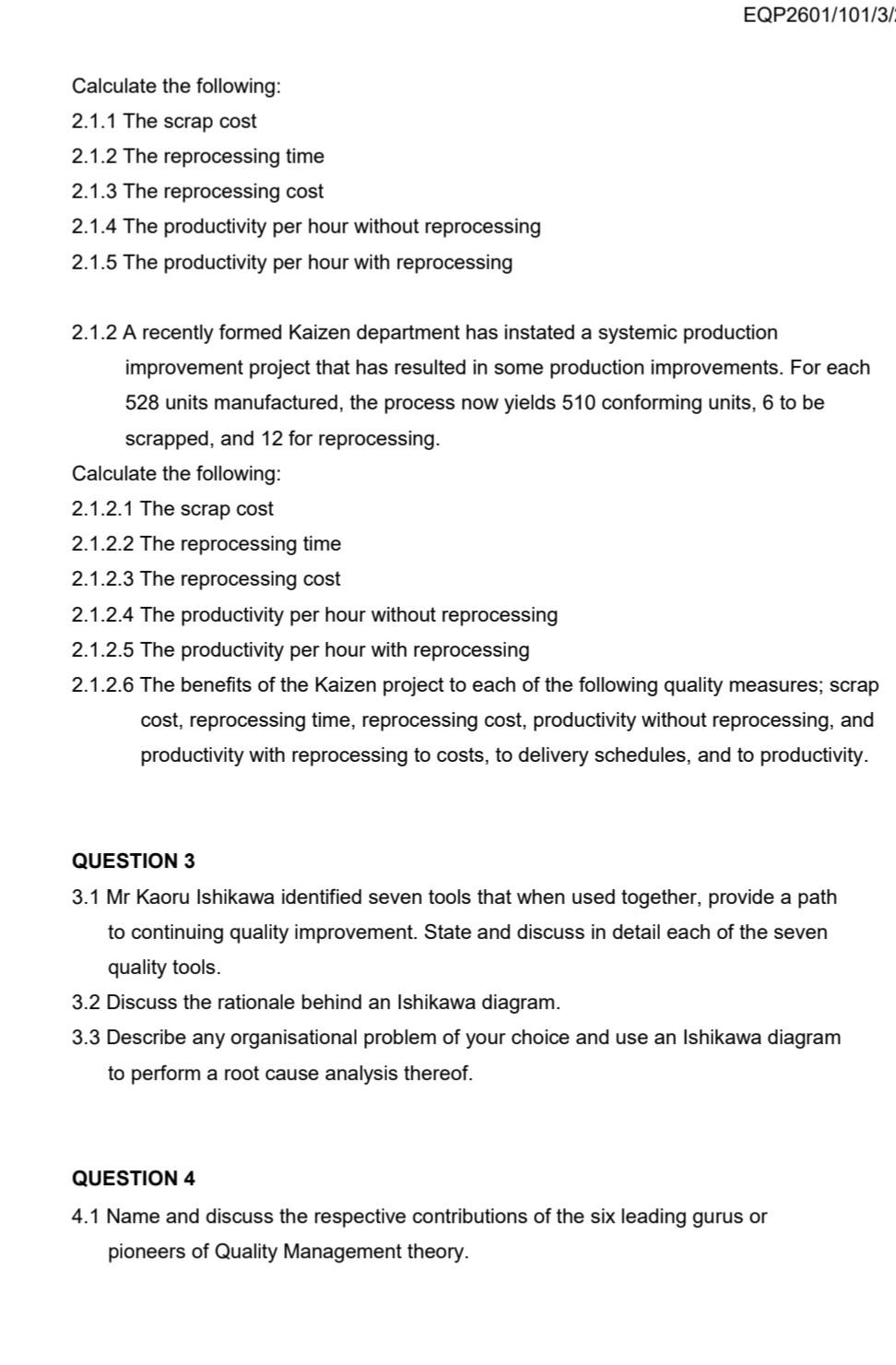
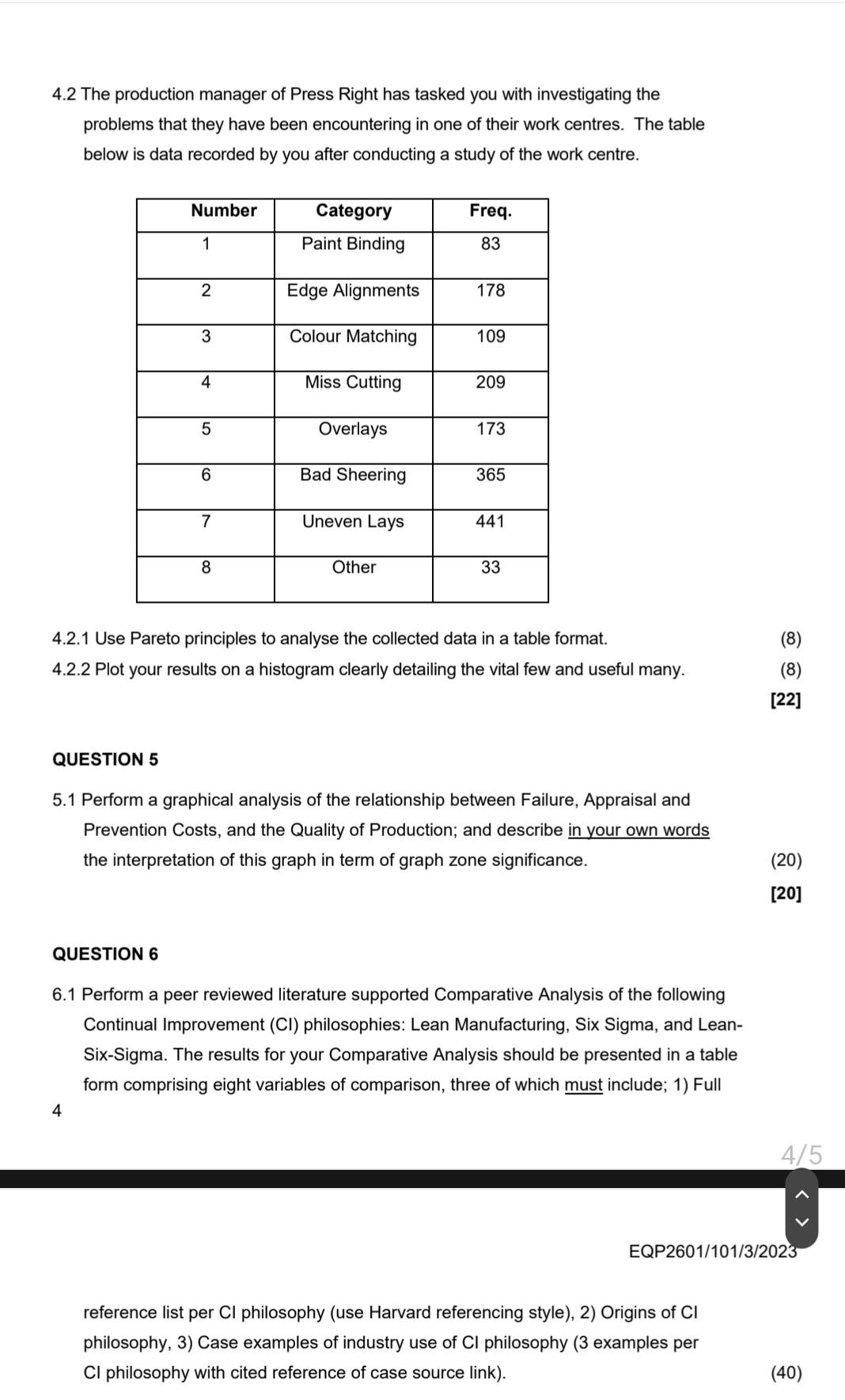
QUESTION 1 1.1 Engineering Quality Planning and Management makes use of discipline specific terminology or jargon to precisely define activities, concepts, and principles as applied in the context of Quality practice. Consider the below ISO 9000:2015 Quality Management terminology and for each term perform the following tasks: 1) cite the ISO \\( 9000: 2015 \\) definition of the term, 2) offer your interpretation of the term using your own words and, 3) provide two real-world applied examples that demonstrate the term. 1.1.1 Quality management system realization 1.1.2 Audit 1.1.3 Repair 1.1.4 Nonconformity 1.1.5 Corrective action 1.1.6 Verification 1.1.7 Validation 1.1.8 Scrap 1.1.9 Preventive action 1.1.10 Rework [30] QUESTION 2 2.1 For each 528 units of product manufactured, a certain process yields 488 conforming units, 22 are scrapped, and 18 that must be reprocessed. Each unit scrapped results in a \\( \\mathrm{R} 1,025 \\) loss and each reprocessed unit requires 0.35 hours of extra processing time, where an hour of processing time costs R252.56 per unit. The resource time of producing the original 528 units is 18 hours. Calculate the following: 2.1.1 The scrap cost 2.1.2 The reprocessing time 2.1.3 The reprocessing cost 2.1.4 The productivity per hour without reprocessing 2.1.5 The productivity per hour with reprocessing 2.1.2 A recently formed Kaizen department has instated a systemic production improvement project that has resulted in some production improvements. For each 528 units manufactured, the process now yields 510 conforming units, 6 to be scrapped, and 12 for reprocessing. Calculate the following: 2.1.2.1 The scrap cost 2.1.2.2 The reprocessing time 2.1.2.3 The reprocessing cost 2.1.2.4 The productivity per hour without reprocessing 2.1.2.5 The productivity per hour with reprocessing 2.1.2.6 The benefits of the Kaizen project to each of the following quality measures; scrap cost, reprocessing time, reprocessing cost, productivity without reprocessing, and productivity with reprocessing to costs, to delivery schedules, and to productivity. QUESTION 3 3.1 Mr Kaoru Ishikawa identified seven tools that when used together, provide a path to continuing quality improvement. State and discuss in detail each of the seven quality tools. 3.2 Discuss the rationale behind an Ishikawa diagram. 3.3 Describe any organisational problem of your choice and use an Ishikawa diagram to perform a root cause analysis thereof. QUESTION 4 4.1 Name and discuss the respective contributions of the six leading gurus or pioneers of Quality Management theory. 4.2 The production manager of Press Right has tasked you with investigating the problems that they have been encountering in one of their work centres. The table below is data recorded by you after conducting a study of the work centre. 4.2.1 Use Pareto principles to analyse the collected data in a table format. 4.2.2 Plot your results on a histogram clearly detailing the vital few and useful many. QUESTION 5 5.1 Perform a graphical analysis of the relationship between Failure, Appraisal and Prevention Costs, and the Quality of Production; and describe in your own words the interpretation of this graph in term of graph zone significance. QUESTION 6 6.1 Perform a peer reviewed literature supported Comparative Analysis of the following Continual Improvement \\( (\\mathrm{Cl}) \\) philosophies: Lean Manufacturing, Six Sigma, and LeanSix-Sigma. The results for your Comparative Analysis should be presented in a table form comprising eight variables of comparison, three of which must include; 1) Full 4 EQP2601/101/3/202 reference list per \\( \\mathrm{Cl} \\) philosophy (use Harvard referencing style), 2) Origins of \\( \\mathrm{Cl} \\) philosophy, 3) Case examples of industry use of \\( \\mathrm{Cl} \\) philosophy (3 examples per \\( \\mathrm{Cl} \\) philosophy with cited reference of case source link)
Step by Step Solution
There are 3 Steps involved in it

Get step-by-step solutions from verified subject matter experts
 Study Help