







Question: Question 1 (12 marks) Consider a consumer choosing the level of consumption for three periods to maximise utility. The intertemporal utility function is lnco +
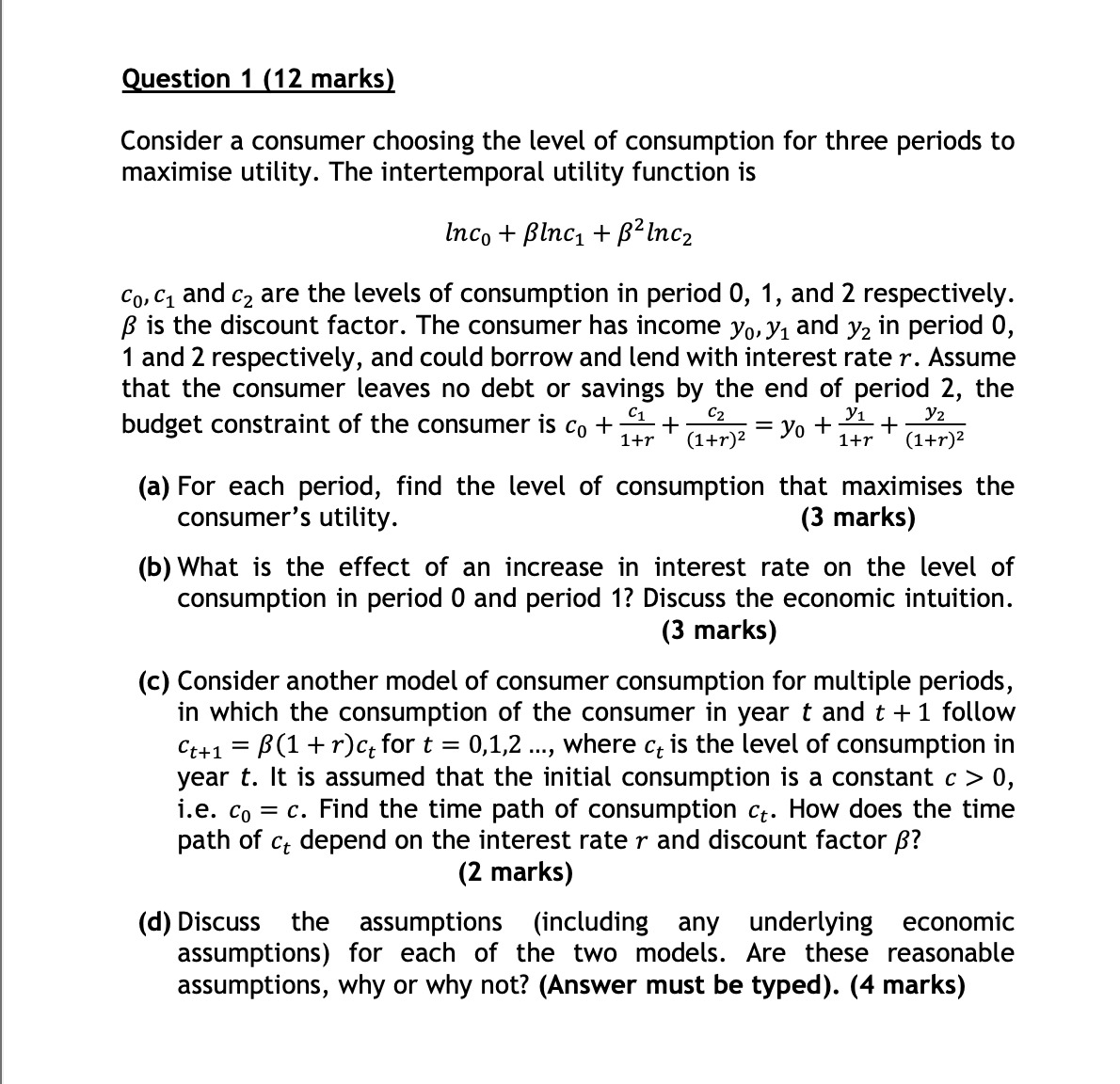
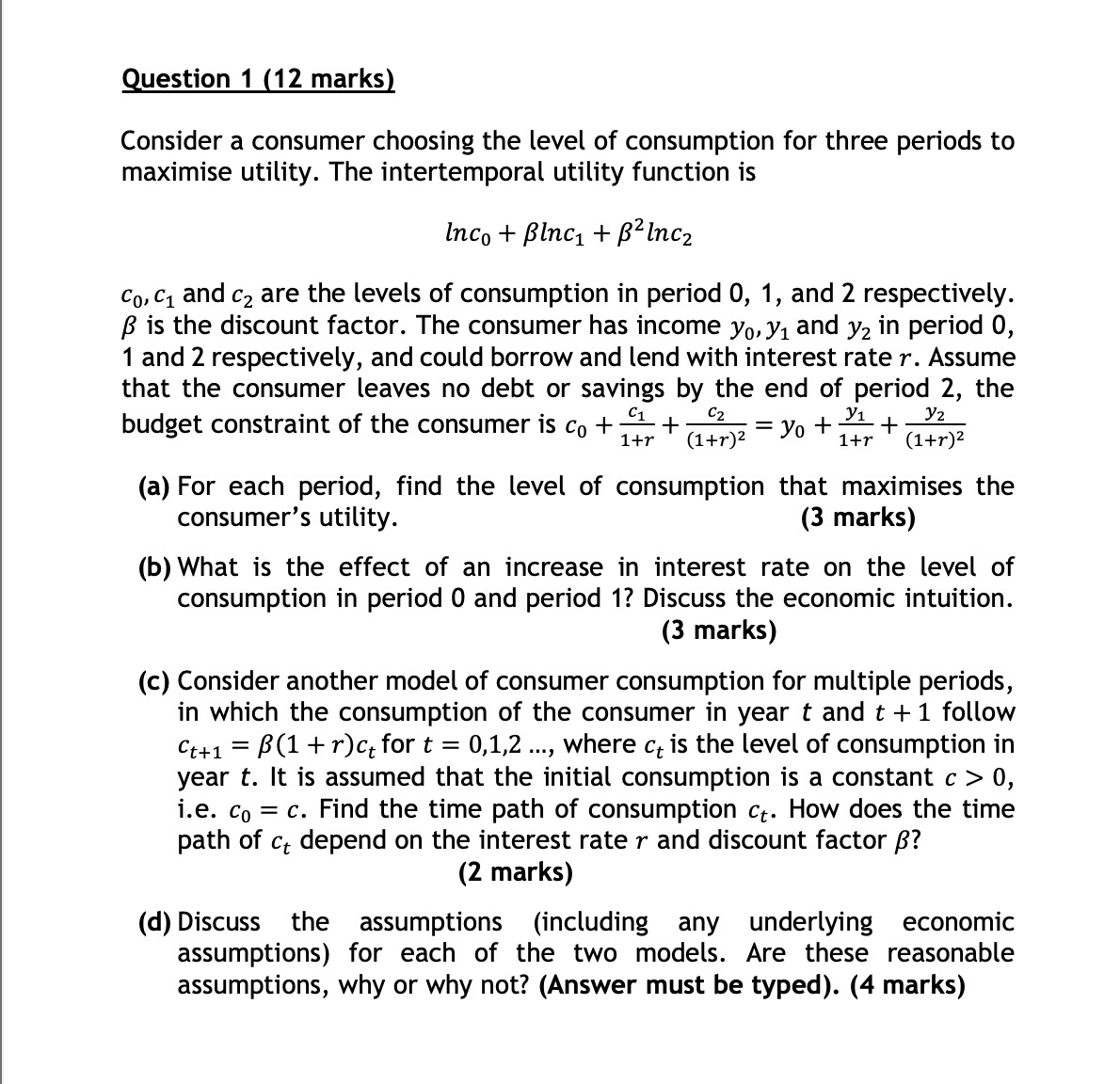
Question 1 (12 marks) Consider a consumer choosing the level of consumption for three periods to maximise utility. The intertemporal utility function is lnco + Blncl + [32an co, c1 and c2 are the levels of consumption in period 0, 1, and 2 respectively. B is the discount factor. The consumer has income yo, yl and y2 in period 0, 1 and 2 respectively, and could borrow and lend with interest rate r. Assume that the consumer leaves no debt or savings by the end of period 2, the - - i \"2 _ 3'2 budget constraint of the consumer IS (:0 + 1+1, + (1+r)2 yo + 1\" 0+1\"? (a) For each period, find the level of consumption that maximises the consumer's utility. (3 marks) (b)What is the effect of an increase in interest rate on the level of consumption in period 0 and period 1? Discuss the economic intuition. (3 marks) (c) Consider another model of consumer consumption for multiple periods, in which the consumption of the consumer in year t and t + 1 follow CH1 = 3(1 + r)c, for t = 0,1,2 ..., where c, is the level of consumption in year t. It is assumed that the initial consumption is a constant c > 0, Le. c0 = c. Find the time path of consumption Ct- How does the time path of Cr. depend on the interest rate r and discount factor )9? (2 marks) (d) Discuss the assumptions (including any underlying economic assumptions) for each of the two models. Are these reasonable assumptions, why or why not? (Answer must be typed). (4 marks)
Step by Step Solution
There are 3 Steps involved in it

Get step-by-step solutions from verified subject matter experts
 Study Help