







Question: Question 1 (14 points). Consider the function f(x) == 2x-6 2x x3 (a) Factor the numerator and the denominator of f(x) as much as
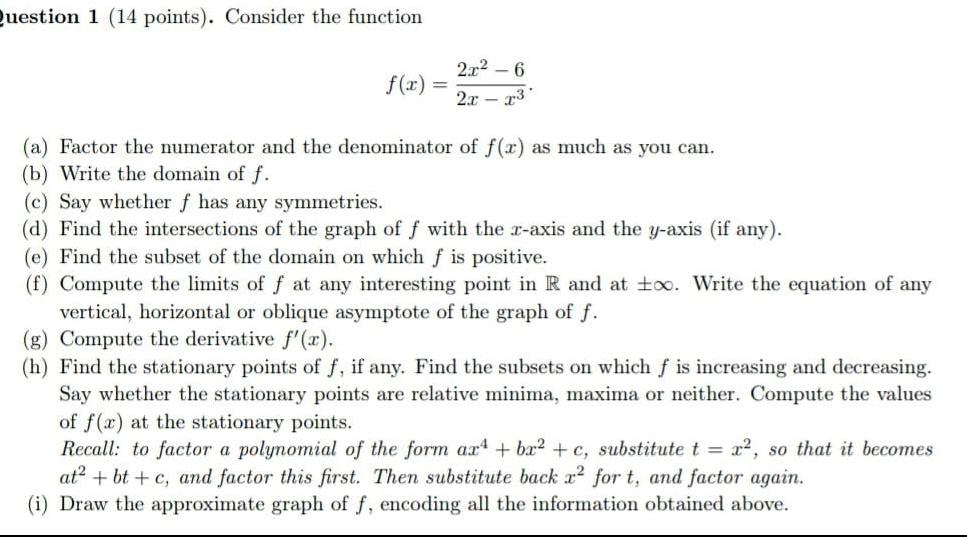
Question 1 (14 points). Consider the function f(x) == 2x-6 2x x3 (a) Factor the numerator and the denominator of f(x) as much as you can. (b) Write the domain of f. (c) Say whether f has any symmetries. (d) Find the intersections of the graph of f with the x-axis and the y-axis (if any). (e) Find the subset of the domain on which f is positive. (f) Compute the limits of f at any interesting point in R and at too. Write the equation of any vertical, horizontal or oblique asymptote of the graph of f. (g) Compute the derivative f'(x). (h) Find the stationary points of f, if any. Find the subsets on which f is increasing and decreasing. Say whether the stationary points are relative minima, maxima or neither. Compute the values of f(x) at the stationary points. Recall: to factor a polynomial of the form ax + bx+c, substitute t = a, so that it becomes at2 +bt+c, and factor this first. Then substitute back a for t, and factor again. (i) Draw the approximate graph of f, encoding all the information obtained above.
Step by Step Solution
There are 3 Steps involved in it

Get step-by-step solutions from verified subject matter experts
 Study Help