







Question: Question 1 (16 marks) (a) Let A and B be two invertible matrices. Prove that the product AB is invertible and that (AB) = BA-
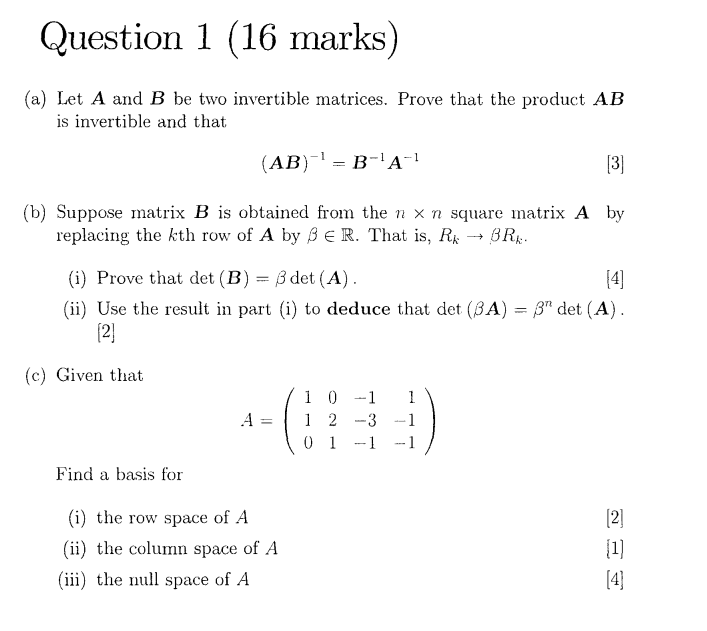
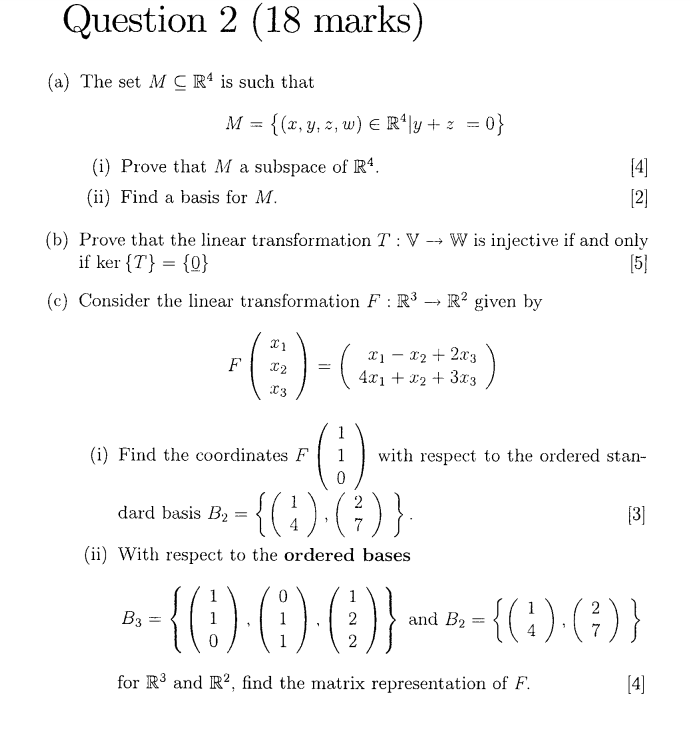
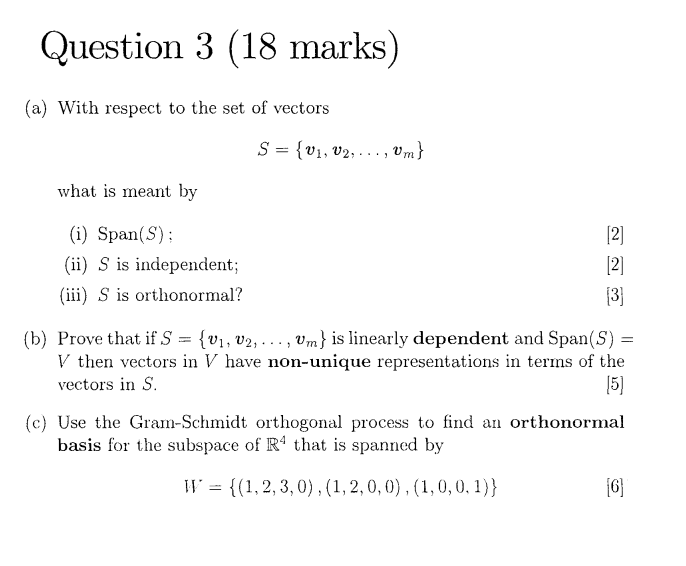
Question 1 (16 marks) (a) Let A and B be two invertible matrices. Prove that the product AB is invertible and that (AB) = BA- (b) Suppose matrix B is obtained from the n x n square matrix A by replacing the kth row of A by B e R. That is, Rx - OR. (i) Prove that det (B ) = 3 det (A) . (4] (ii) Use the result in part (i) to deduce that det (BA) = 3" det ( A) . [2) (c) Given that A = 1 2 LL - 1 Find a basis for (i) the row space of A (ii) the column space of A EEN (iii) the null space of AQuestion 2 (18 marks) (a) The set M C R' is such that M = {(x, y, =, W) ER'ly + = = 0} (i) Prove that M a subspace of R4. [4] (ii) Find a basis for M. [2] (b) Prove that the linear transformation T : V - W is injective if and only if ker {7} = {0} (c) Consider the linear transformation F : R3 - R given by F 21 - 12 + 203 4x1 + 12 + 313 (i) Find the coordinates Fi with respect to the ordered stan- dard basis By { ( : ) ( ? )} [3] (ii) With respect to the ordered bases B3 = for R3 and R', find the matrix representation of F. [4]Question 3 (18 marks) (a) With respect to the set of vectors S = {v1, v2. . . ., Um} what is meant by (i) Span(S) ; (ii) S is independent; (iii) S is orthonormal? 13 (b) Prove that if S = {v1, v2, ..., Um} is linearly dependent and Span(S) = V then vectors in V have non-unique representations in terms of the vectors in S. (c) Use the Gram-Schmidt orthogonal process to find an orthonormal basis for the subspace of R* that is spanned by WI = {(1, 2, 3, 0) , (1, 2, 0, 0) , (1, 0, 0.1) }
Step by Step Solution
There are 3 Steps involved in it

Get step-by-step solutions from verified subject matter experts
 Study Help