







Question: QUESTION 1 ( 2 0 Marks ) Good trininginitatives can have a transtormative effect on an orgarisation and ineffecfive raining, on the ofher hand, can
QUESTION
Marks
Good trininginitatives can have a transtormative effect on an orgarisation and ineffecfive raining, on the ofher hand, can have the opposite elfect. and assess the benefts of conducting trairing reeds snalysis:
QUESTION
Marks have the opposte eftect.
QUESTION
Marks
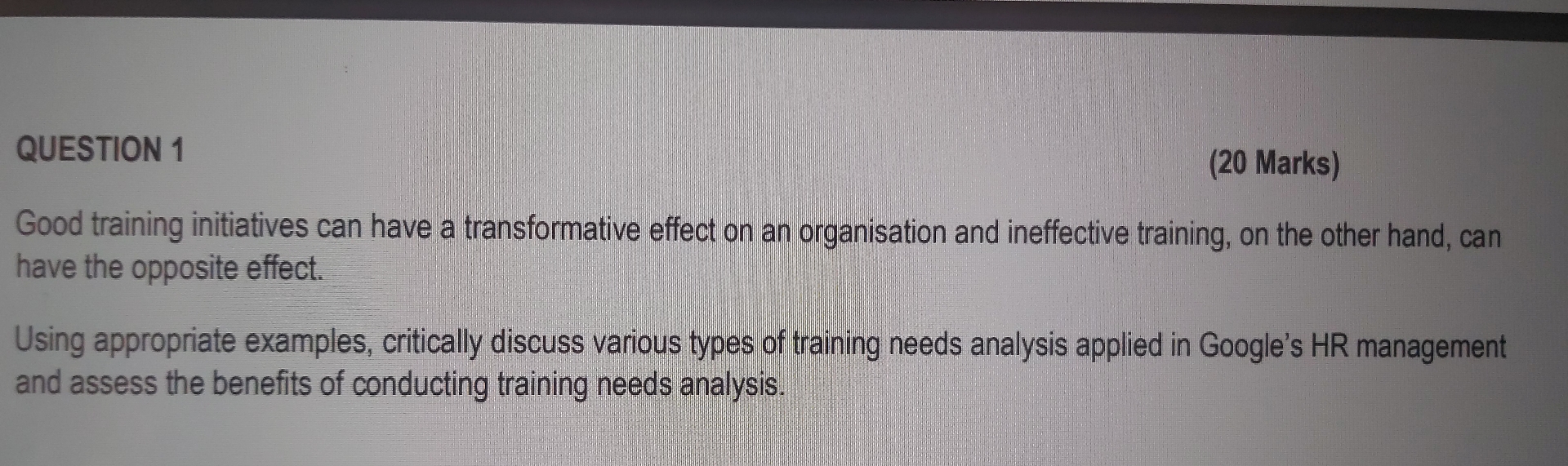
Good training initiatives can have a transformative effect on an organisation and ineffective training, on the other hand, can have the opposite effect.
Using appropriate examples, critically discuss various types of training needs analysis applied in Google's HR management and assess the benefits of conducting training needs analysis.
Google HRM: Training, Performance Management
Google's Alphabets human resource management practices cover effective employee training programs, as well as performance management to maximize human resource capabilities. The information techno company as needs analysis to design training programs aimed at supporting an innovative workforce. The training programs and their results are regularly evaluated to ensure that they meet Google's human resource needs. The company also has finely tuned performance management practices, inclusive of performance planning that directly addresses corporate objectives for HRM and supports the competitive advantages noted in the SWOT analysis of Google Alphabet To solve performance issues, Alphabet's human resource management uses performance management practices along with employee training programs.
Employee Training at Google
Needs Analysis: Google's HR management uses different types of heeds analysis, such as organizational analysis, work analysis, and costbenefit analysis. Organizational analysis dentifies new human resource needs based on the firm's current situation. For example, in developing new software products and investing in new businesses, Google conducts organizational analysis to determine the corresponding human resource requirements. Work analysis determines the specific requirements to fulfil work tasks. Google applies work analysis on new jobs, or when an organizational restructuring has just occurred. Costbenefit analysis determines the practicality of training programs and activities. Alphabet's HRM objective in using this type of analysis is to maximize the benefits achieved through training programs.
Program Design: Google's HR management uses a combination of the relational model and the resultsoriented approach for training program design. The relational model focuses on the relationship of the company with its employees. Google maintains positive internal relations to foster employee participation in creative and innovative processes. The resultsoriented approach focuses on training outcomes. For example, in implementing a training program, Google uses this approach to facilitate employees' learning. Thus, the relational model optimizes relations among employees, while the resultsoriented approach ensures that the information technology company's human resources are effective.
Delivery: Google's human resource management delivers training programs in various ways, such as discussions,
Delivery: Google's human resource management delivers training programs in various ways, such as discussions, simulations, and onthejob training. Discussions enable Google to maintain rich communications involving employees. With rich communications, training programs also benefit through maximum feedback from the trainees. The company uses simulations to facilitate creative responses. Simulations empower Google's employees to understand the details of work tasks, projects, and products. The company's HRM uses onthejob training to maximize the transfer of knowledge to new hires or interns. Many of these interns are absorbed into Alphabet's organization.
Evaluation: Google has summative and descriptive purposes in evaluating training programs. The summative purpose is to determine the effectiveness of the program in developing human resources to support strategies, such as Google's Alphabets generic strategy for competitive advantage and intensive strategies for growth. The descriptive purpose of evaluation is to understand the effects of the training on employees. Google's human resource management uses evaluation variables, like trainees' learning and reactions, and the results of training programs in terms of changes in human resource knowledge, skills, and abilities.
Alphabet's Performance Management Practices
Performance Planning: Google's performance planning efforts address different dimensions of its human resource management, including customer service, communication, support for diversity, and problemsolving abilities. Google's performance appraisal programs also use variables corresponding to these dimensions. For example, the company's HRM
evaluates employees' performance in internal communications and problemsolving activities to decide on performance management approaches.
Link to Corporate Objectives:
Step by Step Solution
There are 3 Steps involved in it
1 Expert Approved Answer
Step: 1 Unlock

Question Has Been Solved by an Expert!
Get step-by-step solutions from verified subject matter experts
Step: 2 Unlock
Step: 3 Unlock
 Study Help