







Question: Question 1 ( 2 0 marks ) Your company is evaluating a switch from a cash only policy to a net 3 0 policy. The
Question marks
Your company is evaluating a switch from a cash only policy to a net policy. The price per unit is $ and the variable cost per unit is $ The company currently sells units per month. Under the proposed policy, the company expects to sell units per month at the price per unit $ The probability of default is and the required monthly return is
Assume sales and costs occur at the beginning of the month.
a Should the company offer credit terms of net to a onetime customer? Explain Support your result with calculations marks
b What is the maximum acceptable default probability in part a marks
c The cash flow pattern in the firm is approximated by the Baumol BAT model. Now, the firm has $ holdings in cash and zero marketable securities Over next year, the total amount of new cash needed for transaction purpose is expected to be $ The firm has to pay transaction cost $ each time when it buys or sells securities The annual interest rate on money market securities is
i What is the target cash balance? marks
ii How much of the current cash holding should be used to increase the firm's holdings of marketable securities marks
iii. After the investment of excess cash at part ii how many times will marketable securities be sold to replenish cash during the next months? marks
Question marks
Assume that there are assets stock A and Tbill riskfree asset along with the market. The T bill's return rate is Market portfolio has an expected return of and standard deviation of Price of stock A is $ now. During next period, rate of return of the stock A will be if the economy expands, if the economy is normal and if the economy falls in the recession. The probabilities that the economy is expanding, being normal or in a recession are and respectively. The variance of the stock As return is Correlation between return of Stock A and the market is The stock A pays no dividends.
a What is the expected return rate of stock A
b What is the standard deviation of stock As return? marks
c What is the beta of stock A
d What are the weights of stock A and Tbill if you want to construct a portfolio with beta equals marks
e Based on the result in part d what is the expected return of this portfolio? marks
Question marks
The firm has issued preferred stocks which pay a stated annual dividend of $ per share. The preferred stocks are currently selling for $ Additionally, the firm has corporate bonds and the bond is selling for $ along with a yield to maturity of Also, the firm has outstanding shares of common stock selling for $ per share. The common stocks have a beta of The market risk premium is and riskfree rate is The firm is subject to corporate tax rate percent.
The firm is considering to launch a new project that is as risky as the overall firm. The project needs to make an initial investment of $ The project will save the firm $ per year in pretax operating costs over the year life of the project. It will also need to make an initial investment of $ in working capital which will be recovered at the end of the project. The project will be depreciated based on the three year MACRS class and respectively for years and will be scrapped for $ at the end of its useful life.
a What are the weights of each capital component in the firm's capital structure? marks
b What is the cost of each capital component in the firm's capital structure? marks
c What is the overall cost of capital to the firm? marks
d Should the firm accept the project based on the NPV analysis? marksQuestion marks
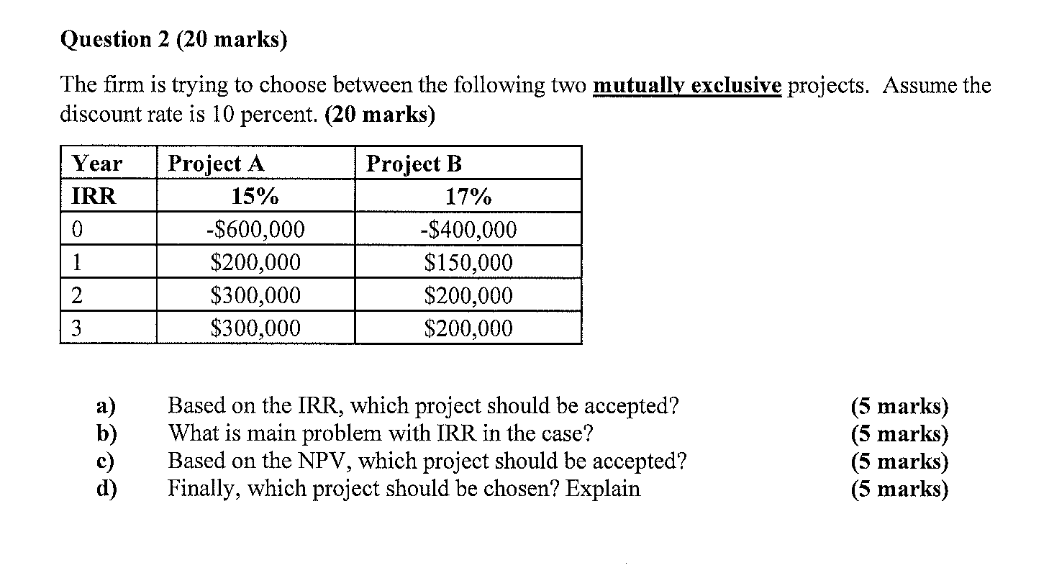
The firm is trying to choose between the following two mutually exclusive projects. Assume the
discount rate is percent. marks
a Based on the IRR, which project should be accepted?
b What is main problem with IRR in the case?
c Based on the NPV which project should be accepted?
d Finally, which project should be chosen? Explain
marks
marks
marks
marks
Step by Step Solution
There are 3 Steps involved in it
1 Expert Approved Answer
Step: 1 Unlock

Question Has Been Solved by an Expert!
Get step-by-step solutions from verified subject matter experts
Step: 2 Unlock
Step: 3 Unlock
 Study Help