







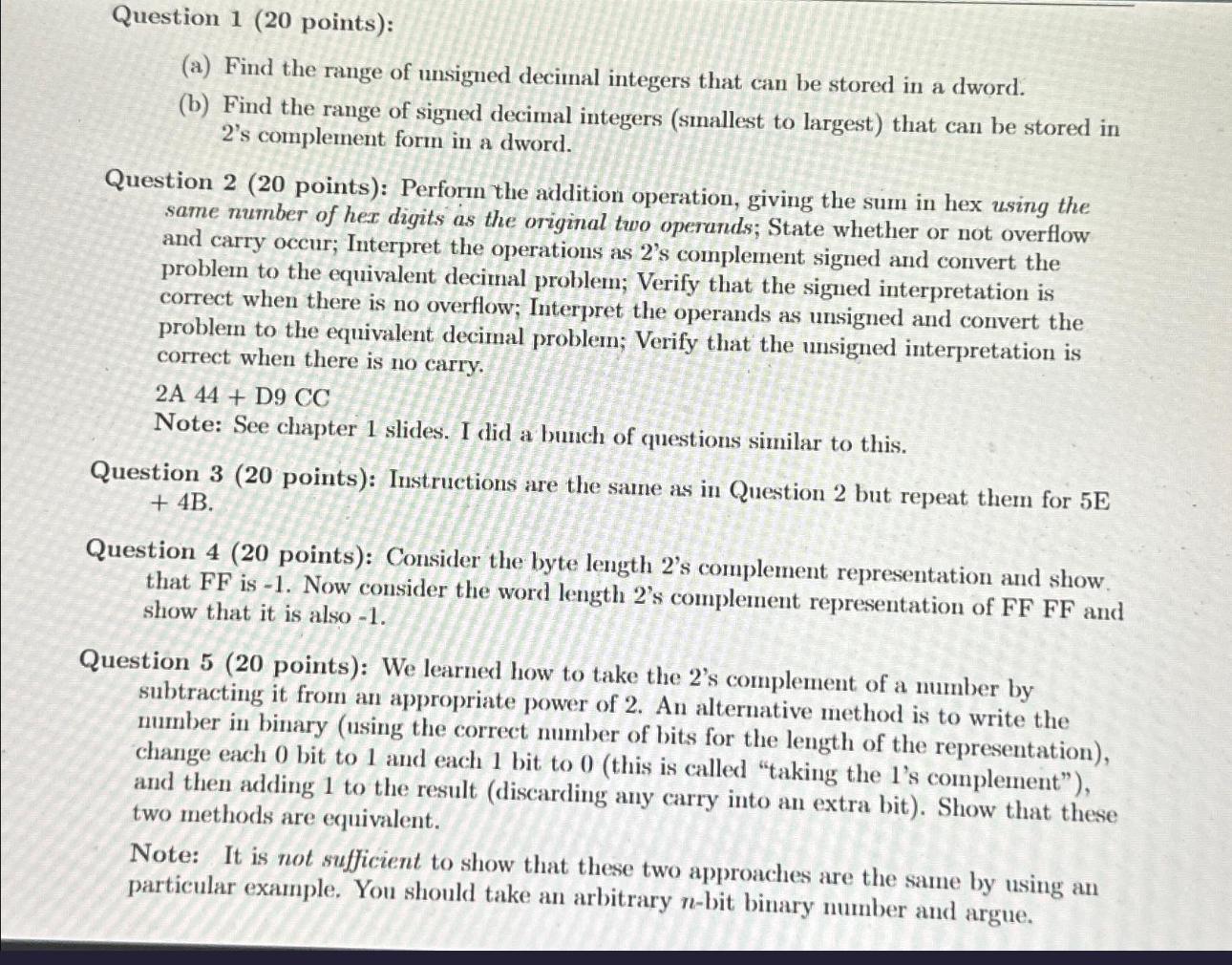
Question: Question 1 ( 2 0 points ) : ( a ) Find the range of unsigned decimal integers that can be stored in a dword.
Question points:
a Find the range of unsigned decimal integers that can be stored in a dword.
b Find the range of signed decimal integers smallest to largest that can be stored in s complement form in a dword.
Question points: Perform the addition operation, giving the sum in hex using the same number of hex digits as the original two operands; State whether or not overflow and carry occur; Interpret the operations as s complement signed and convert the problem to the equivalent decimal problem; Verify that the signed interpretation is correct when there is no overflow; Interpret the operands as unsigned and convert the problem to the equivalent decimal problem; Verify that the unsigned interpretation is correct when there is no carry.
Note: See chapter slides. I did a bunch of questions similar to this.
Question points: Instructions are the same as in Question but repeat them for
Question points: Consider the byte length s complement representation and show. that FF is Now consider the word length s complement representation of FF FF and show that it is also
Question points: We learned how to take the s complement of a number by subtracting it from an appropriate power of An alternative method is to write the number in binary using the correct number of bits for the length of the representation change each bit to and each bit to this is called "taking the s complement" and then adding to the result discarding any carry into an extra bit Show that these two methods are equivalent.
Note: It is not sufficient to show that these two approaches are the same by using an particular example. You should take an arbitrary bit binary number and argue.
Step by Step Solution
There are 3 Steps involved in it
1 Expert Approved Answer
Step: 1 Unlock

Question Has Been Solved by an Expert!
Get step-by-step solutions from verified subject matter experts
Step: 2 Unlock
Step: 3 Unlock
 Study Help