







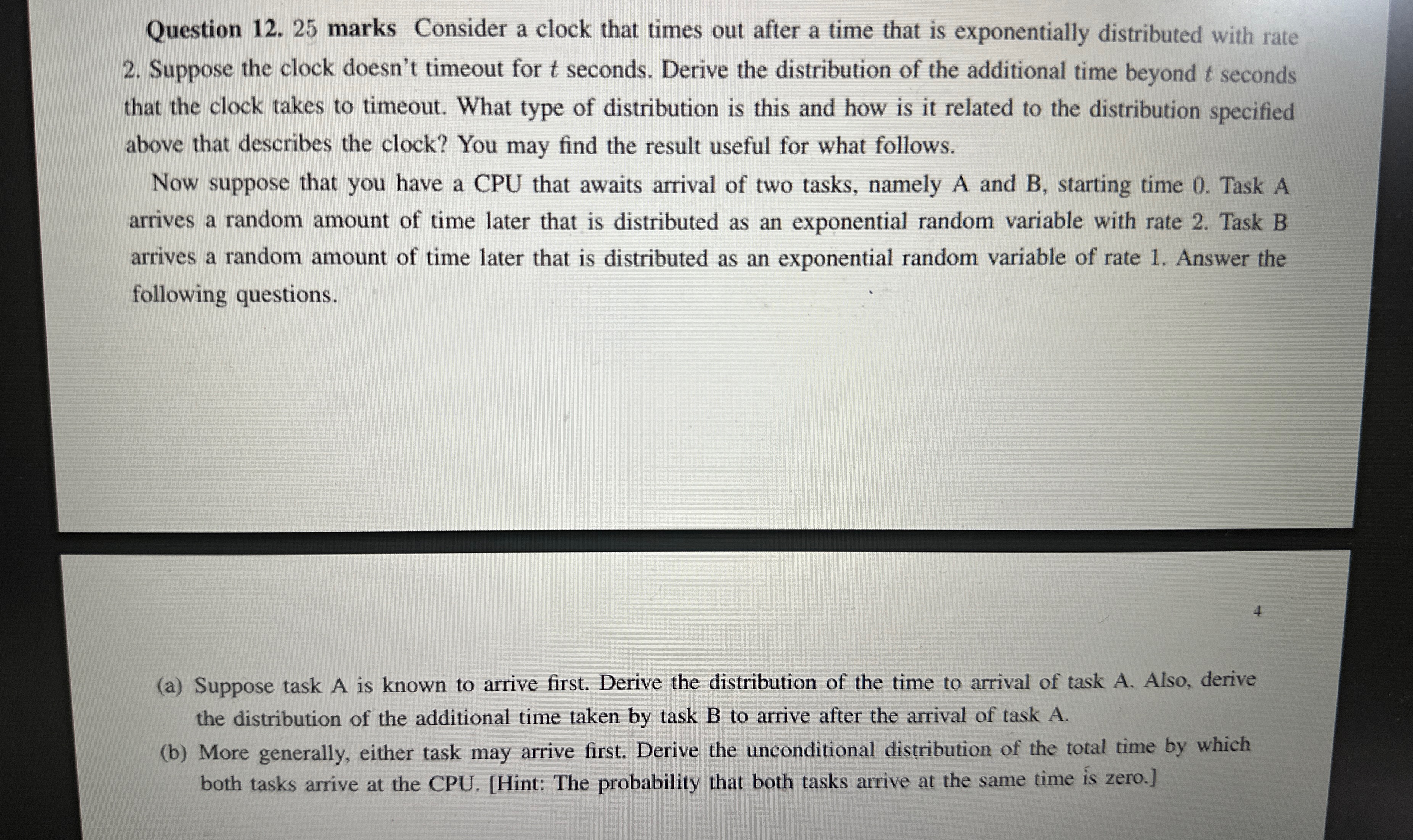
Question: Question 1 2 . 2 5 marks Consider a clock that times out after a time that is exponentially distributed with rate 2 . Suppose
Question marks Consider a clock that times out after a time that is exponentially distributed with rate Suppose the clock doesn't timeout for seconds. Derive the distribution of the additional time beyond seconds that the clock takes to timeout. What type of distribution is this and how is it related to the distribution specified above that describes the clock? You may find the result useful for what follows.
Now suppose that you have a CPU that awaits arrival of two tasks, namely A and B starting time Task A arrives a random amount of time later that is distributed as an exponential random variable with rate Task B arrives a random amount of time later that is distributed as an exponential random variable of rate Answer the following questions.
a Suppose task A is known to arrive first. Derive the distribution of the time to arrival of task A Also, derive the distribution of the additional time taken by task B to arrive after the arrival of task A
b More generally, either task may arrive first. Derive the unconditional distribution of the total time by which both tasks arrive at the CPU. Hint: The probability that both tasks arrive at the same time is zero.
Step by Step Solution
There are 3 Steps involved in it
1 Expert Approved Answer
Step: 1 Unlock

Question Has Been Solved by an Expert!
Get step-by-step solutions from verified subject matter experts
Step: 2 Unlock
Step: 3 Unlock
 Study Help