Question: Question 1 (2 points) What are attitudes, and which two attitudes are considered particularly important for employees? (HINT: This is in the Values & Attitudes
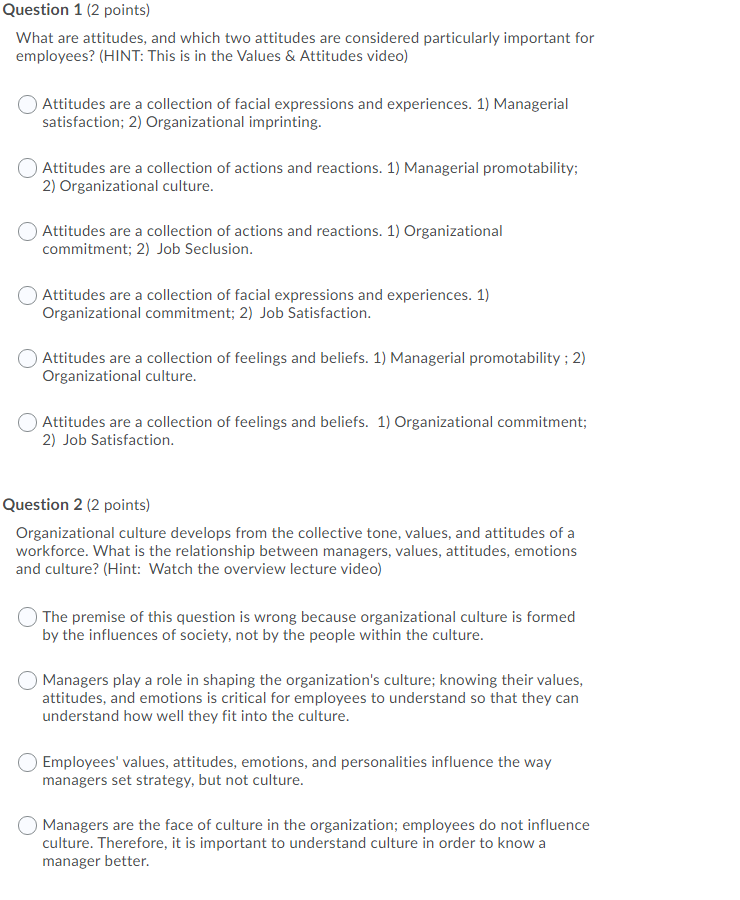
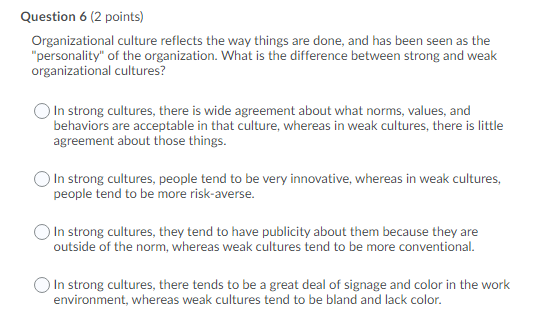
Question 1 (2 points) What are attitudes, and which two attitudes are considered particularly important for employees? (HINT: This is in the Values & Attitudes video) Attitudes are a collection of facial expressions and experiences. 1) Managerial satisfaction; 2) Organizational imprinting. Attitudes are a collection of actions and reactions. 1) Managerial promotability; 2) Organizational culture. Attitudes are a collection of actions and reactions. 1) Organizational commitment; 2) Job Seclusion. Attitudes are a collection of facial expressions and experiences. 1) Organizational commitment; 2) Job Satisfaction. Attitudes are a collection of feelings and beliefs. 1) Managerial promotability; 2) Organizational culture. Attitudes are a collection of feelings and beliefs. 1) Organizational commitment; 2) Job Satisfaction. Question 2 (2 points) Organizational culture develops from the collective tone, values, and attitudes of a workforce. What is the relationship between managers, values, attitudes, emotions and culture? (Hint: Watch the overview lecture video) The premise of this question is wrong because organizational culture is formed by the influences of society, not by the people within the culture. Managers play a role in shaping the organization's culture; knowing their values, attitudes, and emotions is critical for employees to understand so that they can understand how well they fit into the culture. Employees' values, attitudes, emotions, and personalities influence the way managers set strategy, but not culture. Managers are the face of culture in the organization; employees do not influence culture. Therefore, it is important to understand culture in order to know a manager better. Question 6 (2 points) Organizational culture reflects the way things are done, and has been seen as the "personality" of the organization. What is the difference between strong and weak organizational cultures? In strong cultures, there is wide agreement about what norms, values, and behaviors are acceptable in that culture, whereas in weak cultures, there is little agreement about those things. In strong cultures, people tend to be very innovative, whereas in weak cultures, people tend to be more risk-averse. In strong cultures, they tend to have publicity about them because they are outside of the norm, whereas weak cultures tend to be more conventional. In strong cultures, there tends to be a great deal of signage and color in the work environment, whereas weak cultures tend to be bland and lack color









 Study Help