







Question: Question 1: (20 marks) (a) Assuming you work for a multinational company. You manager tells you that different stakeholders would like to know how the
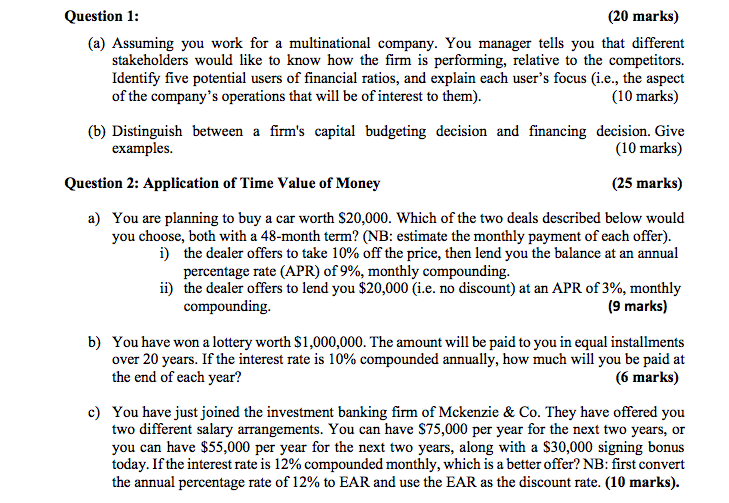
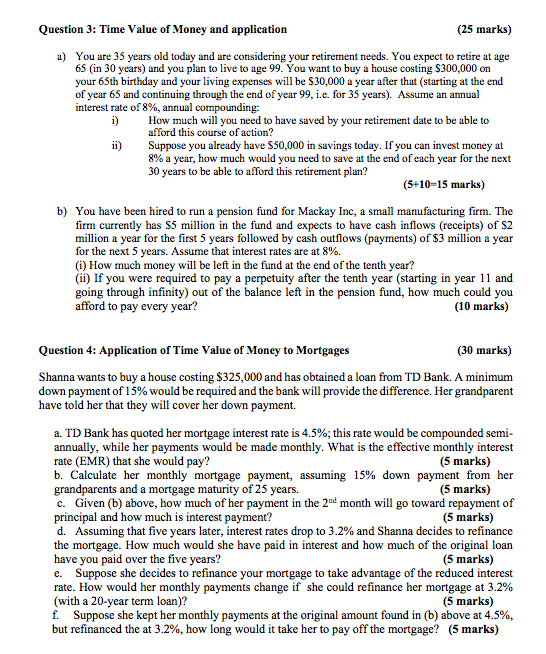
Question 1: (20 marks) (a) Assuming you work for a multinational company. You manager tells you that different stakeholders would like to know how the firm is performing, relative to the competitors. Identify five potential users of financial ratios, and explain each user's focus (i.e., the aspect of the company's operations that will be of interest to them). (10 marks) (b) Distinguish between a firm's capital budgeting decision and financing decision. Give examples. (10 marks) Question 2: Application of Time Value of Money (25 marks) a) You are planning to buy a car worth $20,000. Which of the two deals described below would you choose, both with a 48-month term? (NB: estimate the monthly payment of each offer). i) the dealer offers to take 10% off the price, then lend you the balance at an annual percentage rate (APR) of 9%, monthly compounding. ii) the dealer offers to lend you $20,000 (i.e. no discount) at an APR of 3%, monthly compounding. (9 marks) b) You have won a lottery worth $1,000,000. The amount will be paid to you in equal installments over 20 years. If the interest rate is 10% compounded annually, how much will you be paid at the end of each year? (6 marks) c) You have just joined the investment banking firm of Mckenzie & Co. They have offered you two different salary arrangements. You can have $75,000 per year for the next two years, or you can have $55,000 per year for the next two years, along with a $30,000 signing bonus today. If the interest rate is 12% compounded monthly, which is a better offer? NB: first convert the annual percentage rate of 12% to EAR and use the EAR as the discount rate. (10 marks). Question 3: Time Value of Money and application (25 marks) a) You are 35 years old today and are considering your retirement needs. You expect to retire at age 65 in 30 years) and you plan to live to age 99. You want to buy a house costing $300,000 on your 65th birthday and your living expenses will be $30,000 a year after that starting at the end of year 65 and continuing through the end of year 99, i.e. for 35 years). Assume an annual interest rate of 8%, annual compounding How much will you need to have saved by your retirement date to be able to afford this course of action? ii) Suppose you already have $50,000 in savings today. If you can invest money at 8% a year, how much would you need to save at the end of each year for the next 30 years to be able to afford this retirement plan? (5+10-15 marks) b) You have been hired to run a pension fund for Mackay Inc, a small manufacturing firm. The firm currently has $5 million in the fund and expects to have cash inflows (receipts) of S2 million a year for the first 5 years followed by cash outflows (payments) of $3 million a year for the next 5 years. Assume that interest rates are at 8%. (i) How much money will be left in the fund at the end of the tenth year? (ii) If you were required to pay a perpetuity after the tenth year (starting in year 11 and going through infinity) out of the balance left in the pension fund, how much could you afford to pay every year? (10 marks) Question 4: Application of Time Value of Money to Mortgages (30 marks) Shanna wants to buy a house costing $325,000 and has obtained a loan from TD Bank. A minimum down payment of 15% would be required and the bank will provide the difference. Her grandparent have told her that they will cover her down payment. a. TD Bank has quoted her mortgage interest rate is 4.5%; this rate would be compounded semi- annually, while her payments would be made monthly. What is the effective monthly interest rate (EMR) that she would pay? (5 marks) b. Calculate her monthly mortgage payment, assuming 15% down payment from her grandparents and a mortgage maturity of 25 years. (5 marks) c. Given (b) above, how much of her payment in the 2month will go toward repayment of principal and how much is interest payment? (5 marks) d. Assuming that five years later, interest rates drop to 3.2% and Shanna decides to refinance the mortgage. How much would she have paid in interest and how much of the original loan have you paid over the five years? (5 marks) c. Suppose she decides to refinance your mortgage to take advantage of the reduced interest rate. How would her monthly payments change if she could refinance her mortgage at 3.2% (with a 20-year term loan)? (5 marks) f. Suppose she kept her monthly payments at the original amount found in (b) above at 4.5%, but refinanced the at 3.2%, how long would it take her to pay off the mortgage
Step by Step Solution
There are 3 Steps involved in it

Get step-by-step solutions from verified subject matter experts
 Study Help