







Question: Question 1: (20 points) True / False. Answer with Tor F in the left column and correct the false ones in the right column. Credit
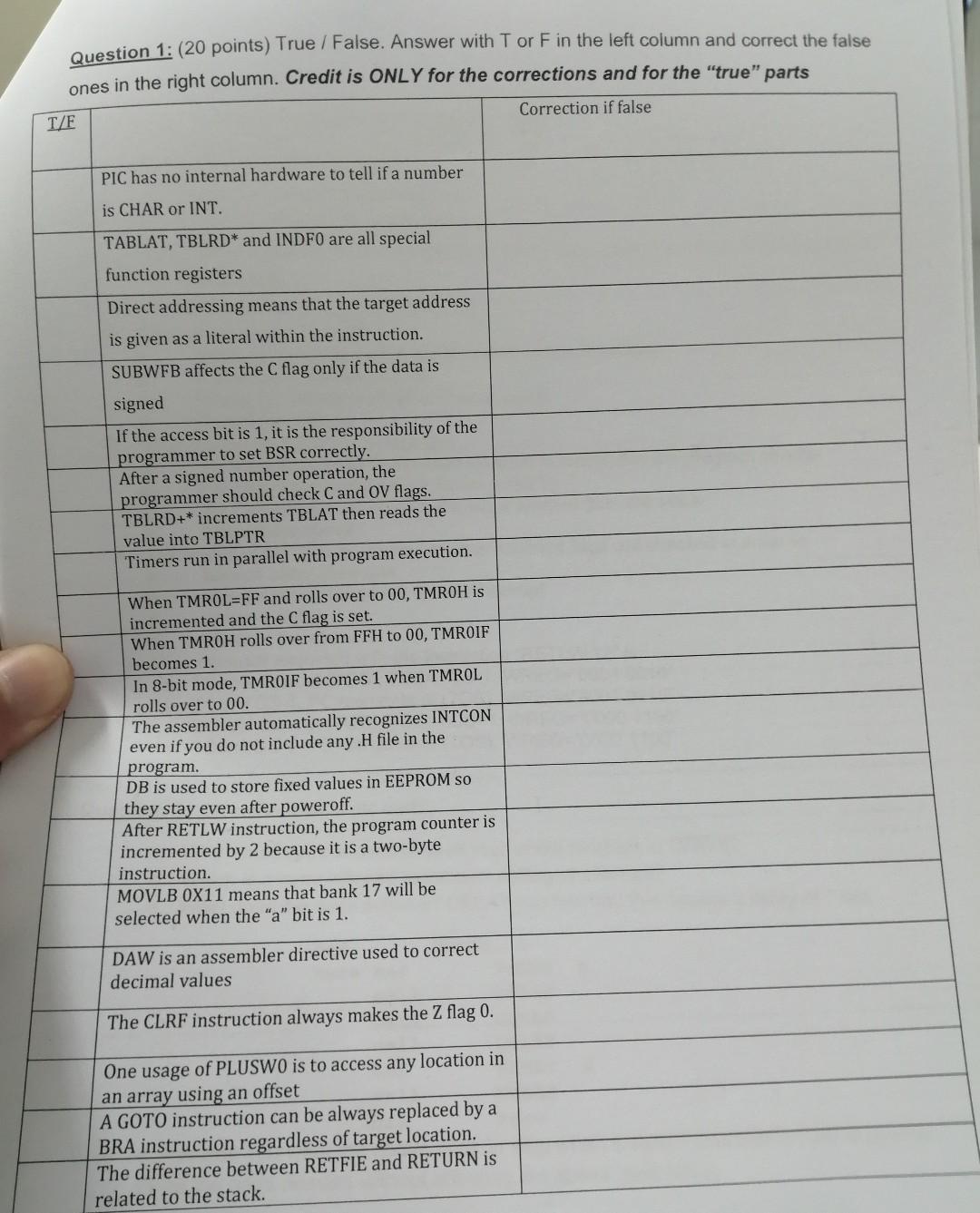
Question 1: (20 points) True / False. Answer with Tor F in the left column and correct the false ones in the right column. Credit is ONLY for the corrections and for the "true" parts T/F Correction if false PIC has no internal hardware to tell if a number is CHAR or INT. TABLAT, TBLRD* and INDFO are all special function registers Direct addressing means that the target address is given as a literal within the instruction. SUBWFB affects the Cflag only if the data is signed If the access bit is 1, it is the responsibility of the programmer to set BSR correctly. After a signed number operation, the programmer should check C and OV flags. TBLRD+* increments TBLAT then reads the value into TBLPTR Timers run in parallel with program execution. When TMROL=FF and rolls over to 00, TMROH is incremented and the C flag is set. When TMROH rolls over from FFH to 00, TMROIF becomes 1. In 8-bit mode, TMROIF becomes 1 when TMROL rolls over to 00. The assembler automatically recognizes INTCON even if you do not include any.H file in the program. DB is used to store fixed values in EEPROM SO they stay even after poweroff. After RETLW instruction, the program counter is incremented by 2 because it is a two-byte instruction. MOVLB OX11 means that bank 17 will be selected when the "a" bit is 1. DAW is an assembler directive used to correct decimal values The CLRF instruction always makes the Z flag 0. One usage of PLUSWO is to access any location in an array using an offset A GOTO instruction can be always replaced by a BRA instruction regardless of target location. The difference between RETFIE and RETURN is related to the stack
Step by Step Solution
There are 3 Steps involved in it

Get step-by-step solutions from verified subject matter experts
 Study Help