







Question: Question 1 (20 pts). Consider a queueing system, which has one server. To serve a customer, a server requires a random length of time, distributed
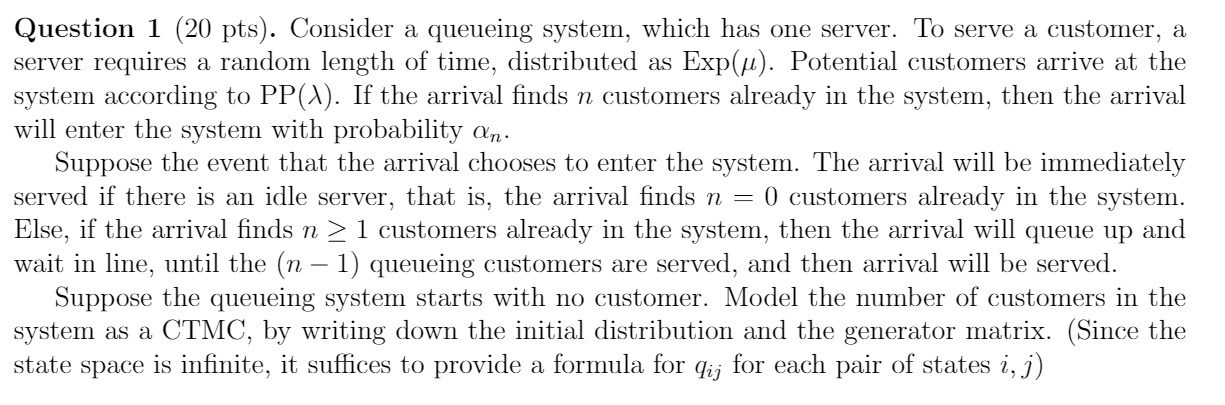
Question 1 (20 pts). Consider a queueing system, which has one server. To serve a customer, a server requires a random length of time, distributed as Exp(). Potential customers arrive at the system according to PP(A). If the arrival finds n customers already in the system, then the arrival will enter the system with probability an. Suppose the event that the arrival chooses to enter the system. The arrival will be immediately served if there is an idle server, that is, the arrival finds n = 0 customers already in the system. Else, if the arrival finds n 2 1 customers already in the system, then the arrival will queue up and wait in line, until the (n - 1) queueing customers are served, and then arrival will be served. Suppose the queueing system starts with no customer. Model the number of customers in the system as a CTMC, by writing down the initial distribution and the generator matrix. (Since the state space is infinite, it suffices to provide a formula for qj for each pair of states i, j)
Step by Step Solution
There are 3 Steps involved in it

Get step-by-step solutions from verified subject matter experts
 Study Help