







Question: A human-computer interaction (HCI) researcher was interested in examining whether humans are better able to use a joystick or a mouse to point a computer
A human-computer interaction (HCI) researcher was interested in examining whether humans are better able to use a joystick or a mouse to point a computer cursor. She therefore constructed an experiment in which participants used either a joystick (joystick condition) or a mouse (mouse condition) to point a cursor to a target displayed on a computer monitor. She measured the time (seconds) that it took to place the cursor over the target (dependent variable referred to as time, where a higher time score indicates poorer performance). To determine whether potential benefits of using the joystick or mouse generalized to difficult HCI scenarios, the target was either stationary (static condition) or moved slowly across the computer screen at a constant velocity (motion condition). Participants were randomly and uniquely assigned to 1 of 4 conditions in the interface (levels: joystick, mouse) × target type (levels: static, motion) experimental design. Given the data collected by the researcher (see Table 1 below), what can she conclude about how easily humans interact these HCI interfaces and how are these HCI interfaces influenced by target type? Include a line graph of the means.
For the analysis, assume a two-tailed hypothesis test with α = .05 unless otherwise specified. All parametric analyses must include effect sizes. Any t-tests must include 95% confidence intervals. Any analysis that includes an F-test must also include an accompanying ANOVA table. Any analysis that includes a correlation must also include the variances of the variables and their cross product (SP; covariability). Any analysis that includes linear regression must also include all relevant descriptive statistics (i.e., SSResidual, standard error of the residual, regression equation). Any non-parametric analysis must include the ranked scores and the sum of ranks (ΣR).
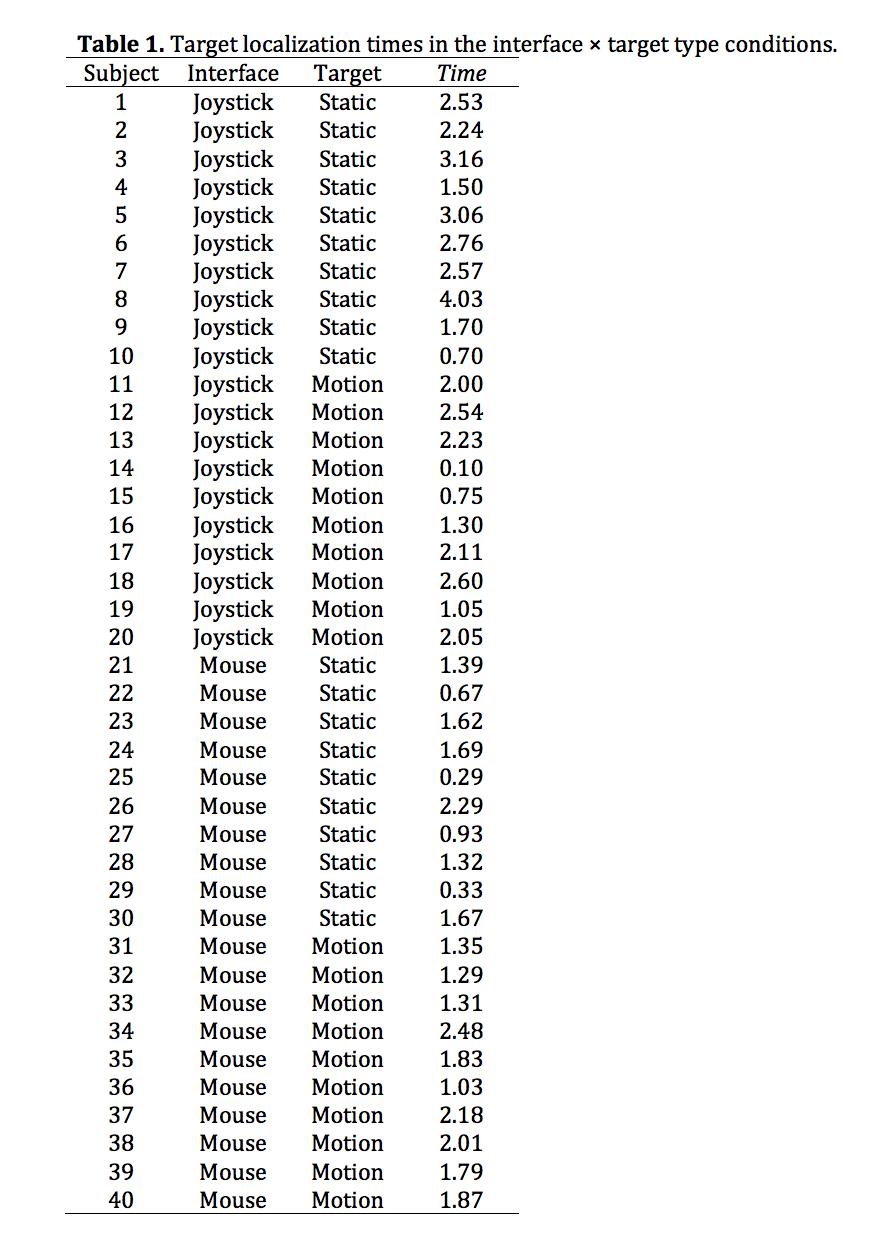
Table 1. Target localization times in the interface x target type conditions. Subject Interface Joystick Joystick Joystick Joystick Joystick Joystick Joystick Joystick Joystick Joystick Joystick Joystick Joystick Joystick Joystick Joystick Joystick Joystick Joystick Joystick Mouse Target Static Time 1 2.53 Static 2.24 Static 3.16 1.50 Static Static 3.06 Static 2.76 Static 2.57 Static 4.03 Static 1.70 0.70 2.00 10 Static 11 Motion 12 Motion 2.54 13 Motion 2.23 0.10 0.75 14 Motion 15 Motion 16 Motion 1.30 17 Motion 2.11 18 Motion 2.60 19 Motion 1.05 20 Motion 2.05 21 Static 1.39 22 Mouse Static 0.67 23 Mouse Static 1.62 24 Mouse Static 1.69 25 Mouse Static 0.29 26 Mouse Static 2.29 27 Mouse Static 0.93 28 Mouse Static 1.32 29 Mouse Static 0.33 30 Mouse Static 1.67 31 Mouse Motion 1.35 32 Mouse Motion 1.29 33 Mouse Motion 1.31 34 Mouse Motion 2.48 35 Mouse Motion 1.83 36 Mouse Motion 1.03 37 Mouse Motion 2.18 38 Mouse Motion 2.01 39 Mouse Motion 1.79 40 Mouse Motion 1.87 2345 6789 9
Step by Step Solution
3.55 Rating (162 Votes )
There are 3 Steps involved in it
Importing the data df summarise mean time mean ... View full answer

Get step-by-step solutions from verified subject matter experts
 Study Help