Question: QUESTION 1 (25 Marks) 1.1 In risk modelling, probability distribution arises in two ways. In that context discuss fully the TWO (2) ways in which
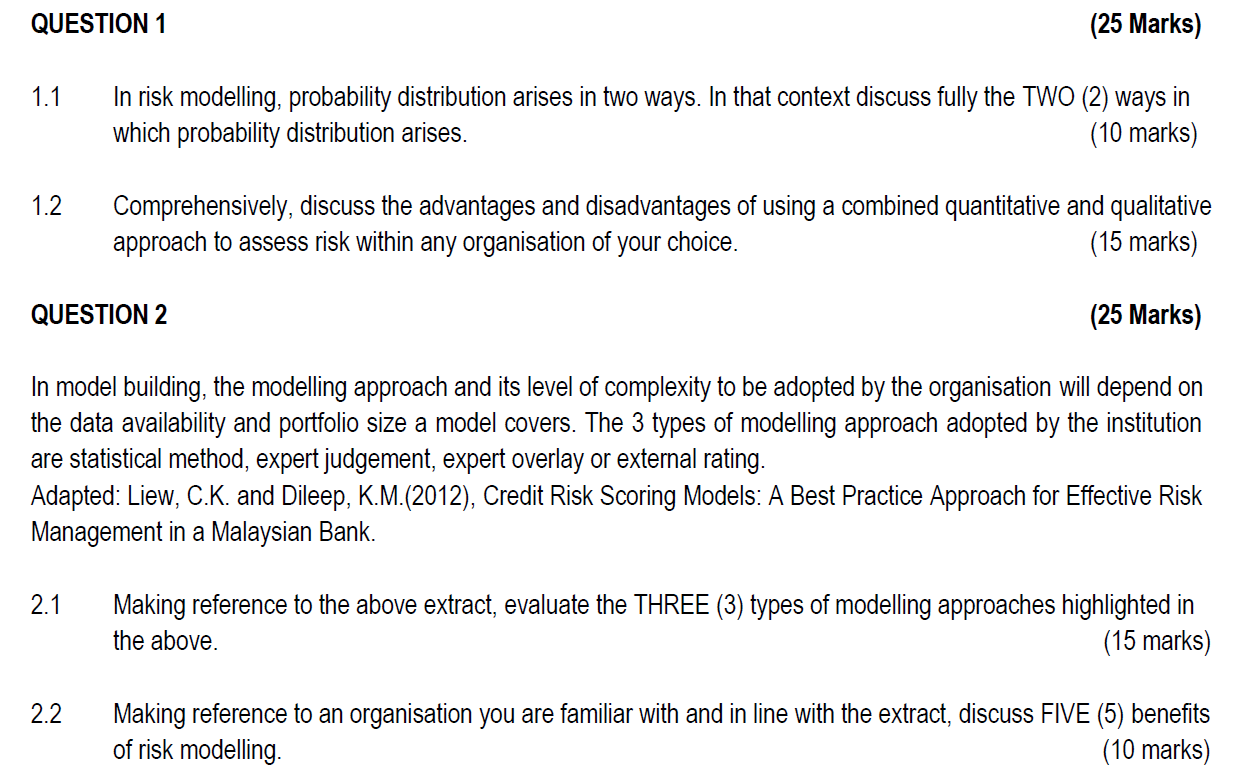
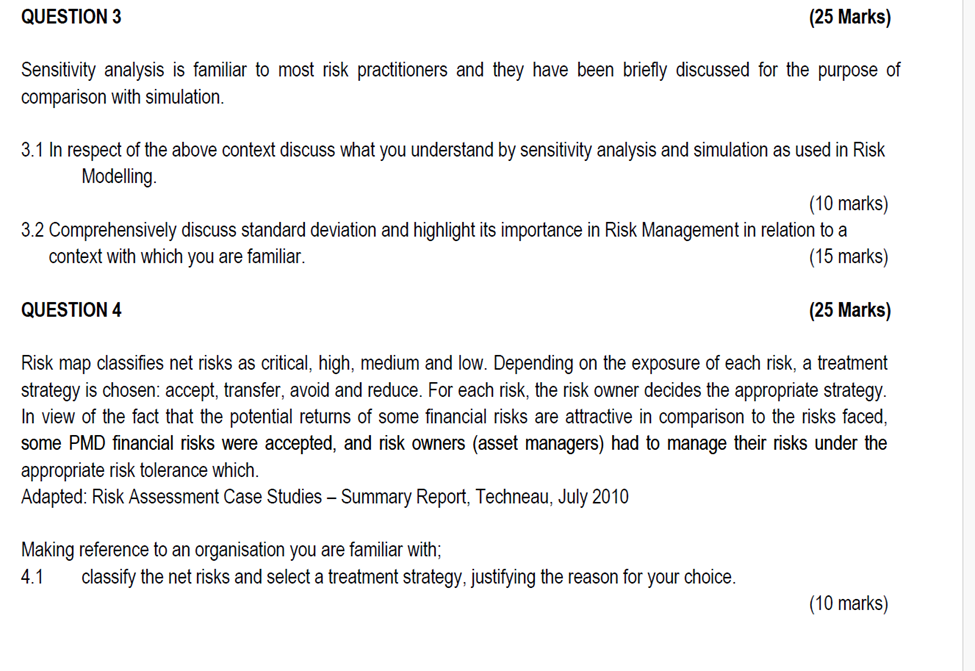
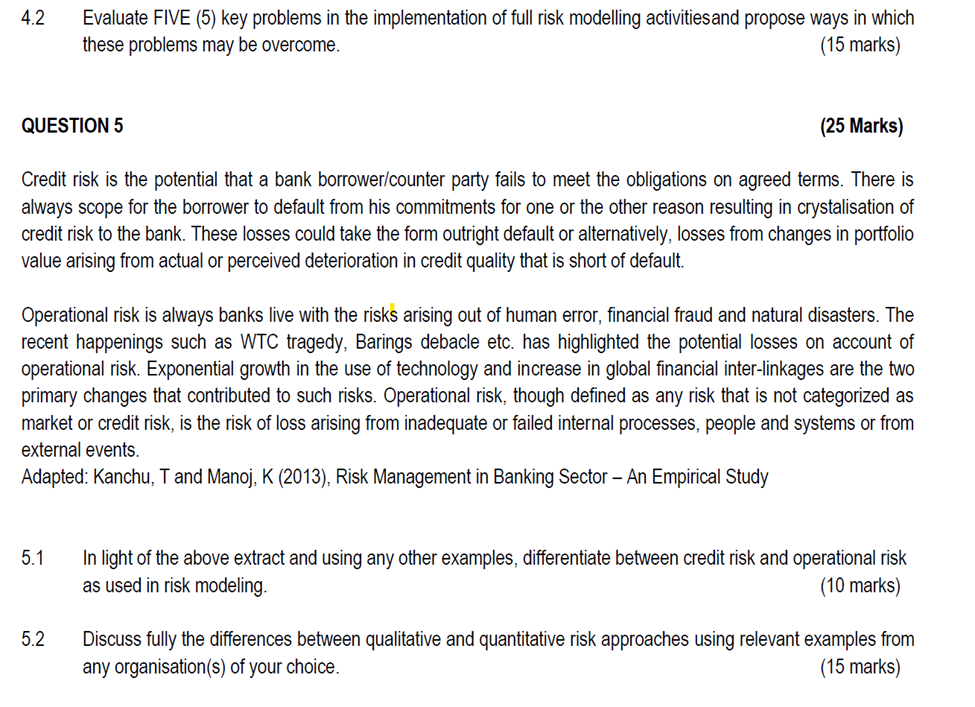
QUESTION 1 (25 Marks) 1.1 In risk modelling, probability distribution arises in two ways. In that context discuss fully the TWO (2) ways in which probability distribution arises. (10 marks) 12 Comprehensively, discuss the advantages and disadvantages of using a combined quantitative and qualitative approach to assess risk within any organisation of your choice. (15 marks) QUESTION 2 (25 Marks) In model building, the modelling approach and its level of complexity to be adopted by the organisation will depend on the data availability and portfolio size a model covers. The 3 types of modelling approach adopted by the institution are statistical method, expert judgement, expert overlay or external rating. Adapted: Liew, C.K. and Dileep, K.M.(2012), Credit Risk Scoring Models: A Best Practice Approach for Effective Risk Management in a Malaysian Bank. 2.1 Making reference to the above extract, evaluate the THREE (3) types of modelling approaches highlighted in the above. (15 marks) 22 Making reference to an organisation you are familiar with and in line with the extract, discuss FIVE (5) benefits of risk modelling. (10 marks) QUESTION 3 (25 Marks) Sensitivity analysis is familiar to most risk practitioners and they have been briefly discussed for the purpose of comparison with simulation. 3.1 In respect of the above context discuss what you understand by sensitivity analysis and simulation as used in Risk Modelling. (10 marks) 3.2 Comprehensively discuss standard deviation and highlight its importance in Risk Management in relation to a context with which you are familiar. (15 marks) QUESTION 4 (25 Marks) Risk map classifies net risks as critical, high, medium and low. Depending on the exposure of each risk, a freatment strategy is chosen: accept, transfer, avoid and reduce. For each risk, the risk owner decides the appropriate strategy. In view of the fact that the potential returns of some financial risks are attractive in comparison to the risks faced, some PMD financial risks were accepted, and risk owners (asset managers) had to manage their risks under the appropriate risk tolerance which. Adapted: Risk Assessment Case Studies Summary Report, Techneau, July 2010 Making reference to an organisation you are familiar with; 4.1 classify the net risks and select a treatment strategy, justifying the reason for your choice. (10 marks) 42 Evaluate FIVE (5) key problems in the implementation of full risk modelling activitiesand propose ways in which these problems may be overcome. (15 marks) QUESTION (25 Marks) Credit risk is the potential that a bank borrower/counter party fails to meet the obligations on agreed terms. There is always scope for the borrower to default from his commitments for one or the other reason resulting in crystalisation of credit risk to the bank. These losses could take the form outright default or alternatively, losses from changes in portfolio value arising from actual or perceived deterioration in credit quality that is short of default. Operational risk is always banks live with the risks arising out of human error, financial fraud and natural disasters. The recent happenings such as WTC fragedy, Barings debacle etc. has highlighted the potential losses on account of operational risk. Exponential growth in the use of technology and increase in global financial inter-linkages are the two primary changes that contributed to such risks. Operational risk, though defined as any risk that is not categorized as market or credit risk; is the risk of loss arising from inadequate or failed internal processes, people and systems or from external events. Adapted: Kanchu, T and Manoj, K (2013), Risk Management in Banking Sector An Empirical Study 9.1 In light of the above extract and using any other examples, differentiate between credit risk and operational risk as used in risk modeling. (10 marks) 5.2 Discuss fully the differences between qualitative and quantitative risk approaches using relevant examples from any organisation(s) of your choice. (15 marks)
Step by Step Solution
There are 3 Steps involved in it
1 Expert Approved Answer
Step: 1 Unlock
Question Has Been Solved by an Expert!
Get step-by-step solutions from verified subject matter experts
Step: 2 Unlock
Step: 3 Unlock
Students Have Also Explored These Related Finance Questions!









 Study Help