Question: Question 1 (2.5 Marks): A) Explain the difference between direct and indirect finance. B) What role do financial intermediaries and financial markets play in the
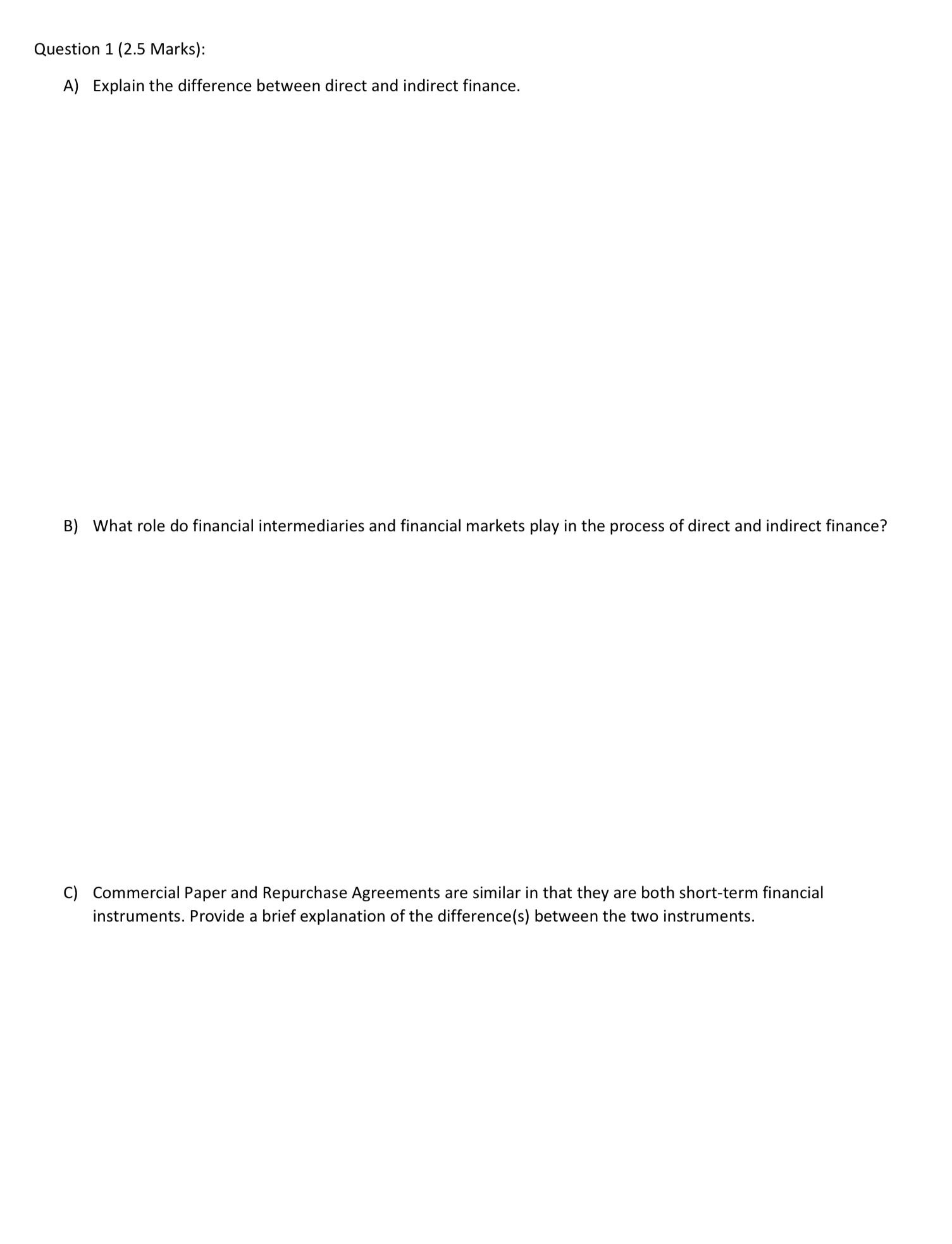
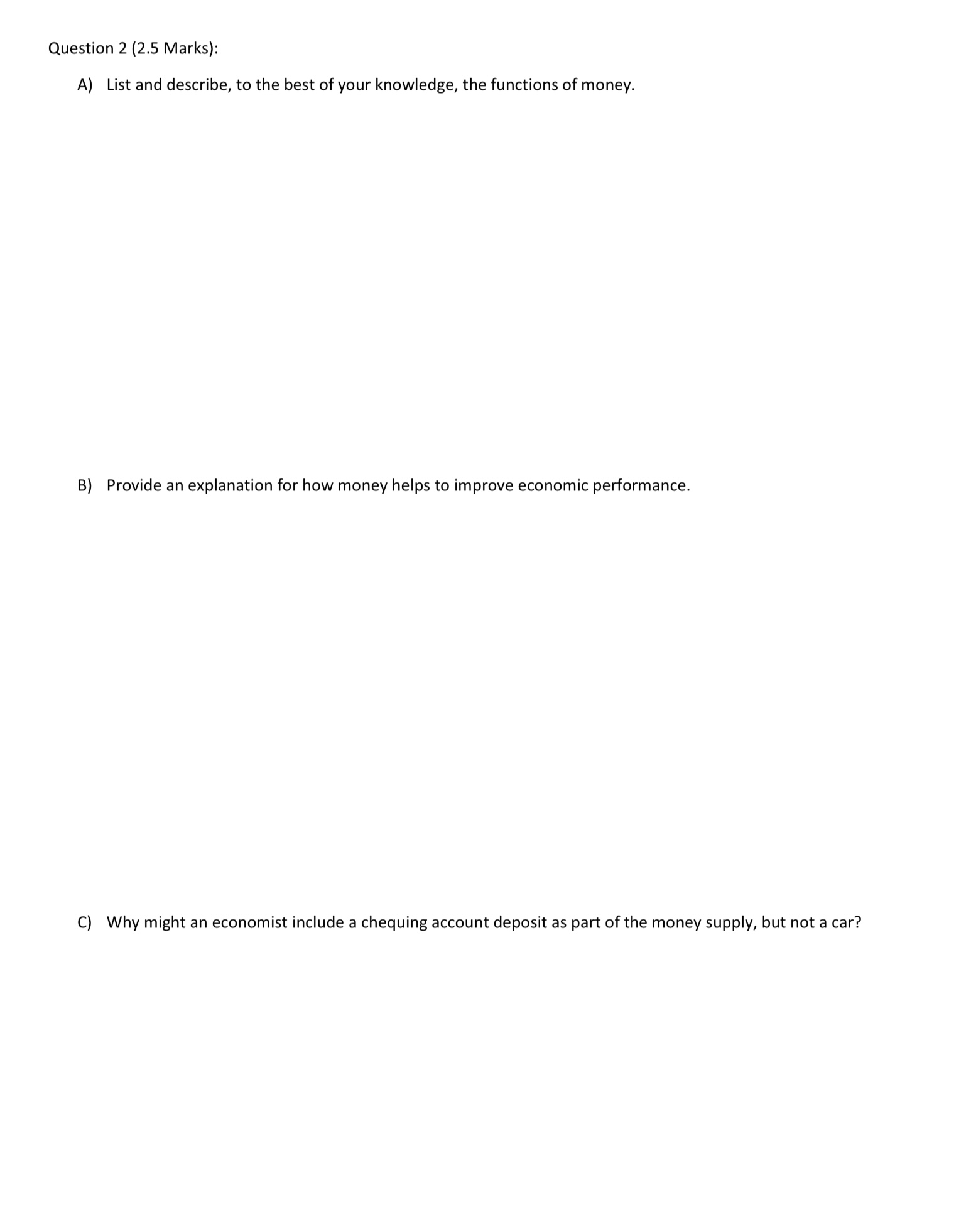
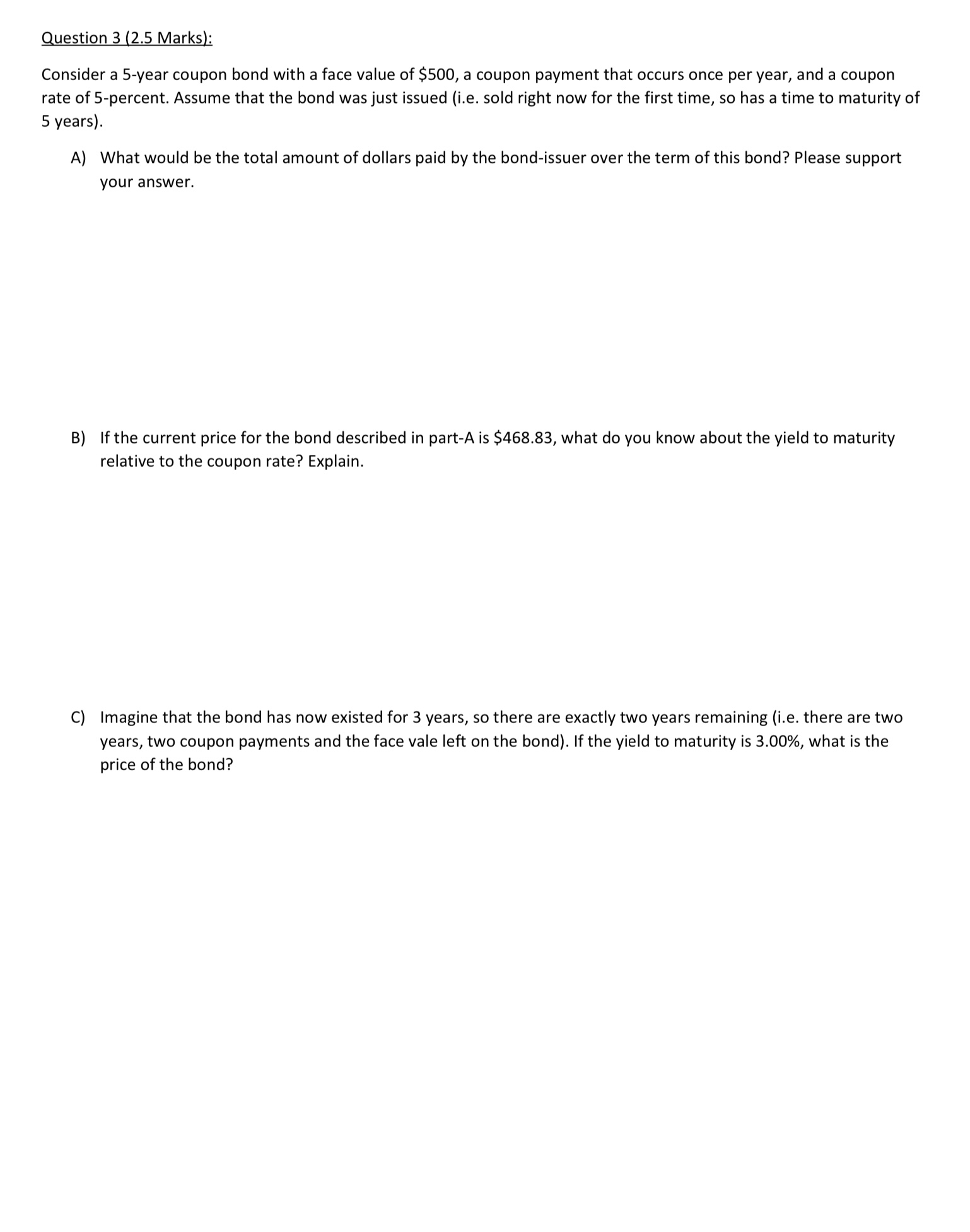
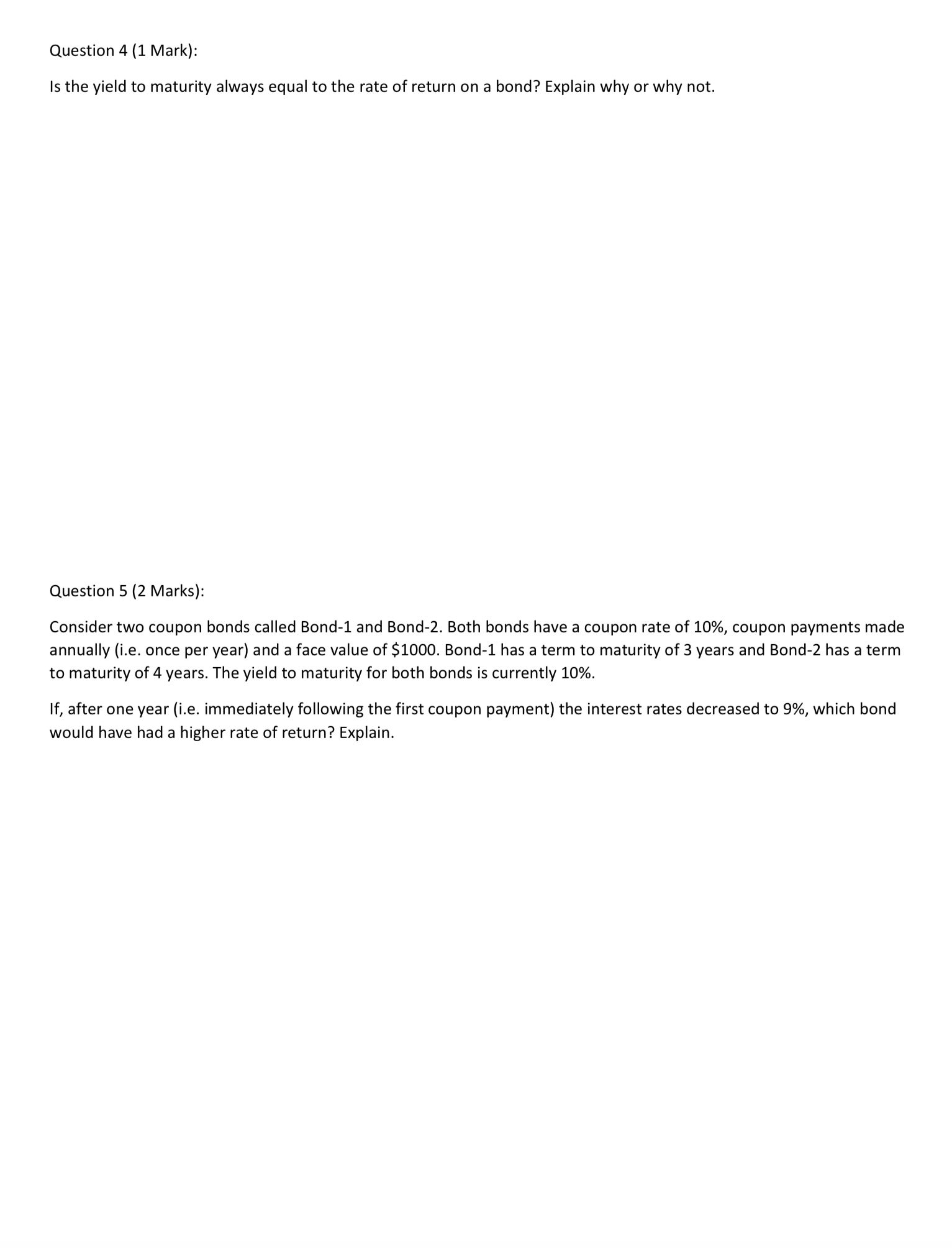
Question 1 (2.5 Marks): A) Explain the difference between direct and indirect finance. B) What role do financial intermediaries and financial markets play in the process of direct and indirect finance? C) Commercial Paper and Repurchase Agreements are similar in that they are both short-term financial instruments. Provide a brief explanation of the difference(s) between the two instruments. Question 2 (2.5 Marks): A) List and describe, to the best of your knowledge, the functions of money. B) Provide an explanation for how money helps to improve economic performance. C) Why might an economist include a chequing account deposit as part of the money supply, but not a car? Question 3 (2.5 Marks): Consider a 5-year coupon bond with a face value of $500, a coupon payment that occurs once per year, and a coupon rate of 5-percent. Assume that the bond was just issued (i.e. sold right now for the first time, so has a time to maturity of 5 years). A) What would be the total amount of dollars paid by the bond-issuer over the term of this bond? Please support your answer. B) If the current price for the bond described in part-A is $468.83, what do you know about the yield to maturity relative to the coupon rate? Explain. C) Imagine that the bond has now existed for 3 years, so there are exactly two years remaining (i.e. there are two years, two coupon payments and the face vale left on the bond). If the yield to maturity is 3.00%, what is the price of the bond? Question 4 (1 Mark): Is the yield to maturity always equal to the rate of return on a bond? Explain why or why not. Question 5 (2 Marks): Consider two coupon bonds called Bond-1 and Bond-2. Both bonds have a coupon rate of 10%, coupon payments made annually (i.e. once per year) and a face value of $1000. Bond-1 has a term to maturity of 3 years and Bond-2 has a term to maturity of 4 years. The yield to maturity for both bonds is currently 10%. If, after one year (i.e. immediately following the first coupon payment) the interest rates decreased to 9%, which bond would have had a higher rate of return? Explain. Question 6 (2.5 Marks): Use the model of supply and demand in the bond market for this question. A) Represent the bond market using a properly-labelled diagram. Assume the market equilibrium price is $850 and the equilibrium quantity is $300 billion and that the current market price is $900. B) Given the current price of $900, what is the anticipated change to the price of this bond? Assume the market is competitive and that there is good information (i.e. the market functions as predicted by the demand and supply model). Be sure to explain the reason for the change (i.e. don't simply say the change without explaining using the economics to explain). Question 6 Continued.... ) Represent the following situation in a diagram below and then provide an explanation in the space below the diagram. Consider a market for a particular bond that is initially in equilibrium. Now imagine there is an increase in the riskiness of this bond relative to other assets, all else equal. Demonstrate the predicted effect on the market and briefly discuss the predicted effect on equilibrium interest rates and equilibrium guantity of these bonds. Question 7 (2.5 Marks): Use the Liquidity Preference Framework (under the typical assumptions) and a properly labelled diagram for this question. A) Represent the market for money that is in equilibrium. Be sure to identify the equilibrium in your diagram. B) Using your diagram, illustrate and explain the predicted effect on the equilibrium interest rate of an increase in the price level, all else equal. Be sure to provide an explanation for why the interest rate is changing. Question 7 Continued: C) Remember to use the Liquidity Preference Framework....... Assume there is a decrease in the demand for money. If the central bank wants to keep interest rates at the level prior to the decrease in demand for money, what actions should it take? Provide an explanation, which could include a diagram
Step by Step Solution
There are 3 Steps involved in it
1 Expert Approved Answer
Step: 1 Unlock
Question Has Been Solved by an Expert!
Get step-by-step solutions from verified subject matter experts
Step: 2 Unlock
Step: 3 Unlock
Students Have Also Explored These Related Finance Questions!









 Study Help