


Question: Question 1 (3 +3 = 6 marks) A Strategic Asset Allocation (SAA) for an Endowment has been created and consists of 40% allocation to the
Question 1 (3 +3 = 6 marks) A Strategic AssetQuestion 1 (3 +3 = 6 marks) A Strategic Asset
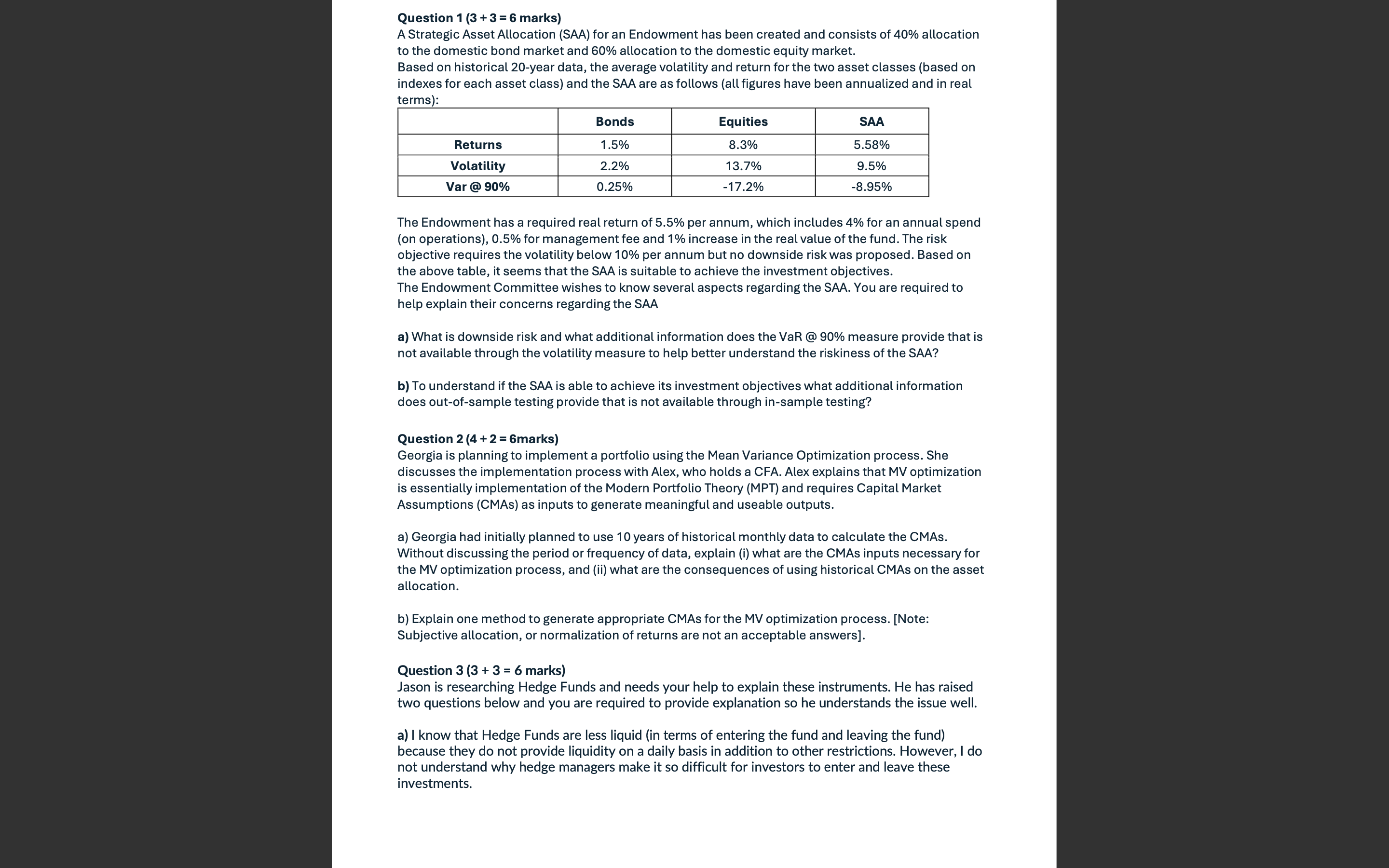
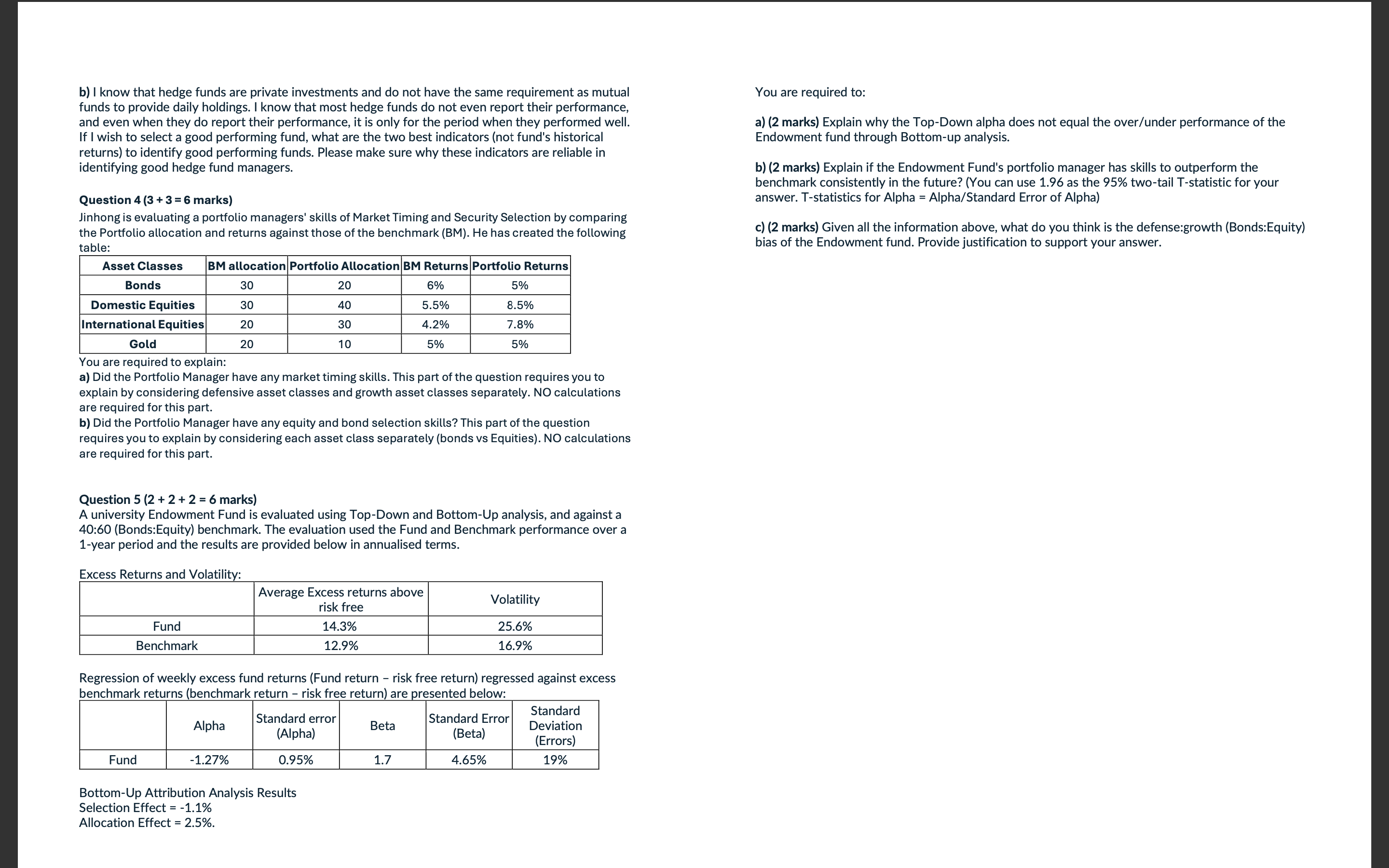
Question 1 (3 +3 = 6 marks) A Strategic Asset Allocation (SAA) for an Endowment has been created and consists of 40% allocation to the domestic bond market and 60% allocation to the domestic equity market. Based on historical 20-year data, the average volatility and return for the two asset classes (based on indexes for each asset class) and the SAA are as follows (all figures have been annualized and in real terms): Bonds Equities SAA Returns 1.5% 8.3% 5.58% Volatility 2.2% 13.7% 9.5% Var @ 90% 0.25% -17.2% -8.95% The Endowment has a required real return of 5.5% per annum, which includes 4% for an annual spend (on operations), 0.5% for management fee and 1% increase in the real value of the fund. The risk objective requires the volatility below 10% per annum but no downside risk was proposed. Based on the above table, it seems that the SAA is suitable to achieve the investment objectives. The Endowment Committee wishes to know several aspects regarding the SAA. You are required to help explain their concerns regarding the SAA a) What is downside risk and what additional information does the VaR @ 90% measure provide that is not available through the volatility measure to help better understand the riskiness of the SAA? b) To understand if the SAA is able to achieve its investment objectives what additional information does out-of-sample testing provide that is not available through in-sample testing? Question 2 (4 + 2= 6marks) Georgia is planning to implement a portfolio using the Mean Variance Optimization process. She discusses the implementation process with Alex, who holds a CFA. Alex explains that MV optimization is essentially implementation of the Modern Portfolio Theory (MPT) and requires Capital Market Assumptions (CMAs) as inputs to generate meaningful and useable outputs. a) Georgia had initially planned to use 10 years of historical monthly data to calculate the CMAs. Without discussing the period or frequency of data, explain (i) what are the CMAs inputs necessary for the MV optimization process, and (ii) what are the consequences of using historical CMAs on the asset allocation. b) Explain one method to generate appropriate CMAs for the MV optimization process. [Note: Subjective allocation, or normalization of returns are not an acceptable answers]. Question 3 (3 + 3 = 6 marks) Jason is researching Hedge Funds and needs your help to explain these instruments. He has raised two questions below and you are required to provide explanation so he understands the issue well. a) | know that Hedge Funds are less liquid (in terms of entering the fund and leaving the fund) because they do not provide liquidity on a daily basis in addition to other restrictions. However, | do not understand why hedge managers make it so difficult for investors to enter and leave these investments. b) | know that hedge funds are private investments and do not have the same requirement as mutual funds to provide daily holdings. | know that most hedge funds do not even report their performance, and even when they do report their performance, it is only for the period when they performed well. If | wish to select a good performing fund, what are the two best indicators (not fund's historical returns) to identify good performing funds. Please make sure why these indicators are reliable in identifying good hedge fund managers. Question 4 (3 +3 =6 marks) Jinhong is evaluating a portfolio managers' skills of Market Timing and Security Selection by comparing the Portfolio allocation and returns against those of the benchmark (BM). He has created the following table: Asset Classes BM allocation|Portfolio Allocation|BM Returns/Portfolio Returns Bonds 30 20 6% 5% Domestic Equities 30 40 5.5% 8.5% International Equities, 20 30 4.2% 7.8% Gold 20 10 5% 5% You are required to explain: a) Did the Portfolio Manager have any market timing skills. This part of the question requires you to explain by considering defensive asset classes and growth asset classes separately. NO calculations are required for this part. b) Did the Portfolio Manager have any equity and bond selection skills? This part of the question requires you to explain by considering each asset class separately (bonds vs Equities). NO calculations are required for this part. Question 5 (2 + 2 + 2 = 6 marks) A university Endowment Fund is evaluated using Top-Down and Bottom-Up analysis, and against a 40:60 (Bonds:Equity) benchmark. The evaluation used the Fund and Benchmark performance over a 1-year period and the results are provided below in annualised terms. Excess Returns and Volatility: Average Excess returns above Volatility risk free Fund 14.3% 25.6% Benchmark 12.9% 16.9% Regression of weekly excess fund returns (Fund return - risk free return) regressed against excess benchmark returns (benchmark return - risk free return) are presented below: Standard Alpha Standard error Beta Standard Error Deviation (Alpha) (Beta) (Errors) Fund -1.27% 0.95% 17 4.65% 19% Bottom-Up Attribution Analysis Results Selection Effect = -1.1% Allocation Effect = 2.5%. You are required to: a) (2 marks) Explain why the Top-Down alpha does not equal the over/under performance of the Endowment fund through Bottom-up analysis. b) (2 marks) Explain if the Endowment Fund's portfolio manager has skills to outperform the benchmark consistently in the future? (You can use 1.96 as the 95% two-tail T-statistic for your answer. T-statistics for Alpha = Alpha/Standard Error of Alpha) c) (2 marks) Given all the information above, what do you think is the defense:growth (Bonds:Equity) bias of the Endowment fund. Provide justification to support your

Step by Step Solution

There are 3 Steps involved in it

1 Expert Approved Answer
Step: 1 Unlock blur-text-image

Question Has Been Solved by an Expert!

Get step-by-step solutions from verified subject matter experts

Step: 2 Unlock
Step: 3 Unlock

Students Have Also Explored These Related Accounting Questions!