



Question: Question 1 (3 points) Consider the following statements: * Evidence from Harvard University, located in the USA and widely acknowledged to be one of the
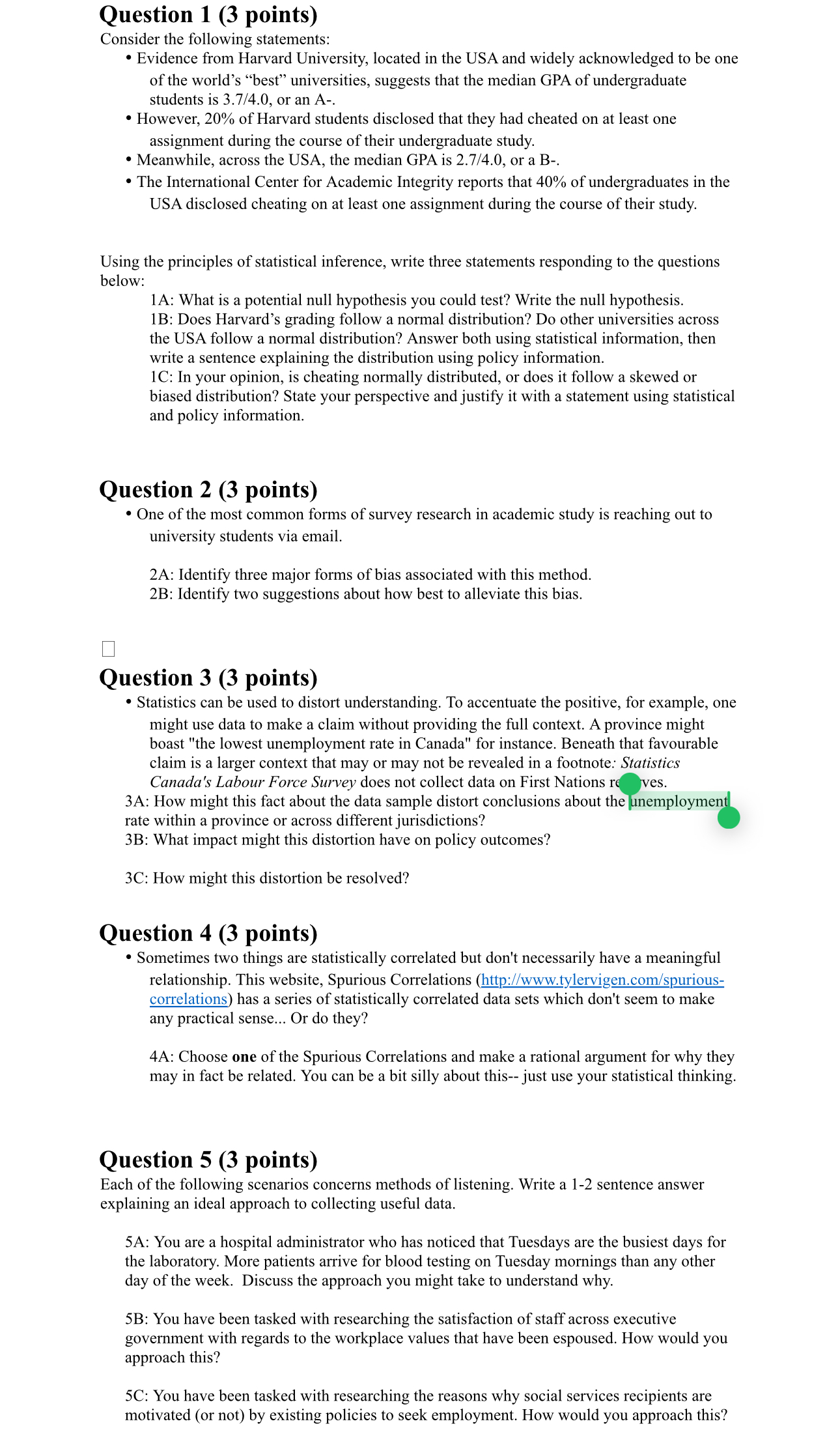
Question 1 (3 points) Consider the following statements: * Evidence from Harvard University, located in the USA and widely acknowledged to be one of the world's \"best\" universities, suggests that the median GPA of undergraduate students 1s 3.7/4.0, or an A-. * However, 20% of Harvard students disclosed that they had cheated on at least one assignment during the course of their undergraduate study. * Meanwhile, across the USA, the median GPA is 2.7/4.0, or a B-. The International Center for Academic Integrity reports that 40% of undergraduates in the USA disclosed cheating on at least one assignment during the course of their study. Using the principles of statistical inference, write three statements responding to the questions below: 1A: What is a potential null hypothesis you could test? Write the null hypothesis. 1B: Does Harvard's grading follow a normal distribution? Do other universities across the USA follow a normal distribution? Answer both using statistical information, then write a sentence explaining the distribution using policy information. 1C: In your opinion, is cheating normally distributed, or does it follow a skewed or biased distribution? State your perspective and justify it with a statement using statistical and policy information. Question 2 (3 points) * One of the most common forms of survey research in academic study is reaching out to university students via email. 2A: Identify three major forms of bias associated with this method. 2B: Identify two suggestions about how best to alleviate this bias. Question 3 (3 points) * Statistics can be used to distort understanding. To accentuate the positive, for example, one might use data to make a claim without providing the full context. A province might boast "the lowest unemployment rate in Canada" for instance. Beneath that favourable claim is a larger context that may or may not be revealed in a footnote: Statistics Canada's Labour Force Survey does not collect data on First Nations ref Dves. 3A: How might this fact about the data sample distort conclusions about the nemploymer}{d\\ rate within a province or across different jurisdictions? @ 3B: What impact might this distortion have on policy outcomes? 3C: How might this distortion be resolved? Question 4 (3 points) * Sometimes two things are statistically correlated but don't necessarily have a meaningful relationship. This website, Spurious Correlations (http://www.tylervigen.com/spurious- correlations) has a series of statistically correlated data sets which don't seem to make any practical sense... Or do they? 4A: Choose one of the Spurious Correlations and make a rational argument for why they may in fact be related. You can be a bit silly about this-- just use your statistical thinking. Question 5 (3 points) Each of the following scenarios concerns methods of listening. Write a 1-2 sentence answer explaining an ideal approach to collecting useful data. 5A: You are a hospital administrator who has noticed that Tuesdays are the busiest days for the laboratory. More patients arrive for blood testing on Tuesday mornings than any other day of the week. Discuss the approach you might take to understand why. 5B: You have been tasked with researching the satisfaction of staff across executive government with regards to the workplace values that have been espoused. How would you approach this? 5C: You have been tasked with researching the reasons why social services recipients are motivated (or not) by existing policies to seek employment. How would you approach this
Step by Step Solution
There are 3 Steps involved in it

Get step-by-step solutions from verified subject matter experts