







Question: Question 1. (4 points) Consider the following simplied version (e.g. Varian Intermediate Microeconomics) of the Lemons model of Akerlof (1970). There are N sellers who
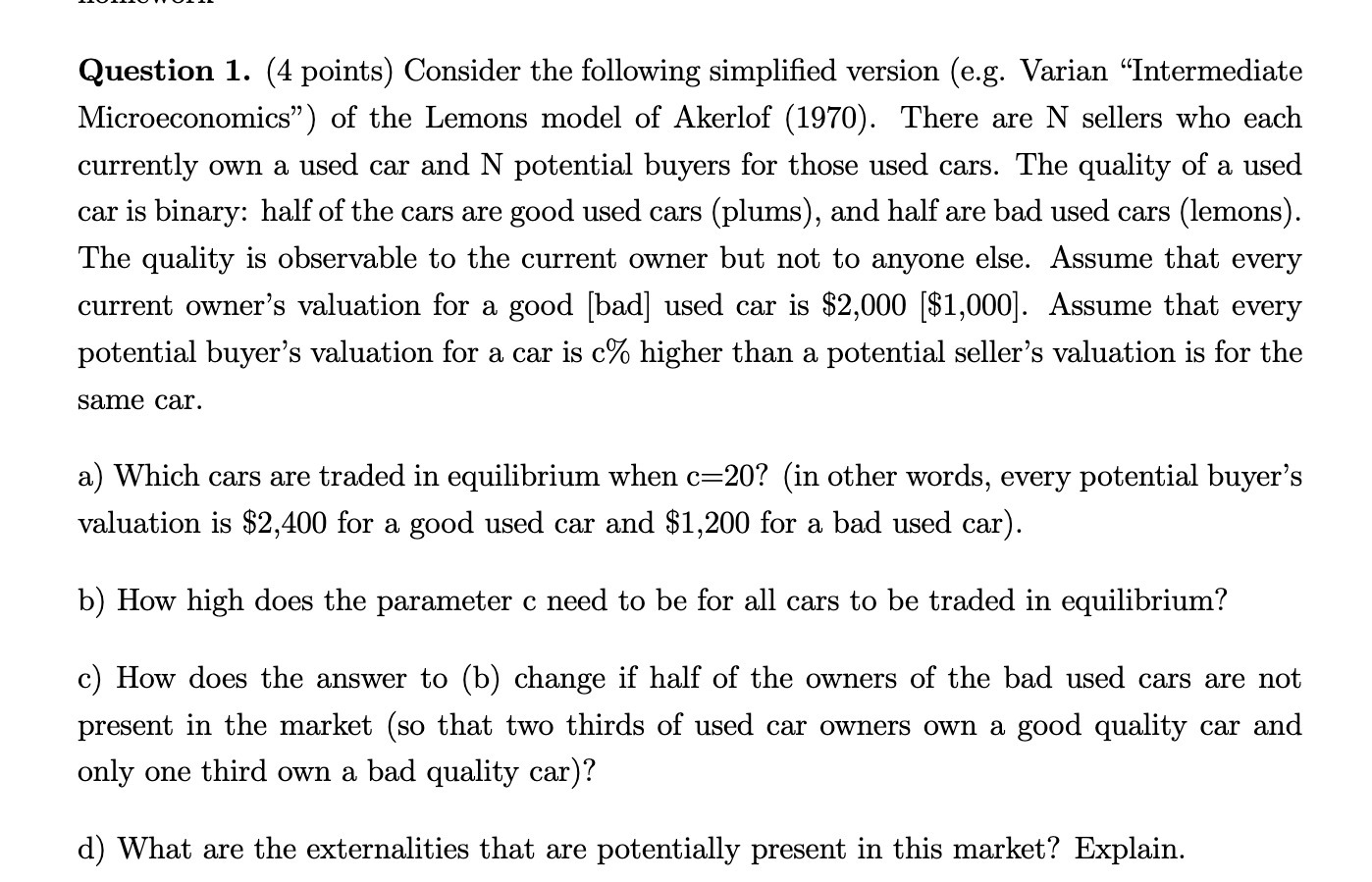
Question 1. (4 points) Consider the following simplied version (e.g. Varian \"Intermediate Microeconomics\") of the Lemons model of Akerlof (1970). There are N sellers who each currently own a used car and N potential buyers for those used cars. The quality of a used car is binary: half of the cars are good used cars (plums), and half are had used cars (lemons). The quality is observable to the current owner but not to anyone else. Assume that every current owner's valuation for a good [had] used car is $2,000 [$1,000]. Assume that every potential buyer's valuation for a car is 0% higher than a potential seller's valuation is for the same car. a) Which cars are traded in equilibrium when c=20? (in other words, every potential buyer's valuation is $2,400 for a good used car and $1,200 for a bad used car). b) How high does the parameter c need to be for all cars to be traded in equilibrium? 0) How does the answer to (1)) change if half of the owners of the had used cars are not present in the market (so that two thirds of used car owners own a good quality car and only one third own a bad quality car)? d) What are the externalities that are potentially present in this market? Explain
Step by Step Solution
There are 3 Steps involved in it

Get step-by-step solutions from verified subject matter experts
 Study Help